All species › Passerines › Buntings › Cinnamon-Breasted Bunting
Cinnamon-Breasted Bunting | Emberiza tahapisi
Zevenstrepengors | Escribano canelo
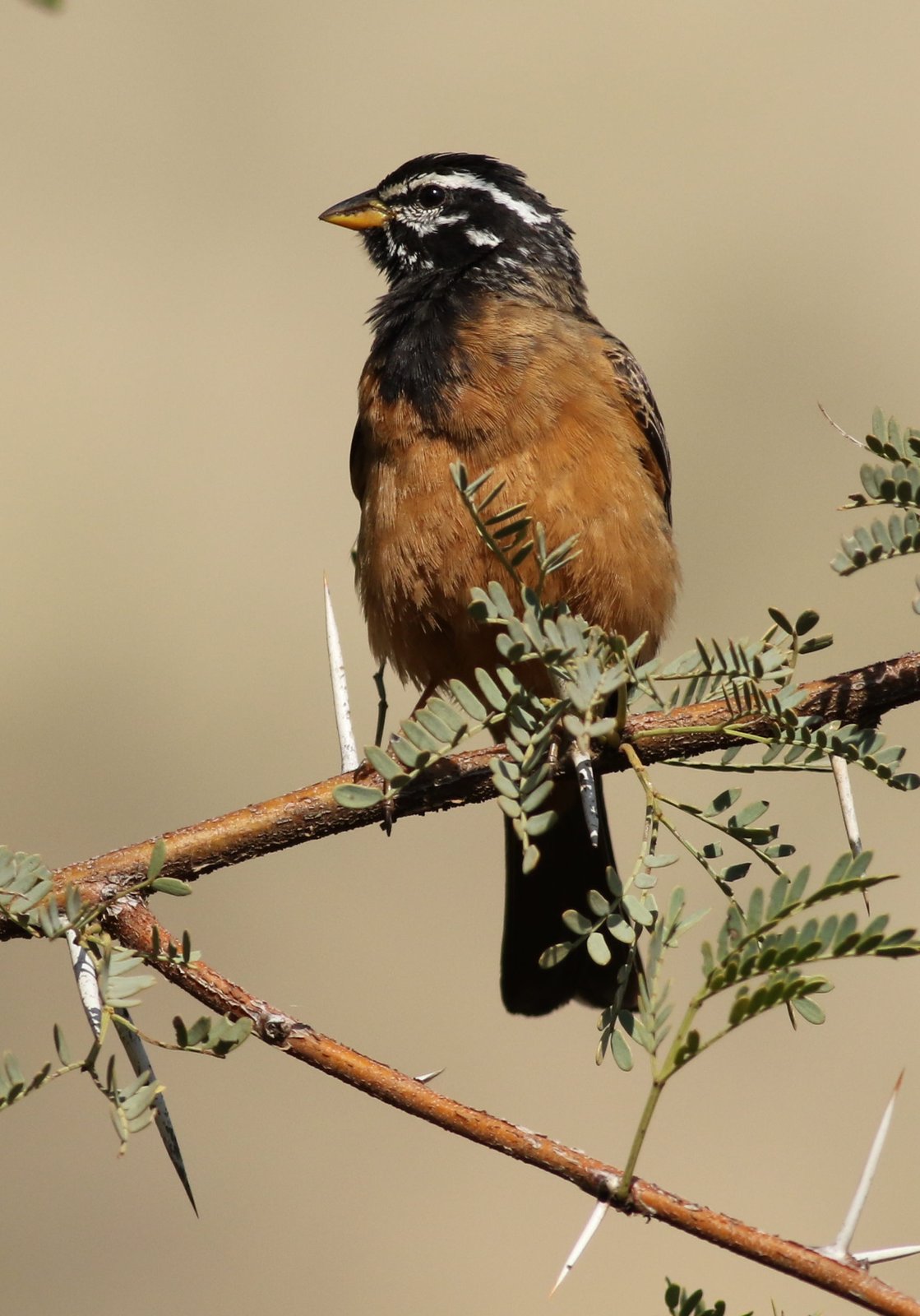
The Cinnamon-breasted Bunting is an African bunting that in this region lives only in south-western Arabia and on Socotra. The male stands out with its black head with seven white stripes above deep cinnamon underparts; on rocky slopes it is one of the common small songbirds.
Voice
The song is a short, fast, rattling phrase, chip-chirree-chirree or trrp-tree-tree-tree, repeated many times from a rock or low branch, especially after rain. The call is a soft, nasal pee-wee or a thin tseet.
Recording: bert de bruin — CC BY-NC-SA 4.0 · converted to mono · xeno-canto
Identification
14 cm. The male has a black head and throat with narrow white stripes: a white crown stripe and on each side a white supercilium and a white stripe below the eye. Mantle and back are cinnamon-brown with dark streaks, the wing-coverts rufous with dark centres, without white wingbars. Breast, belly and flanks are deep cinnamon. The upper mandible is dark, the lower yellowish. The female is duller, with a brown head with pale buff stripes and a grey-brown streaked throat. Juveniles resemble the female. The Arabian form arabica is slightly paler than African birds; the island form insularis on Socotra is small and dark.
Confusion species
Striolated Bunting (Emberiza striolata) partly shares its terrain, but has a grey, finely streaked throat and breast rather than black, a greyer, less contrasting head and paler orange-brown underparts; it is more often found around villages and in drier, barer terrain. On Socotra, Socotra Bunting (Emberiza socotrana) has a white throat, pale underparts and two pale wingbars.
Habitat
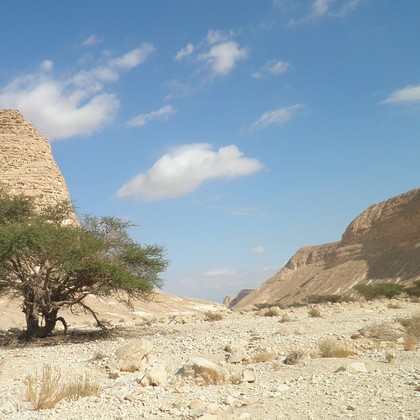
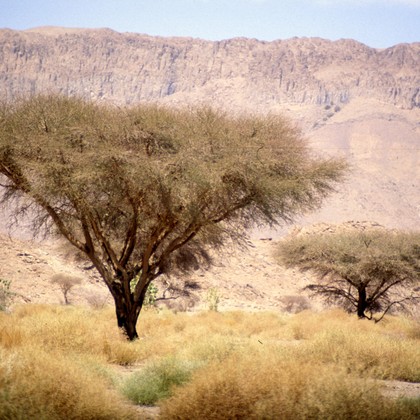
Rocky, stone-strewn mountain slopes and hills with scattered acacias and shrubs, wadi banks, terraces and the edges of small fields in the highlands, from the lowlands to high in the mountains. It forages on the ground on seeds and in the breeding season on insects. On Socotra mainly on rocky slopes and limestone terrain in the low and middle parts of the island.
Where the bird is most at home, classified by the habitats of North Africa and the Middle East.

Range and movements
Within the region in the mountains of south-western Saudi Arabia (Hejaz and Asir, roughly from Taif southwards), in western and southern Yemen, in Dhofar in southern Oman and on Socotra. Beyond the region widespread in sub-Saharan Africa, from the Sahel and Ethiopia to southern Africa.
- Resident
- Summer visitor (c. Oct–Mar)
- Winter visitor (c. Apr–Sep)
- Passage (Mar–Apr, Oct–Nov)
- dark = core range, pale = thinly spread
How and when to look
In the Asir around Abha and on the slopes of Dhofar above Salalah, singing males are easy to find in spring and after the monsoon. Listen for the rattling song from a boulder and watch for the cinnamon breast when the bird flies up; on the ground it is surprisingly well camouflaged among the stones.
Conservation status
Not globally threatened and widespread in Africa. In Arabia locally common in suitable mountain terrain; there is no evidence of a clear decline. The taxonomy is still unsettled: some authors regard the Arabian and Socotran forms as distinct subspecies with a separate history.
Scientific name
Emberiza tahapisi | Smith, 1836
Smith described the species in 1836 and placed it straight away in the genus where it still stands. The genus Emberiza was introduced in 1758 by Linnaeus. Emberiza comes from Old German Embritz, a name for a bunting. tahapisi derives from the Setswana word 'thagapitse', used for various buntings and finch-like birds. The specimen the first description was based on came from headwaters of the Vaal River, Mpumalanga, South Africa.