All species › Passerines › Buntings › Red-Headed Bunting
Red-Headed Bunting | Emberiza bruniceps
Bruinkopgors | Escribano cabecirrojo
Red-headed Bunting is a Central Asian sister species of Black-headed Bunting, breeding in the steppes from Kazakhstan to north-eastern Iran and wintering in India. On migration it touches the east of the region: in Kuwait, the Gulf states and Oman it is a rare but fairly regular passage migrant; further west it is a vagrant.

Voice
The song is a short, rather strident phrase that accelerates and ends abruptly, like Black-headed Bunting's but higher and drier; rarely heard on passage. The call is a short, hard tchip and a soft, descending tchuu.
Recording: Shuangqi Liu — CC BY-NC-SA 4.0 · converted to mono · xeno-canto
Identification
16–17 cm. Large for a bunting, with a heavy conical bill and a long tail without white sides. The male has a rufous-brown head, throat and upper breast, otherwise bright yellow underparts, a greenish-yellow, dark-streaked back and a yellowish-green rump. The female is plain sandy brown and barely marked, with a pale supercilium, unstreaked pale underparts, yellowish undertail-coverts and a greenish-yellow tinge to the rump. Juveniles and autumn birds are duller still and almost patternless.
Confusion species
Black-headed Bunting (Emberiza melanocephala) is the main pitfall. Males are simple: black cap and chestnut back against rufous head and greenish-yellow back. Females and juveniles often cannot be identified with certainty; a yellowish-green rump and a cooler, greenish-grey back point to Red-Headed, but the difference is small and intermediates occur where the breeding ranges meet in Iran. Corn Bunting (Emberiza calandra) is larger and streaked on the breast; Ortolan Bunting (Emberiza hortulana) and Cinereous Bunting (Emberiza cineracea) show white in the tail. Beware of escapes: the species was widely traded as a cage bird.
Habitat
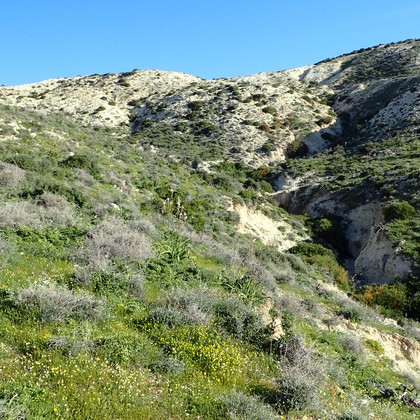
On passage in open country with bushes: fields and irrigated farmland, cereal and alfalfa fields, rough margins, gardens and parks at the desert edge, often together with Black-Headed Buntings and sparrows.
Where the bird is most at home, classified by the habitats of North Africa and the Middle East.

Range and movements
In the region mainly in Kuwait, where it is a rare passage migrant and winter visitor, and in Bahrain, Qatar, the United Arab Emirates and Oman, where small numbers are seen each spring and autumn, most in April and May. Probably also scarce on passage in eastern Saudi Arabia and Iraq, but rarely reported. West of there a vagrant: Israel has only a few accepted records, one of them from 1979. Beyond the region it breeds from the steppes around the Caspian Sea and Kazakhstan to north-eastern Iran and Afghanistan and winters in western and central India.
- Summer visitor (c. Oct–Mar)
- Passage (Mar–Apr, Oct–Nov)
- dark = core range, pale = thinly spread
How and when to look
The best chance is in April and May in the green oases and gardens of Kuwait and the Emirates, among resting Black-Headed Buntings. A lone female is rarely certain; a rufous-headed male is, but check for rings and signs of captivity.
Conservation status
Not globally threatened (IUCN: Least Concern). Not a breeding bird in the region; a rare passage migrant in the east and a vagrant elsewhere. Because of the cage-bird trade the origin of records away from the migration route is not always certain.
Scientific name
Emberiza bruniceps | Brandt, 1841
Brandt described the species in 1841 and placed it straight away in the genus where it still stands. The genus Emberiza was introduced in 1758 by Linnaeus. Emberiza comes from Old German Embritz, a name for a bunting. bruniceps means 'brown-headed', from Medieval Latin brunus 'brown' and -ceps '-headed', from caput 'head'. The specimen the first description was based on came from Turkmenistan.