All species › Passerines › Buntings › Cretzschmar's Bunting
Cretzschmar's Bunting | Emberiza caesia
Bruinkeelortolaan | Escribano ceniciento
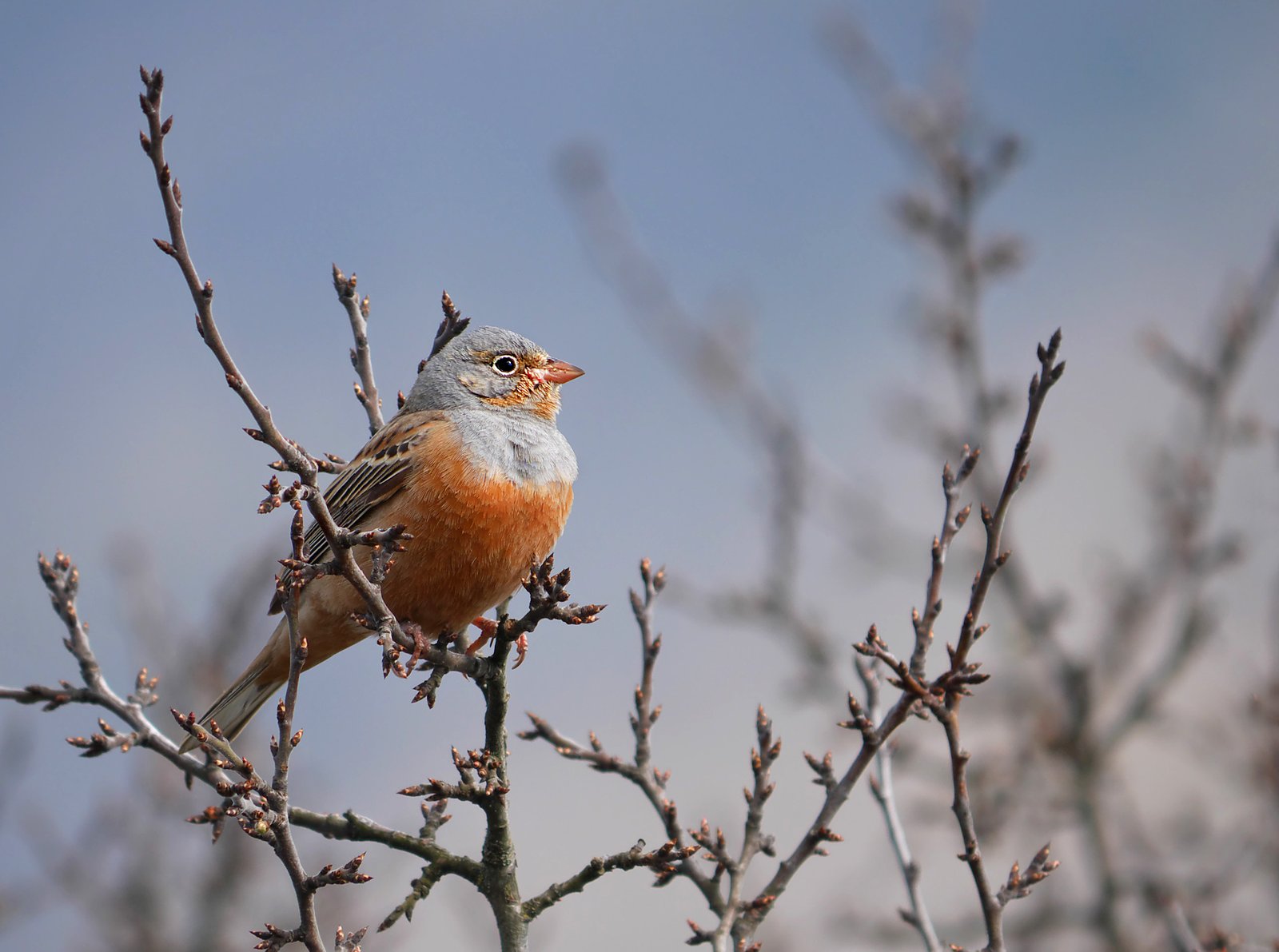
Cretzschmar's Bunting is the ortolan of the eastern Mediterranean: a small, slim bunting with a pure blue-grey head and a warm orange-brown throat. It breeds on dry, rocky slopes in Israel, Samaria and Judea, Lebanon, western Syria and north-western Jordan, migrates south along the Red Sea and in March is the first sign of spring on the Levantine hillsides.
Voice
The song is short and matter-of-fact: three or four equal, slightly rasping notes followed by one lower, drawn-out note, tchu tchu tchu tchrüü, over in a few seconds and repeated at short intervals. It sings from late March into June from a boulder, a low bush or a wall. The call is a hard, short tchep and a thin tsee.
Recording: Stanislas Wroza — CC BY-NC-SA 4.0 · converted to mono · xeno-canto
Identification
15–16.5 cm. Small, slim bunting with a long tail with white outer feathers and a pink bill. The male has a plain blue-grey head and breast band, a warm orange-brown throat and moustachial stripe, a narrow whitish eye-ring and rusty-orange underparts; the back is rufous-brown with dark streaks. The female is duller and finely streaked on crown and breast, but keeps the greyish head and orange-brown throat. Juveniles are brown and streaked, with a rusty wash on rump and undertail.
Confusion species
Ortolan Bunting (Emberiza hortulana) is the only real confusion species and often stands next to it on passage. In Ortolan the throat and moustachial stripe are pale yellow, the head grey-green and the eye-ring yellow; in Cretzschmar's the throat and moustachial stripe are orange-brown, the head pure blue-grey and the eye-ring whitish, and the underparts deeper rufous. In females and juveniles the difference is weaker but the same. Grey-necked Bunting (Emberiza buchanani) has a whitish throat and an unstreaked grey back; Cinereous Bunting (Emberiza cineracea) is larger, grey and white below. Striolated Bunting (Emberiza striolata) on the same rocky slopes is smaller, has a streaked head and throat and lacks white in the tail.
Habitat
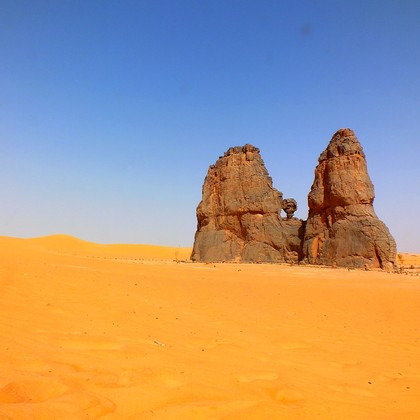
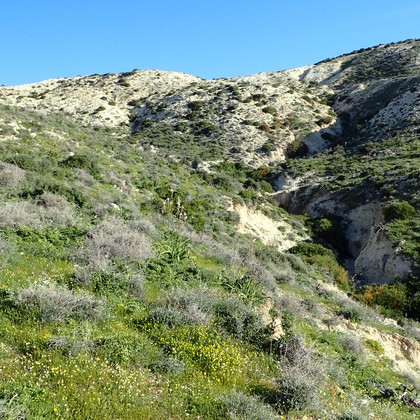
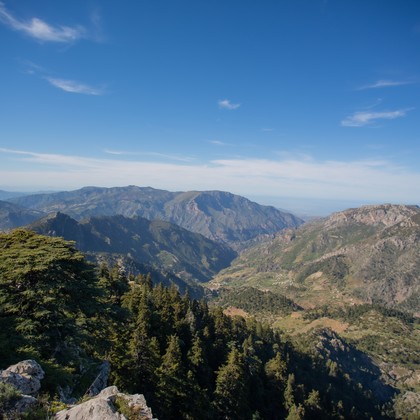
Dry, sunny, rocky slopes with low shrubs, garrigue and scattered trees, terraces and stony fields with walls, from sea level to about 1,500 m. On passage and in winter on stony plains, in wadis and on dry slopes with bushes.
Where the bird is most at home, classified by the habitats of North Africa and the Middle East.
Range and movements
Breeds in Israel, from Galilee and the Golan to the northern Negev, in Samaria and Judea, in Lebanon, in western Syria and in north-western Jordan. On passage, mainly in March and in August – September, along the Red Sea: in Sinai, eastern Egypt and western Saudi Arabia, and scarcely in southern Jordan. Winters in western and south-western Saudi Arabia and in Yemen, and beyond the region in Sudan and Eritrea. Further east, in Iraq and the Gulf, rare. Beyond the region it breeds in Greece, on the Aegean islands, on Cyprus and in Turkey.
- Summer visitor (c. Oct–Mar)
- Passage (Mar–Apr, Oct–Nov)
- dark = core range, pale = thinly spread
How and when to look
In April visit the rocky slopes of the Golan, Mount Carmel or the hills around Jerusalem and listen for the short, rasping phrase with its lower ending; a male often sits on the same boulder for a long time. Late March passage at Eilat is also good, when it can often be seen alongside Ortolan Buntings.
Conservation status
Not globally threatened (IUCN: Least Concern). Fairly common on suitable rocky slopes in the Levant, but sensitive to scrub encroachment, building and the abandonment of terrace farming.
Scientific name
Emberiza caesia | Cretzschmar, 1827
Cretzschmar described the species in 1827 and placed it straight away in the genus where it still stands. The genus Emberiza was introduced in 1758 by Linnaeus. Emberiza comes from Old German Embritz, a name for a bunting. caesia comes from Latin caesius 'bluish-grey', for the grey head of the male. The specimen the first description was based on came from Kurgos Island, Sudan.