All species › Passerines › Tits › Coal Tit
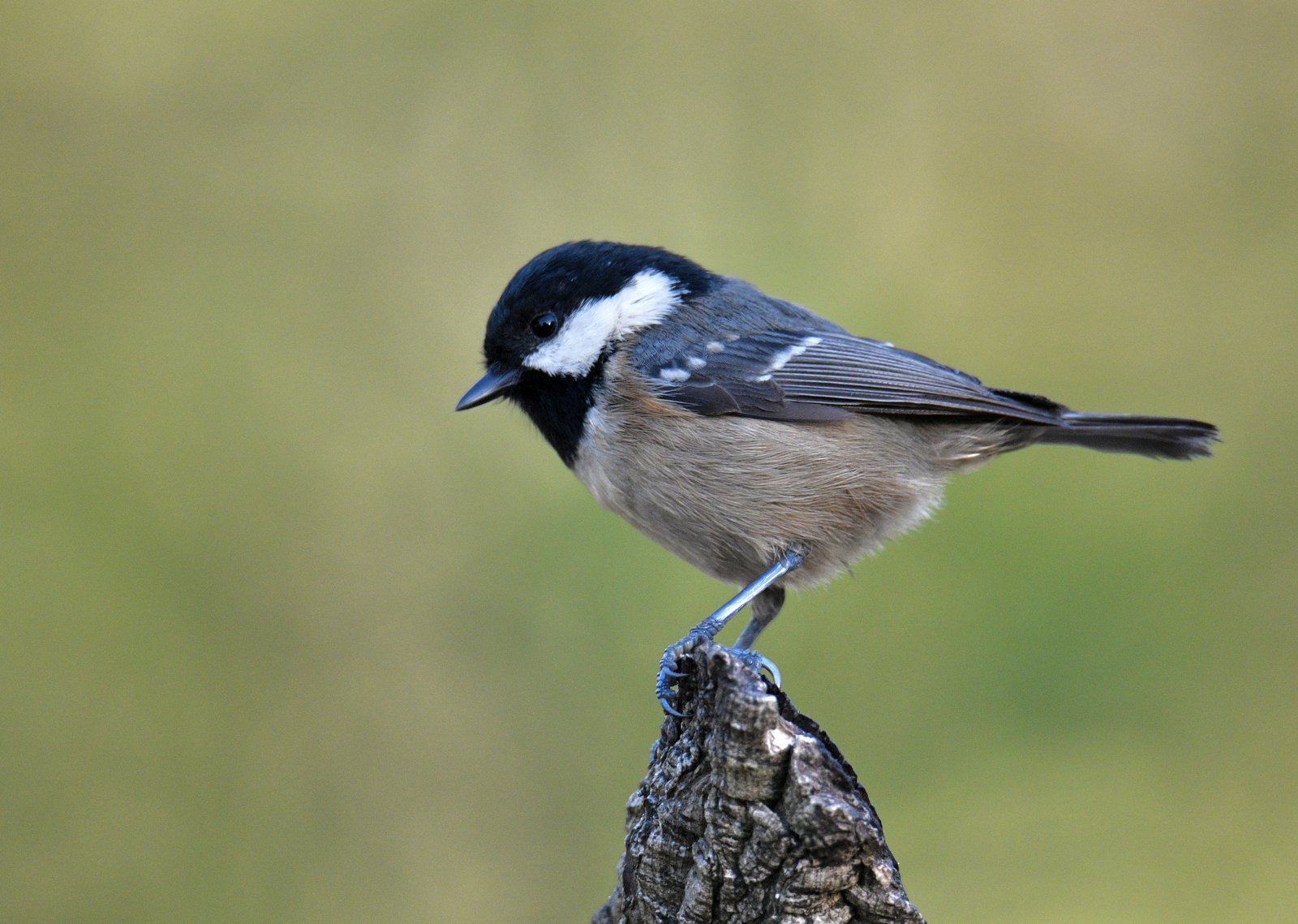
Coal Tit | Periparus ater
Zwarte mees | Carbonero garrapinos
The smallest tit of the region, a restless inhabitant of mountain conifer forest. It lives in the cedar, fir and pine forests of the Atlas and Kabylia and, far away, in the cedar forests of Lebanon and the coastal mountains of Syria.
Voice
The song is a fast, clear, repeated tee-chu tee-chu tee-chu or weezy-weezy, higher and faster than that of Great Tit. Calls a thin, plaintive tsuu or tsee-oo, often from high in the canopy.
Recording: Jorge Leitão — CC BY-NC-SA 4.0 · converted to mono · xeno-canto
Identification
10–11.5 cm. Small and big-headed, with a fine bill and a short tail. Head and throat glossy black with a white cheek and an obvious white nape patch, the best feature. Upperparts grey to olive-grey, with two rows of white spots forming two wing-bars; underparts dirty white with pale buff to ochre flanks. The North African forms atlas and ledouci have a yellowish to ochre-yellow breast and cheek and a greenish back; Levant birds sometimes show a small crest. Juveniles have yellowish cheeks and nape patch.
Confusion species
Great Tit (Parus major) is much larger, with a greenish back, yellow underparts with a black belly stripe and no white nape patch. Sombre Tit (Poecile lugubris) is larger, with a large black bib and no white nape patch or wing-bars. African Blue Tit (Cyanistes teneriffae) shows blue on head, wings and tail and has yellow underparts.
Habitat
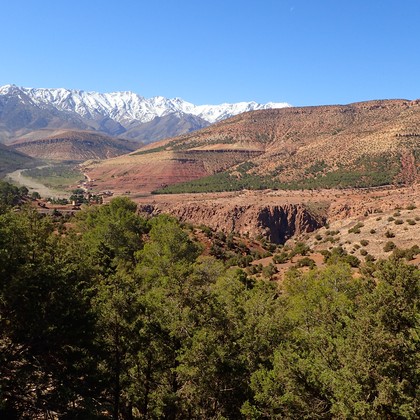
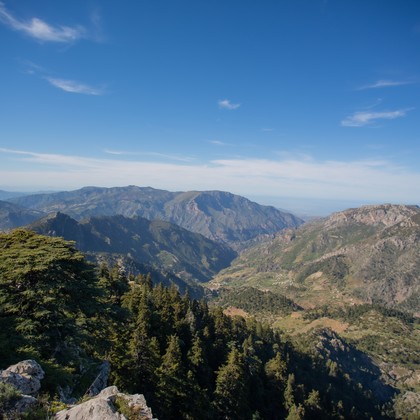
Mainly mountain conifer forest: Atlas cedar, Algerian fir and pines in the Maghreb, cedar, fir and juniper in Lebanon and Syria; also mixed forest with oak. Forages high in the canopy and on thin twigs, often with other tits. In winter sometimes lower in broadleaf woodland and orchards. Nests in holes in trees, stumps, rocks and the ground.
Where the bird is most at home, classified by the habitats of North Africa and the Middle East.
Range and movements
In Morocco in the Rif, the Middle Atlas and the High Atlas; in northern Algeria in Kabylia, the Djurdjura, the Babors and the Aurès; in north-western Tunisia in Kroumirie and the Mogods. In the Levant in the mountain forests of Lebanon and the coastal mountains of western Syria. Otherwise absent from the region, including Israel, Jordan and Iraq. Beyond the region from Europe, Turkey and Cyprus across Asia to Japan and the Himalayas.
- Resident
- Summer visitor (c. Oct–Mar)
- Winter visitor (c. Apr–Sep)
- Passage (Mar–Apr, Oct–Nov)
- dark = core range, pale = thinly spread
How and when to look
The cedar forest around Azrou and Ifrane in the Middle Atlas is easiest. In Algeria, in the Babors and at Guerrouch, it shares the forest with Algerian Nuthatch (Sitta ledanti). In Lebanon the cedar reserves of the Shouf and Tannourine; follow the high tee-chu from the treetops.
Conservation status
Not globally threatened. In the region it is tied to a limited area of mountain forest that is shrinking through logging, fires, overgrazing and drought; the isolated populations in Lebanon and Syria are small.
Scientific name
Periparus ater | (Linnaeus, 1758)
Linnaeus described the species in 1758 as Parus ater; because it was later moved to another genus, the author and year stand in brackets. The genus Periparus was introduced in 1884 by De Sélys Longchamps. Periparus combines the Greek peri 'around, near' with the genus Parus, the tits. ater is Latin for 'dull black', for the black head and throat. The specimen the first description was based on came from Sweden.