All species › Passerines › Tits › Sombre Tit
Sombre Tit | Poecile lugubris
Rouwmees | Carbonero lúgubre
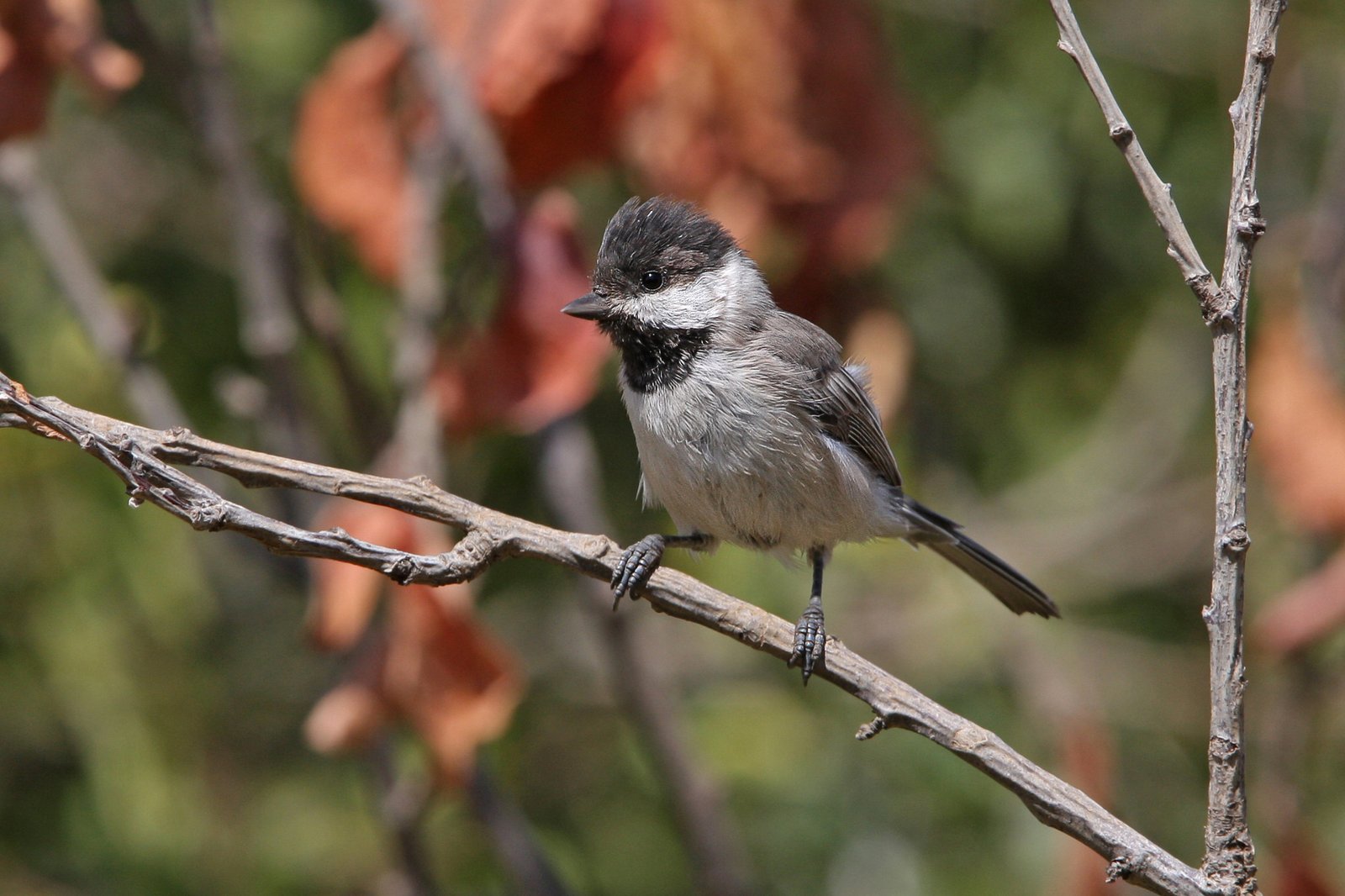
A large, sombre tit of dry oak woods and rocky scrubby slopes, the typical tit of Galilee and the Golan. In the region it lives only in the north of the Levant and in Iraqi Kurdistan; it is absent from North Africa.
Voice
The song is a repeated, buzzing chiv-chiv-chiv or zree-zree-zree, somewhat rasping and less clear than that of Great Tit. Calls a harsh, scolding chrrr-rrr, rougher than in other tits, and high see-see notes.
Recording: Stanislas Wroza — CC BY-NC-SA 4.0 · shortened to the first 60 s, mono · xeno-canto
Identification
13.5–15 cm. As large as Great Tit, but with a longer tail and a heavy bill. A large, dull brownish-black cap reaching below the eye and a large, rectangular black bib enclose a white cheek patch that widens towards the rear. Upperparts plain grey-brown, wings with paler fringes to the flight feathers; underparts dirty white with grey-buff flanks. No yellow, no wing-bar, no nape patch. The female has a slightly browner cap. Juveniles are duller, with a smaller bib.
Confusion species
Great Tit (Parus major) has a glossy black head, yellow underparts with a black belly stripe, a greenish back and a white wing-bar. Coal Tit (Periparus ater) is much smaller with a white nape patch and wing-bars. A female Eurasian Blackcap (Sylvia atricapilla) has a dark cap but no bib and a thin warbler bill.
Habitat
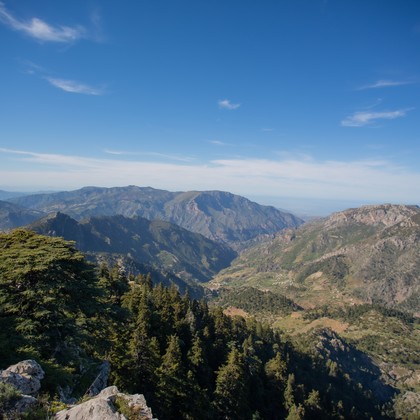
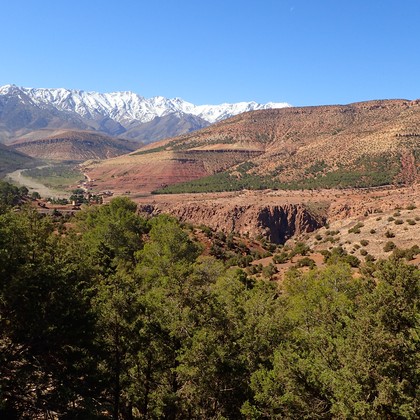
Open, dry oak woodland and oak scrub, rocky slopes with scattered trees and bushes, ravines, and the upper edges of orchards and olive groves; in the mountains up to the treeline. More at home in rough, steep terrain than other tits. Nests in tree holes, rock crevices and wall cavities.
Where the bird is most at home, classified by the habitats of North Africa and the Middle East.

Range and movements
In Israel in the north: Upper Galilee, the Golan and Mount Hermon, locally to Mount Carmel; in Lebanon in the mountain areas, and in Syria in the western mountains and the Anti-Lebanon. In Iraq in the oak forests and ravines of Kurdistan. Elsewhere in the region at most an exceptional wanderer. Beyond the region from the Balkans and Greece through Turkey to the Caucasus and the Zagros in Iran.
- Resident
- Summer visitor (c. Oct–Mar)
- Winter visitor (c. Apr–Sep)
- Passage (Mar–Apr, Oct–Nov)
- dark = core range, pale = thinly spread
How and when to look
The oak woods on the Golan (near Odem and the foot of Mount Hermon) and Mount Meron in Upper Galilee are the best-known sites; in spring listen for the buzzing song and the harsh scolding. In Iraqi Kurdistan it occurs in the mountains around Sulaymaniyah and Barzan.
Conservation status
Not globally threatened. Fairly scarce everywhere and at low densities; in the Levant sensitive to the loss of old oak woodland through clearance, fires and building, and in Israel dependent on a small range in the north.
Scientific name
Poecile lugubris | (Temminck, 1820)
Temminck described the species in 1820 as Parus lugubris; because it was later moved to another genus, the author and year stand in brackets. The genus Poecile was introduced in 1829 by Kaup. Poecile is Greek, from poikilos 'many-coloured'. lugubris is Latin for 'mournful', after the plain brown-grey plumage. The specimen the first description was based on came from Dalmatia and Hungary.