All species › Passerines › Bulbuls › Common Bulbul
Common Bulbul | Pycnonotus barbatus
Grauwe buulbuul | Bulbul naranjero
Throughout North Africa the Common Bulbul sets the soundscape of gardens, oases and village squares: an inconspicuous brown, long-tailed songbird with a full, clear whistled song. From the Atlantic coast of Morocco to the Nile Valley it is one of the first birds a visitor hears.
Voice
The song is a short, loud and fluent series of eight to ten whistled notes, somewhat rolling, classically rendered as doctor-quick, doctor-quick. The contact call is a sharp chip-chip-chip, turning into a rasping chrr in alarm. Heard year-round, most from February to June.
Recording: Deville Tanguy — CC BY-NC-SA 4.0 · converted to mono · xeno-canto
Identification
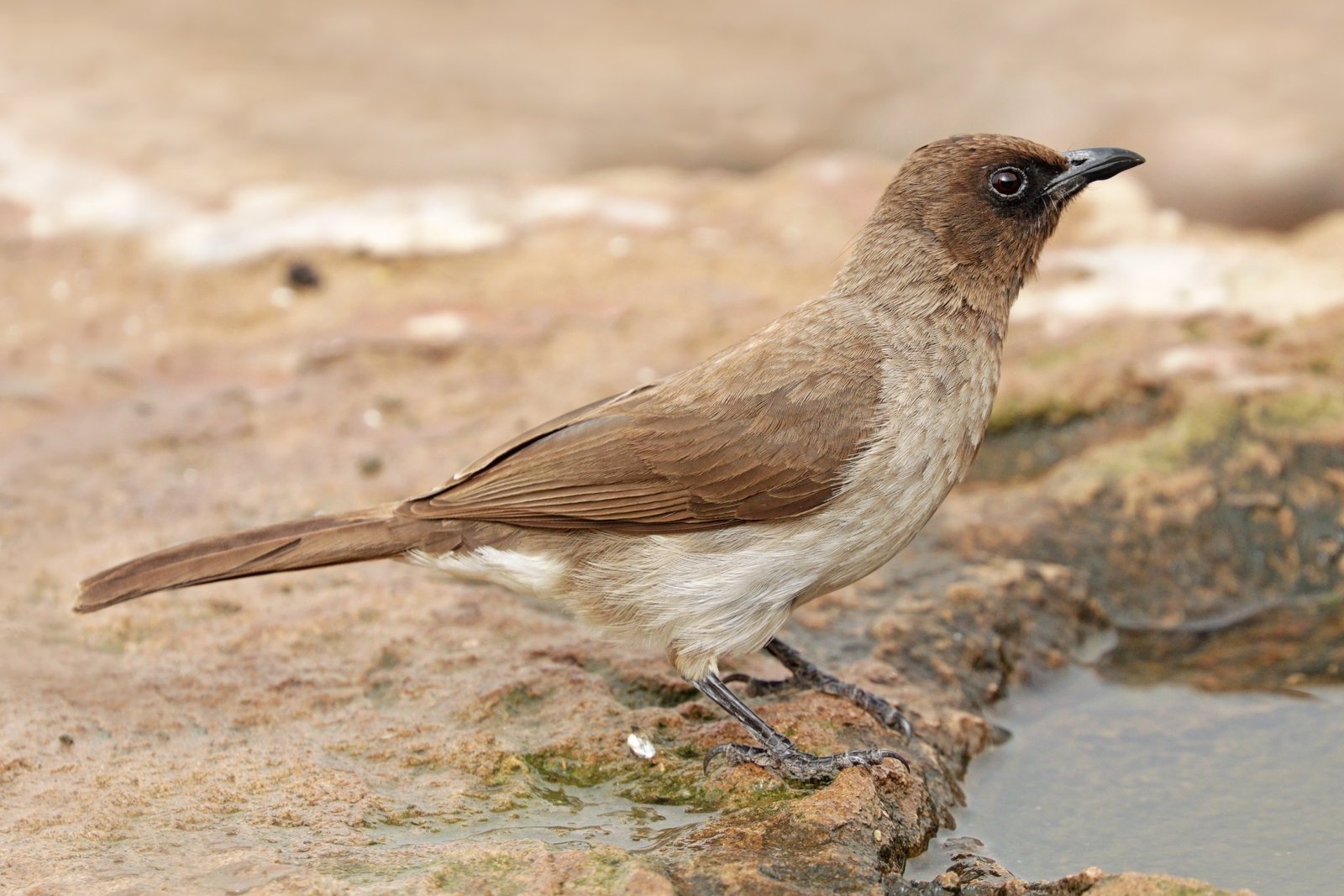
18–20 cm. Slender, with a fairly large head and a long, straight tail. The head is sooty-brown to blackish and extends over the throat; this dark hood contrasts with the dull brown mantle and wings. The underparts are dirty greyish-white, slightly darker washed on the breast, and the undertail coverts white (yellow in the subspecies south of the Sahara). There is no white eye-ring. The bill is thin, black and slightly decurved. The sexes are alike; juveniles are duller with a browner hood. The Egyptian form arsinoe is smaller and paler than birds of the Maghreb (barbatus), with a blacker head.
Confusion species
In the Maghreb there is no real confusion species: a starling-sized, uniformly brown bird with a dark head and long tail, hopping low through scrub, is the Common Bulbul. A female Common Blackbird (Turdus merula) is bulkier, has a yellow or horn-coloured bill and works the ground. From Sinai eastwards comes White-spectacled Bulbul (Pycnonotus xanthopygos), with a white eye-ring and bright yellow undertail coverts; in north-east Egypt and Sinai hybrids occur, with a faint eye-ring or yellowish vent.
Habitat
Almost anything with shrubs or trees that is not closed: gardens and parks, hotel grounds, orchards, olive and argan plantations, oleander scrub along seasonal rivers, maquis, date gardens and oases deep into the desert edge, and in Egypt the plantings along the Nile and canals. It avoids closed forest and open desert. The diet is largely fruit (figs, dates, mulberries, olives), supplemented with flowers, nectar and insects. The nest is a loose cup in the fork of a shrub or low tree.
Where the bird is most at home, classified by the habitats of North Africa and the Middle East.


Range and movements
In Morocco common north of the Sahara, from the Rif and the Atlantic lowlands to the Souss and the oases of the Drâa, Ziz and Tafilalt, south to the northern edge of Western Sahara. In Algeria in the Tell, on the High Plateaux and in the oases on the northern edge of the Sahara; throughout Tunisia, including the southern oases of Tozeur, Nefta and Gabès; in Libya mainly in Tripolitania and the Jebel Nafusa. In Egypt the form arsinoe in the Nile Delta and the Nile Valley to Aswan and Abu Simbel, in the Faiyum and in oases of the Western Desert; in the north-east to the Suez Canal and western Sinai, where it hybridises with White-spectacled Bulbul. Beyond the region it breeds in Ceuta, Melilla and since 2013 near Tarifa in southern Spain, and in other subspecies across the Sahel and almost all of sub-Saharan Africa.
- Resident
- Summer visitor (c. Oct–Mar)
- Winter visitor (c. Apr–Sep)
- Passage (Mar–Apr, Oct–Nov)
- dark = core range, pale = thinly spread
How and when to look
A breakfast terrace in Marrakesh, Agadir, Tunis or Luxor is enough: from sunrise the males sing from the top of an oleander or a lamppost and allow approach to a few metres. In north-east Egypt and Sinai it pays to check the eye-ring and vent colour to pick out hybrids with White-spectacled Bulbul.
Conservation status
Not globally threatened and common to very common over almost its whole range. In North Africa it benefits from gardens, irrigation and urban greenery and is spreading rather than declining. As a fruit-eater it is locally regarded as a nuisance in orchards, and it is trapped here and there as a cage bird, but without noticeable effect on numbers.
Scientific name
Pycnonotus barbatus | (Desfontaines, 1789)
Desfontaines described the species in 1789 as Turdus barbatus; because it was later moved to another genus, the author and year stand in brackets. The genus Pycnonotus was introduced in 1826 by Boie. Pycnonotus is Greek, from puknos 'thick, compact' and -nōtos '-backed', from nōton 'back', after the dense plumage of the back. barbatus is Latin for 'bearded', from barba 'beard'. The specimen the first description was based on came from near Algiers.