All species › Waders, gulls and terns › Buttonquails › Common Buttonquail
Common Buttonquail | Turnix sylvaticus
Gestreepte vechtkwartel | Torillo andaluz
A small, quail-like bird that hardly ever flies and keeps hidden in dense cover. The North African form, the Andalusian Buttonquail, has its last known Mediterranean population in Morocco, in a narrow strip of farmland along the Atlantic coast.
Voice
The female calls mainly at dusk and at night: a deep, humming hoooo, like a distant foghorn or a lowing cow, lasting a few seconds and repeated at intervals. The sound is hard to locate and is often the only sign of presence.
Recording: Campbell Fleming — CC BY-NC-SA 4.0 · converted to mono · xeno-canto
Identification
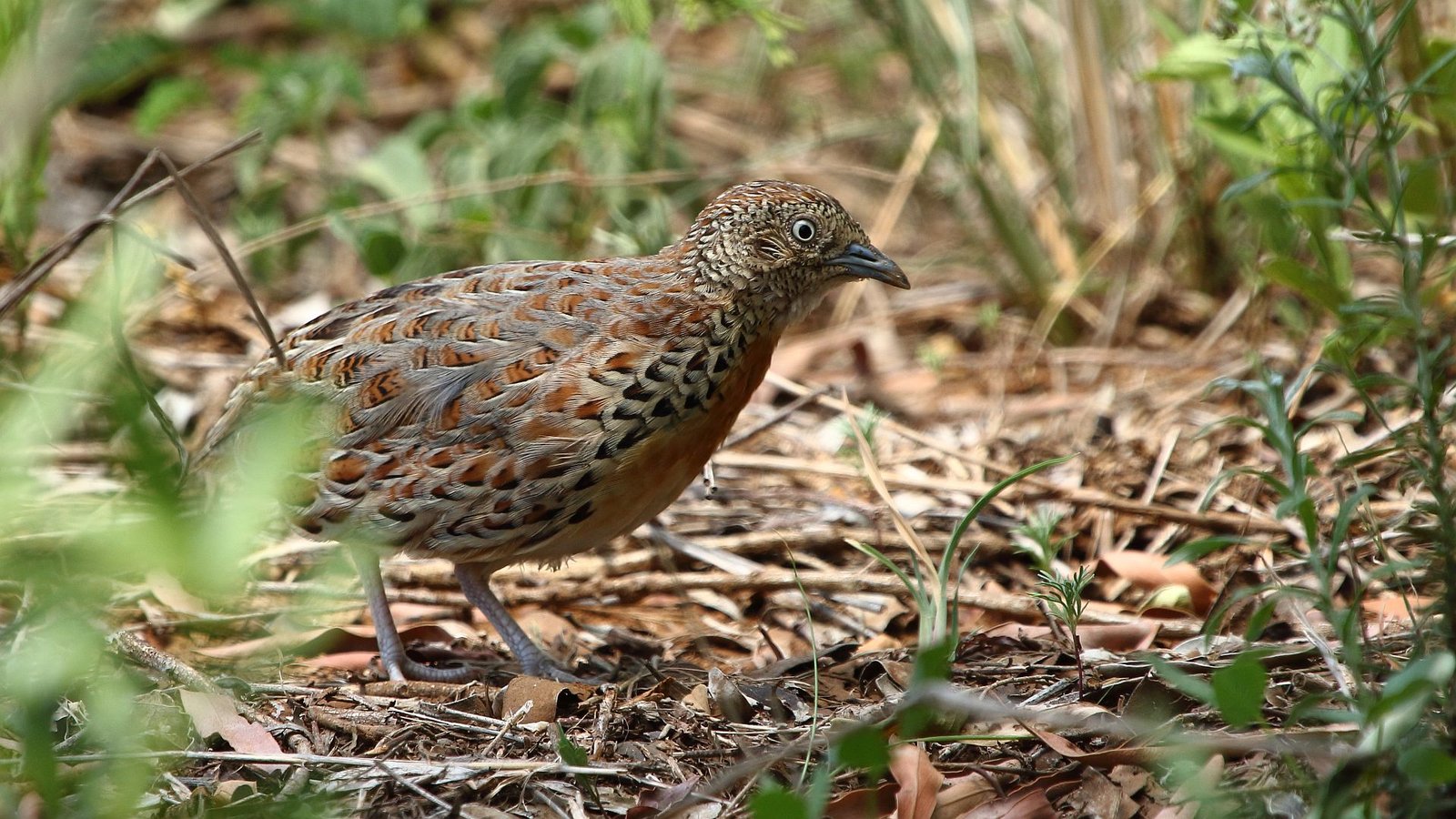
Smaller than Common Quail, round and short-tailed, with a thin greyish bill and flesh-coloured legs lacking a hind toe. Upperparts warm rufous-brown with black and pale scaling and streaking; the breast is orange-buff with dark heart-shaped spots along the sides, the belly white. The female is larger and brighter than the male, who incubates the eggs and raises the young. In flight, usually only a few metres low over the vegetation, the pale sandy wing coverts contrast with the dark flight feathers.
Confusion species
Common Quail (Coturnix coturnix) is larger, has a striped head with a pale crown stripe, lacks the orange breast with dark spots and flies off farther and higher. With a bird flushing briefly, the small size, pale wing coverts and quick dropping into cover after a few metres are the best features.
Habitat
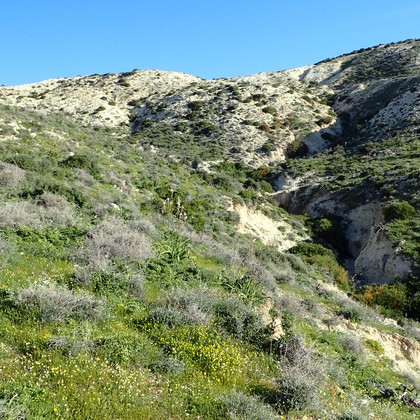
In Morocco fallow fields, stubble, extensive pastures and low dwarf-palm scrub (doum) on sandy soils near the coast; also edges of market-garden and maize fields. It needs dense, low cover with small open patches. Elsewhere in Africa and Asia grasslands and savannas.
Where the bird is most at home, classified by the habitats of North Africa and the Middle East.

Range and movements
The subspecies sylvaticus is confined to western Morocco, where the last known population lives on the coastal plain of the Doukkala between Sidi Abed and Oualidia. Surveys in 2011, 2014 and 2017 showed a decline from about 1,900 to 600 birds and from 270 to 117 breeding females. Formerly it also occurred in the Mamora and elsewhere in northern Morocco, in northern Algeria and in Tunisia; in Algeria a bird was reported again in 2019. In Oman the species is listed as an accidental vagrant. Beyond the region other subspecies live in sub-Saharan Africa and in South and Southeast Asia; the Andalusian Buttonquail is extinct in Spain, Portugal and Sicily (officially in Spain in 2018).
- Summer visitor (c. Oct–Mar)
- dark = core range, pale = thinly spread
How and when to look
Searching only makes sense with local knowledge and with respect for the bird: listen at dusk in May–July along the fields between Sidi Abed and Oualidia for the humming calls. Do not enter fields without permission and do not use playback; the population is too small for disturbance.
Conservation status
Not globally threatened owing to the large African and Asian populations, but the Andalusian subspecies is critically threatened: the Moroccan population is declining steeply through agricultural intensification (greenhouses, irrigation, loss of fallow and dwarf-palm scrub) and building along the coastal strip. Researchers consider its survival unlikely without urgent conservation action.
Scientific name
Turnix sylvaticus | (Desfontaines, 1789)
Desfontaines described the species in 1789 as Tetrao sylvaticus; because it was later moved to another genus, the author and year stand in brackets. The genus Turnix was introduced in 1791 by Bonnaterre. Turnix is an abbreviation of the genus name Coturnix, the Latin word for 'quail'. sylvaticus is Latin for 'of the woods', from silva 'wood'. The specimen the first description was based on came from near Algiers.