All species › Cranes, rails and allies › Cranes › Common Crane
Common Crane | Grus grus
Kraanvogel | Grulla común
A large, grey crane that winters in the region, highlighted by the tens of thousands of birds in the Hula Valley in northern Israel. Elsewhere flocks pass in V-formation with far-carrying trumpeting over the Levant, Sinai and the Nile Valley to Sudan and Ethiopia.
Voice
A far-carrying, metallic trumpeting, kroo-kroo, audible for kilometres and often heard before the birds are seen. Young birds still give high peeping calls in their first winter. At roosts and in flocks overhead they call incessantly.
Recording: MarekJas — CC BY-NC-SA 4.0 · converted to mono · xeno-canto
Identification
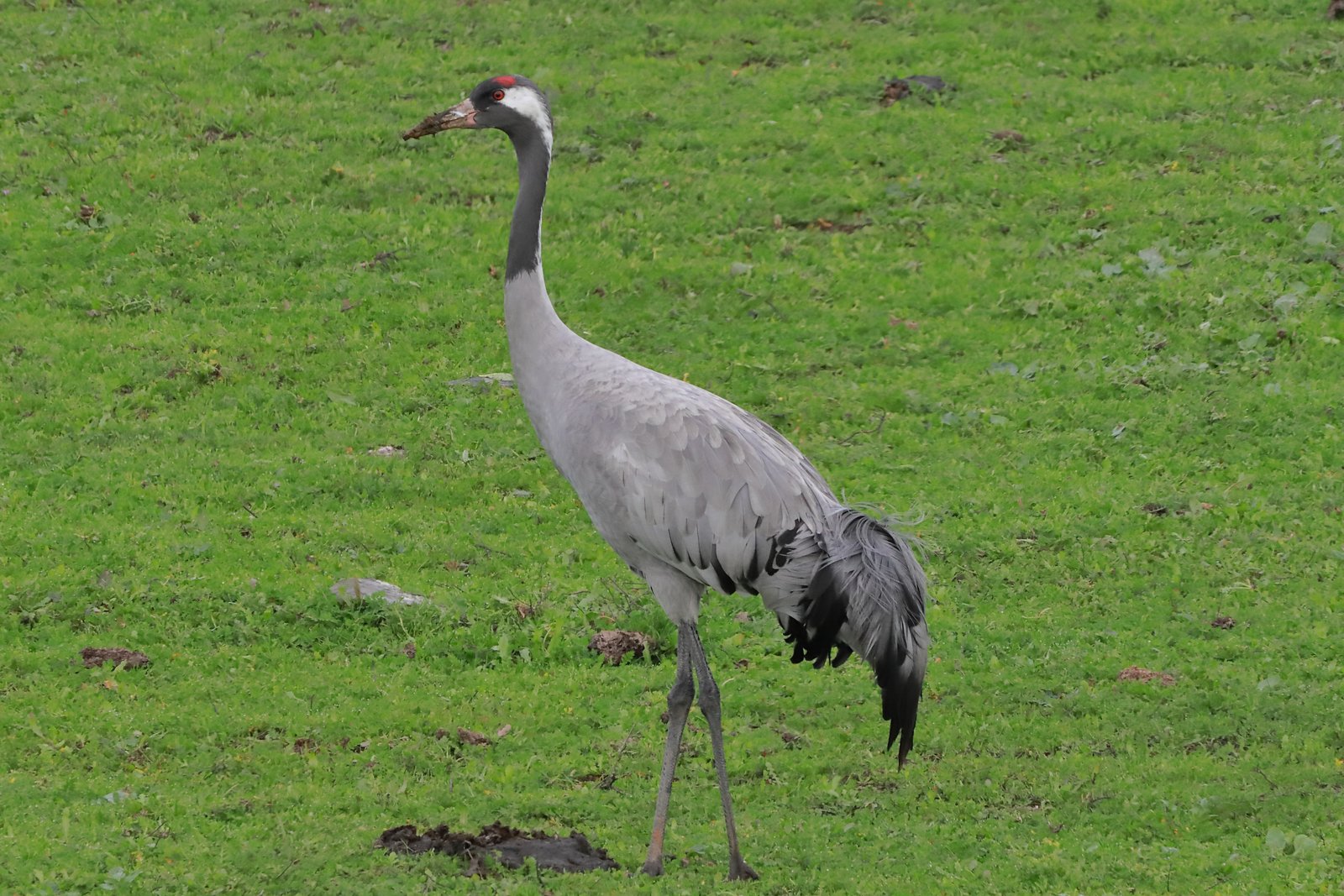
Very large, long-legged bird with slate-grey plumage, a black and white head and neck pattern and a bare red crown patch. Characteristic is the black bustle of drooping tertials over the tail. Flies with neck and legs outstretched and with powerful, unhurried beats; the black flight feathers contrast with the grey coverts. Young birds are brownish on head and neck and lack the black and white pattern and the red crown.
Confusion species
Demoiselle Crane (Grus virgo) is smaller and slimmer, with a black breast plume and white ear tufts. Herons such as Grey Heron (Ardea cinerea) fly with the neck retracted; storks (Ciconia) are black and white and soar more.
Habitat
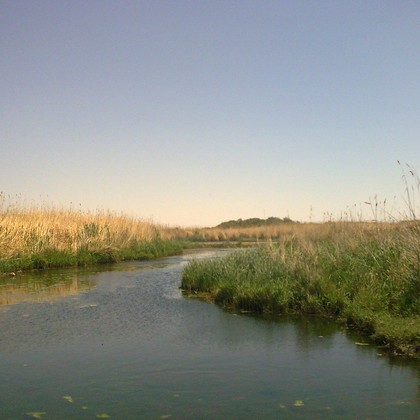
By day on fields, stubble, winter wheat and peanut and maize fields, often in flocks; at night on shallow lakes, reservoirs and marshes. In the Maghreb on the high plateaus and at temporary pools (dayas).
Where the bird is most at home, classified by the habitats of North Africa and the Middle East.


Range and movements
Israel: tens of thousands winter in the Hula Valley, helped by supplementary feeding at Agamon Hula; smaller flocks in the Beit She'an Valley and the Negev. On passage over the Levant, Jordan, Sinai and the Nile Valley; in Egypt a scarce winter visitor. Iraq: winter visitor on the plains of the centre and south. North-west Africa: winter visitor in Morocco, Algeria and Tunisia, mainly on the high plateaus and at inland waters; scarce in Libya. Scarce passage migrant and winter visitor in northern Saudi Arabia and Kuwait, rare in the Gulf states, Oman and Yemen. Breeds from northern Europe and Turkey to eastern Siberia; also winters in Spain, Sudan, Ethiopia and South Asia.
- Winter visitor (c. Apr–Sep)
- Passage (Mar–Apr, Oct–Nov)
- dark = core range, pale = thinly spread
How and when to look
From November to February Agamon Hula in the Hula Valley is one of the largest crane gathering sites in the region: at dawn tens of thousands of cranes fly from the roost to the fields. A tour by wagon or a visit to the hide gives close views.
Conservation status
Not globally threatened and strongly increasing in Europe. In Israel the growth in wintering numbers caused crop damage, which was solved with supplementary feeding. In parts of North Africa and the Middle East hunting and the drying out of wetlands remain a threat.
Scientific name
Grus grus | (Linnaeus, 1758)
Linnaeus described the species in 1758 as Ardea Grus; because it was later moved to another genus, the author and year stand in brackets. The genus Grus was introduced in 1760 by Brisson. Grus is the Latin word for 'crane'. The specific name repeats the genus name. The specimen the first description was based on came from Sweden.