All species › Waders, gulls and terns › Gulls and terns › Common Gull
Common Gull | Larus canus
Stormmeeuw | Gaviota cana
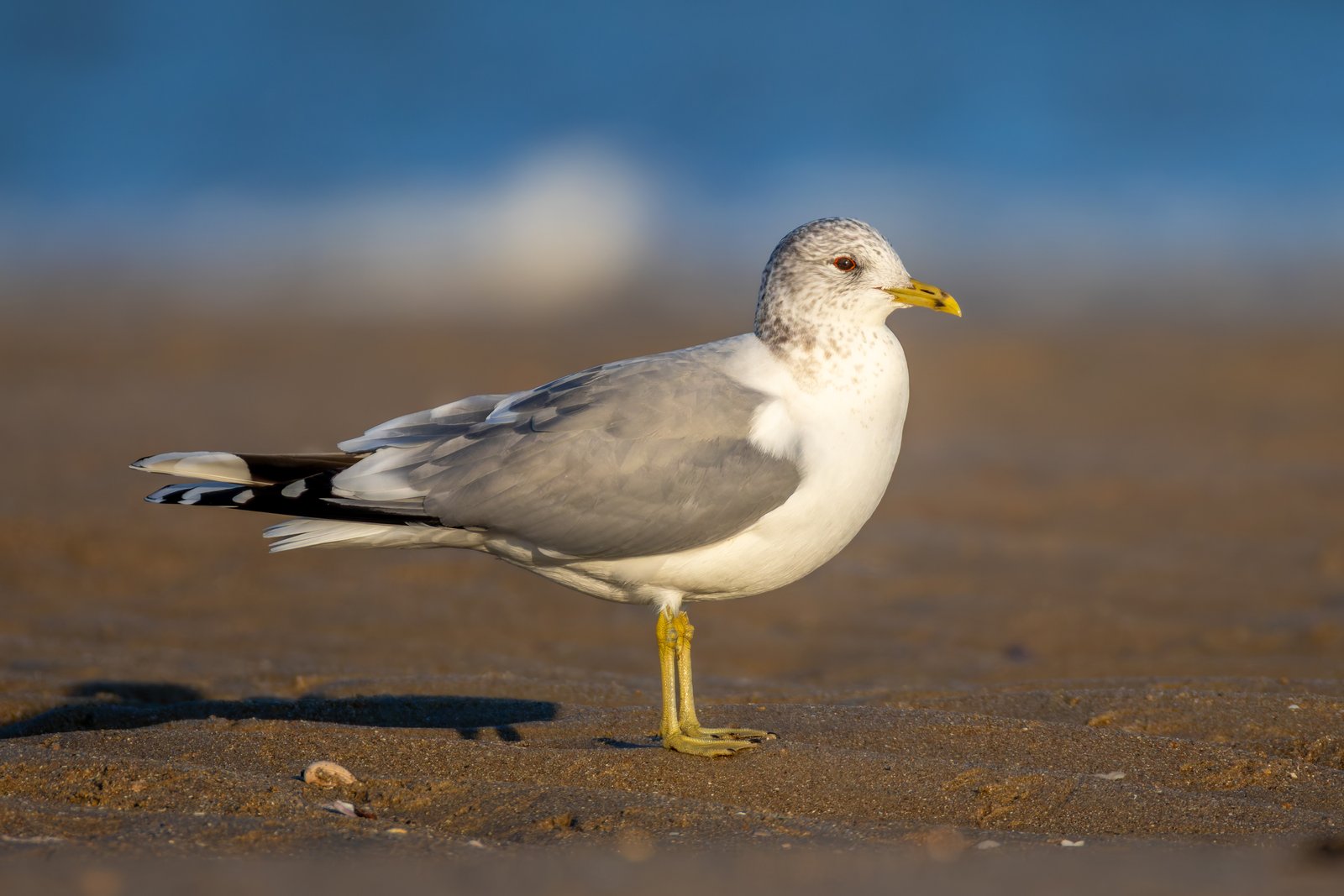
A small, gentle-looking 'large gull' with a round head, a slim bill and a dark eye. In the region it is a winter visitor from the north, appearing only in small numbers in North Africa but regularly found among other gulls in Israel, Egypt, Iraq and on the Persian Gulf.
Voice
Higher and shriller than large gulls; a mewing kee-ah and a high kleew; mostly silent in winter.
Recording: Stanislas Wroza — CC BY-NC-SA 4.0 · converted to mono · xeno-canto
Identification
Clearly smaller and slimmer than Yellow-legged Gull and European Herring Gull, with a round head, a gentle expression from the dark eye and a slim greenish-yellow bill, often with a faint dark ring in winter. The mantle is mid-grey, the legs greenish-yellow. The black wingtip has large white mirrors, and at rest a conspicuous white tertial crescent shows above the wingtip. In winter the head and hindneck are streaked brownish-grey. First-years have a grey mantle, brown coverts, a white tail with a sharp, narrow black terminal band and a pink bill with a dark tip. The eastern form heinei, which winters in the Middle East, is slightly larger and darker-mantled.
Confusion species
Ring-billed Gull (Larus delawarensis) is bulkier with a paler mantle, a yellow eye and a heavy bill with a sharp ring. Black-headed Gull (Chroicocephalus ridibundus) is smaller, with a red bill and legs and a white leading edge to the wing. Young Common Gulls can resemble second-years of larger gulls, but are smaller, with a narrower and more sharply defined tail band and a finer bill. An adult Audouin's Gull (Ichthyaetus audouinii) is larger and has a dark red bill.
Habitat
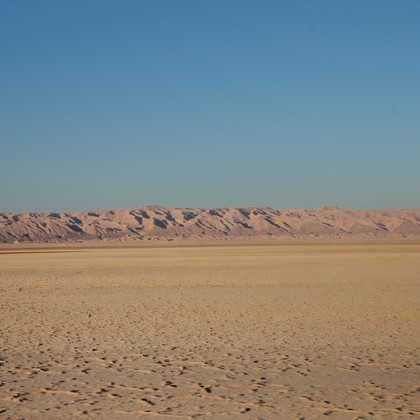
Beaches, estuaries, lagoons, salt pans, harbours, fish farms and reservoirs, and in Egypt and Iraq also irrigated fields and floodplains. Often forages on wet fields and mudflats and roosts among other gulls.
Where the bird is most at home, classified by the habitats of North Africa and the Middle East.


Range and movements
Fairly scarce in North Africa: small numbers on the Mediterranean coast of Tunisia, Algeria and Libya, rare in Morocco and on the Atlantic coast. More numerous in the east: a regular winter visitor to the Nile Delta and the Suez Canal in Egypt, to Israel (coastal plain, fishponds, Hula Valley), Lebanon and Syria, to Iraq and along the Persian Gulf in Kuwait, Bahrain, Qatar, eastern Saudi Arabia and the Emirates into northern Oman; scarce in inland Arabia and rare in Yemen. Beyond the region it breeds from Iceland and north-west Europe to eastern Siberia and winters on the coasts of Europe, the Black and Caspian Seas and East Asia.
- Resident
- Winter visitor (c. Apr–Sep)
- Passage (Mar–Apr, Oct–Nov)
- dark = core range, pale = thinly spread
How and when to look
In the Gulf, the coast of Kuwait (Jahra) and the rubbish tips and farms around the large cities are good places to find it among winter gull flocks. In Israel it can be found in winter among the large gulls at the fishponds of the coastal plain. Look for the round head and the dark eye.
Conservation status
Not globally threatened. In the region a winter visitor without particular threats; numbers vary with the severity of the winter further north.
Scientific name
Larus canus | Linnaeus, 1758
Linnaeus described the species in 1758 and placed it straight away in the genus where it still stands. He introduced the genus Larus in that same work. Larus is Latin, from Ancient Greek laros, and appears to have referred to a gull or another large seabird. canus is Latin for 'grey', after the grey mantle. The specimen the first description was based on came from Sweden.