All species › Passerines › Finches › Crimson-Winged Finch
Crimson-Winged Finch | Rhodopechys sanguineus
Rode woestijnvink | Camachuelo alirrojo asiático
The Crimson-winged Finch is a bulky, heavy-billed finch of bare high mountains which in the region lives only in the east, in the mountains of Lebanon, Mount Hermon and Kurdistan. The birds of the Atlas are now treated as a separate species, African Crimson-winged Finch (Rhodopechys alienus).

Voice
The call is a soft, rolling dvoo-ee or a short chee-rup, in flight often a chirping chip. The song is a short, melodious, somewhat babbling phrase recalling a Crested Lark or a Linnet, delivered from a boulder.
Recording: András Schmidt — CC BY-NC-SA 4.0 · converted to mono · xeno-canto
Identification
15–17 cm. Stocky, with a large head, a heavy yellow to horn-coloured conical bill and a short, slightly forked tail. The plumage is sandy brown with faint streaking on the back. The male has a blackish-brown crown, a pink wash on the cheek and breast, a rosy-red rump and a striking rosy-red wing panel on the greater coverts and primary edges; the outer tail feathers are edged white. The female is duller with less pink.
Confusion species
African Crimson-winged Finch (Rhodopechys alienus) occurs only in the Atlas; the male lacks the black crown and has a greyer head and neck, less pink on the breast and no pink uppertail coverts. Trumpeter Finch (Bucanetes githagineus) is much smaller and rounder, with a grey head and a short coral-red bill, and shows only a pink wash, not a bright wing panel. Desert Finch (Rhodospiza obsoleta) also has pink in the wing but a black bill, a black-and-white wing and no dark crown. Eurasian Linnet (Linaria cannabina) is much slimmer with white patches in the wing and tail. Hawfinch (Coccothraustes coccothraustes) has a white wingbar and a white tail tip.
Habitat
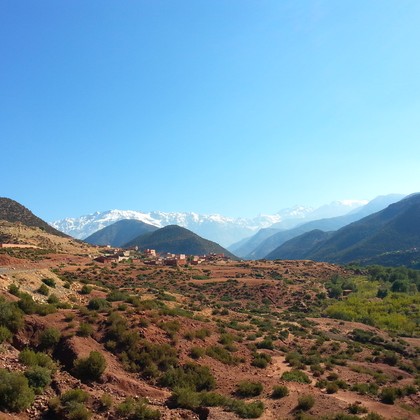
Bare stony slopes, alpine grassland and rocky plateaux above the treeline, with cushion plants and scattered shrubs, in the Levant above about 1500 m. Feeds on the ground on seeds and visits water daily. In winter it moves to lower slopes, valleys and fields.
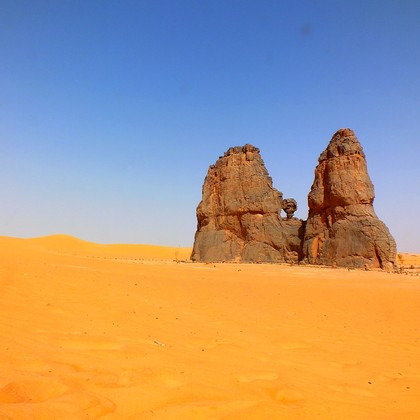
Where the bird is most at home, classified by the habitats of North Africa and the Middle East.
Range and movements
In the region the Lebanon and Anti-Lebanon ranges (Lebanon and Syria), Mount Hermon (Israel and Syria) and the mountains of Kurdistan in northern Iraq; the birds of the Atlas are African Crimson-winged Finches (Rhodopechys alienus). Beyond the region in Turkey, the Caucasus, Iran and farther east to Central Asia and Afghanistan.
- Resident
- Summer visitor (c. Oct–Mar)
- Winter visitor (c. Apr–Sep)
- Passage (Mar–Apr, Oct–Nov)
- dark = core range, pale = thinly spread
How and when to look
In Israel on the highest slopes of Mount Hermon, especially in May and June. The well-known birds of Oukaïmeden in the High Atlas are African Crimson-winged Finches.
Conservation status
Not globally threatened. The populations in the region are small and fragmented and therefore vulnerable to overgrazing and climate change in the high mountains; in the Levant military and tourist use of Mount Hermon locally reduces the habitat.
Scientific name
Rhodopechys sanguineus | (Gould, 1838)
Gould described the species in 1838 as Fringilla sanguinea; because it was later moved to another genus, the author and year stand in brackets. The genus Rhodopechys was introduced in 1851 by Cabanis. Rhodopechys is Greek, from rhodon 'rose' and pēkhus 'forearm', together rhodopēkhus 'rosy-armed', after the pink in the wing. sanguineus is Latin for 'blood-red', from sanguis, sanguinis 'blood'. The specimen the first description was based on came from Erzurum, Turkey.