All species › Passerines › Finches › Desert Finch
Desert Finch | Rhodospiza obsoleta
Vale woestijnvink | Camachuelo desertícola
Desert Finch is a sandy, unstreaked finch with a black bill and a pink wing panel, breeding in the region mainly in the Levant, Syria and Iraq. Despite its name it is not a true desert bird: it lives in orchards, oases and green patches on the edge of steppe and semi-desert.

Voice
The call is a soft, somewhat nasal, rolling trrr-oot or shree, recalling a linnet but slower and softer. The song is a quiet, gently rolling twitter with nasal and buzzing notes, often from a treetop; it carries poorly and is easily missed.
Recording: Alain Verneau — CC BY-NC-SA 4.0 · converted to mono · xeno-canto
Identification
14.5–15 cm, slender, with a fairly long, slightly forked tail. The whole body is plain sandy brown to pale buff, without streaks, with a paler belly. The bill is black all year; the male also has black lores and a thin black surround to the bill base. The wing is strikingly patterned: black flight feathers with broad white edges to the tertials and inner secondaries, and a pink panel across the greater coverts and the base of the primaries, which shows as a rosy band in flight. The tail is black with white edges. The female is duller, with less pink and no black at the bill base. Juveniles are plainer still, with a horn-coloured bill.
Confusion species
Trumpeter Finch (Bucanetes githagineus) is smaller and stockier, with a greyish head, a thick orange-red or yellowish bill and no black and white in the wing. Crimson-winged Finch (Rhodopechys sanguineus) also shows pink in the wing, but is bulkier, with a blackish-brown crown, a spotted breast and a pale, thick bill. Eurasian Linnet (Linaria cannabina) is streaked and shows white, not pink, in wing and tail. A plain sandy finch with a black bill is almost certainly this species.
Habitat
Orchards, vineyards, olive groves, gardens and tree lines on the edge of dry steppe and semi-desert, often near water; also oases, copses in broad wadis, parks and plantations around villages. It often feeds on the ground on weed seeds, in flocks in winter, sometimes with other finches. It nests in a tree or tall shrub.
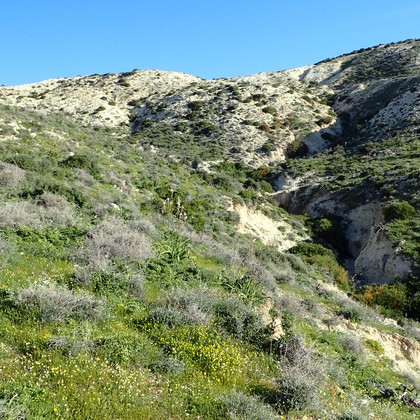
Where the bird is most at home, classified by the habitats of North Africa and the Middle East.


Range and movements
Breeds in Israel (mainly the north, the Jordan Valley and the central hills), Jordan (mainly the north and eastern oases such as Azraq), Lebanon (Beqaa Valley), Syria and northern and central Iraq. More dispersed in winter, with small numbers in Kuwait and northern Saudi Arabia; elsewhere in Arabia and in Egypt (Sinai) a rare visitor. Absent from North Africa west of Egypt. Beyond the region from Turkey and the Caucasus through Iran and Afghanistan to Central Asia and western China.
- Resident
- Summer visitor (c. Oct–Mar)
- Winter visitor (c. Apr–Sep)
- Passage (Mar–Apr, Oct–Nov)
- dark = core range, pale = thinly spread
How and when to look
In spring search orchards and tree lines near villages in northern Israel, the Golan or northern Jordan, where singing males sit in the treetops. The pink wing panel and white tail sides show best when a small flock flushes from the ground.
Conservation status
Not threatened. In the Levant it spread during the 20th century, helped by the planting of orchards and tree lines in dry areas. Little recent information exists on numbers in Syria and Iraq.
Scientific name
Rhodospiza obsoleta | (Lichtenstein, 1823)
Lichtenstein described the species in 1823 as Fringilla obsoleta; because it was later moved to another genus, the author and year stand in brackets. The genus Rhodospiza was introduced in 1888 by Sharpe. Rhodospiza is Greek, from rhodon 'rose, rose-red' and spiza 'finch', after the pink in the wing. obsoleta is Latin for 'plain, faded', after the uniform sandy-brown plumage. The specimen the first description was based on came from near Bukhara, Uzbekistan.