All species › Passerines › Chats and flycatchers › Desert Wheatear
Desert Wheatear | Oenanthe deserti
Woestijntapuit | Collalba desértica
The Desert Wheatear is the wheatear of sand and flat desert with low shrubs, and one of the most widespread songbirds of the region, from the Atlantic Sahara to Oman. It likes to sit on a shrub or stone, bobbing its tail, and in winter is found throughout the Arabian deserts and along field edges.

Voice
The call is a soft, whistled see and a hard chak. The song is a short, melancholy, descending phrase of whistles ending in a roll, tee-tee-teerrr, often in a short song flight or from a shrub.
Recording: Richard E. Webster — CC BY-NC-SA 4.0 · shortened to the first 60 s, mono · xeno-canto
Identification
14–15.5 cm. Pale sandy, with a black tail and white rump: the tail is almost entirely black, without the black-and-white T-pattern of other wheatears. The male has a sandy-buff crown and back, a black throat and cheeks joined to the black wings by a narrow line, white scapular patches and a pale supercilium. In winter pale fringes partly hide the black. The female is plain sandy brown with dark brown, pale-fringed wings, a pale throat or a faint dark throat patch, and the same black tail. The forms differ in tone: homochroa in North Africa is warm, reddish sandy, deserti in the Middle East paler and greyer, and the winter visitor atrogularis has more white in the wing.
Confusion species
The tail is the key feature: no other wheatear of the region has an almost all-black tail with a white rump. Isabelline Wheatear (Oenanthe isabellina) and females of Northern Wheatear (Oenanthe oenanthe) and Western Black-eared Wheatear (Oenanthe hispanica) have white tail sides and a T-pattern. The black-throated male Western Black-eared Wheatear has a white tail with a narrow black terminal band and lacks the connecting line between throat and wing. Blackstart (Oenanthe melanura) has an all-black tail and rump and is greyer.
Habitat
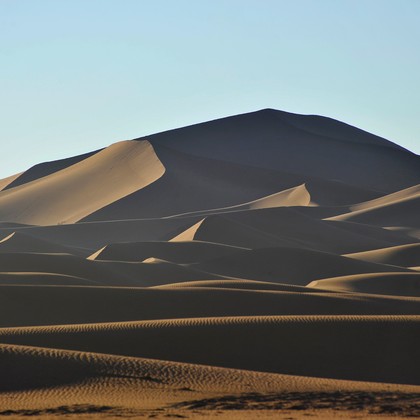
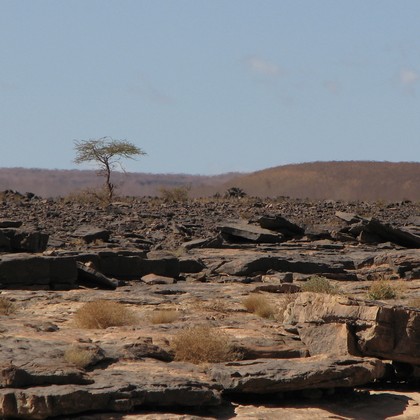
Sandy and gravel plains with scattered low shrubs, dune valleys, semi-desert and the edges of steppe and alfa plains, also around oases and field edges. Avoids bare rock and high mountains. In winter also along coasts, on fallow and farmland.
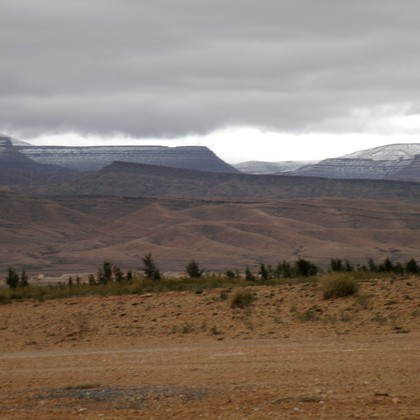
Where the bird is most at home, classified by the habitats of North Africa and the Middle East.
Range and movements
Breeds in North Africa south of the Atlas and in the Sahara, from southern Morocco and Western Sahara through Algeria, southern Tunisia and Libya to Egypt's Western Desert (form homochroa). Further in Sinai, the Negev, Jordan, the desert steppe of Syria and Iraq, Kuwait and northern Saudi Arabia (deserti). In winter common throughout the Arabian Peninsula, with many atrogularis from Central Asia in the Emirates, Oman, Qatar, Bahrain and eastern Saudi Arabia, and further in Yemen and on Socotra; also in the Nile Valley and the Egyptian deserts. Beyond the region the species breeds from Central Asia to Mongolia and also winters in the Sahel, north-east Africa and north-west India.
- Resident
- Summer visitor (c. Oct–Mar)
- Winter visitor (c. Apr–Sep)
- Passage (Mar–Apr, Oct–Nov)
- dark = core range, pale = thinly spread
How and when to look
In Morocco it is common on the gravel plains and sandy tracks around Merzouga and between Boumalne and Tagdilt. In winter in the Emirates and Oman it is on almost every patch of sandy waste ground, even at the edge of towns; watch for the all-black tail as it flies off.
Conservation status
Not globally threatened and widespread and locally common in the region. Overgrazing and drought may affect numbers locally, but there is no evidence of a marked decline.
Scientific name
Oenanthe deserti | (Temminck, 1825)
Temminck described the species in 1825 as Saxicola deserti; because it was later moved to another genus, the author and year stand in brackets. The genus Oenanthe was introduced in 1816 by Vieillot. Oenanthe was used by Aristotle for a bird that can no longer be identified; the word comes from the Greek oinos, oinoē 'wine, vine' and anthos 'flower, bloom'. deserti is Latin for 'of the desert', after the arid habitat. The specimen the first description was based on came from Egypt.