All species › Passerines › Chats and flycatchers › Cyprus Wheatear
Cyprus Wheatear | Oenanthe cypriaca
Cyprustapuit | Collalba chipriota
The Cyprus Wheatear is a small black-and-white wheatear that breeds only on Cyprus and crosses the region on its way to and from its winter quarters in Sudan and Ethiopia. In spring and autumn it is a familiar passage migrant in the Levant and Egypt.
Voice
Rarely sings on passage. The song is a dry, buzzing whirr like a cicada, zrrrrrrr, ending with a few high squeaks. The call is a hard tsak, sometimes with a soft hweet.
Recording: Alain Verneau — CC BY-NC-SA 4.0 · converted to mono · xeno-canto
Identification
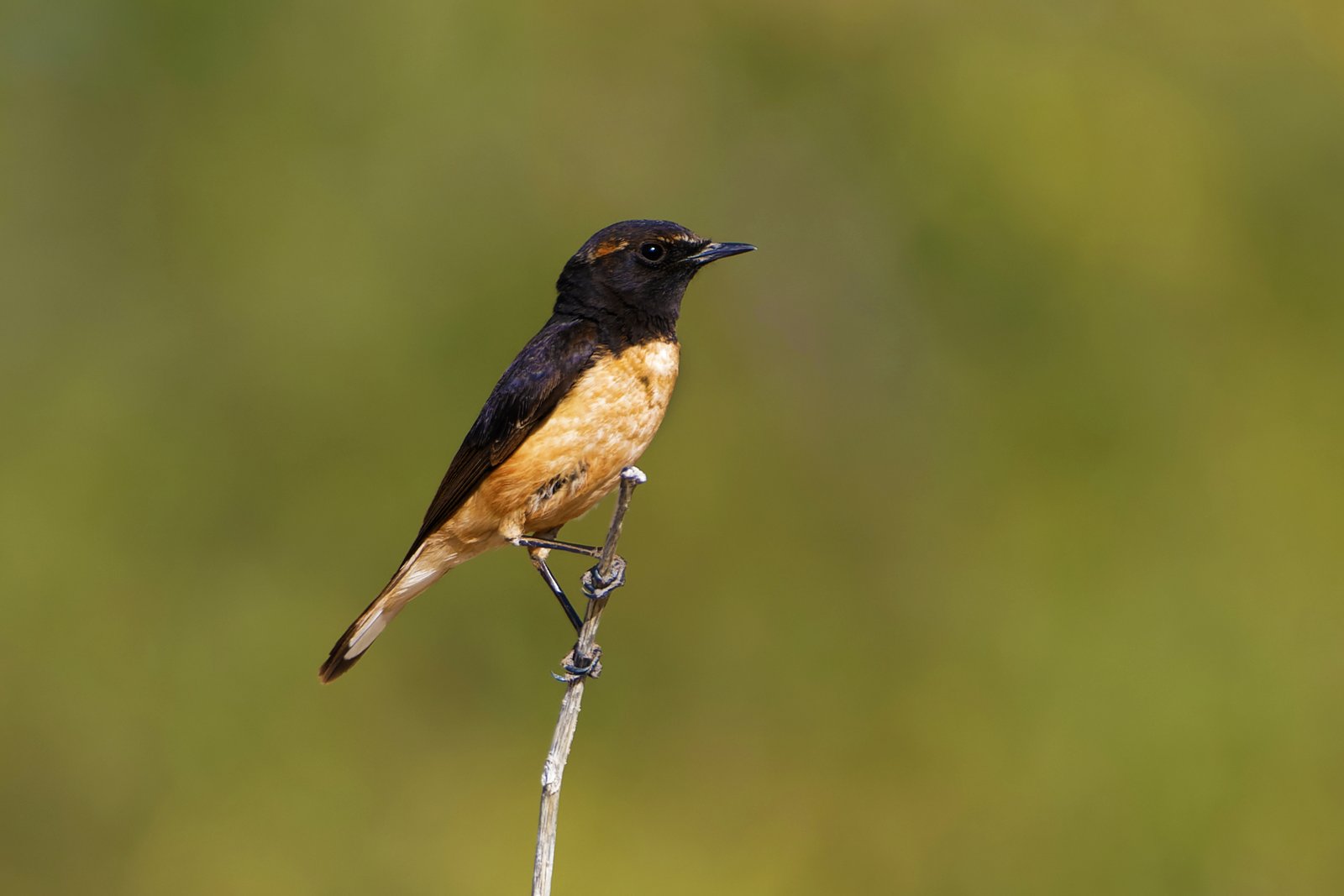
14–15 cm. Small and contrasting. The male has an off-white to creamy crown and nape, a black face, black throat and black back and wings, and warm buff to apricot underparts. The female closely resembles the male but is duller and brownish-black; that both sexes are nearly alike is a feature in itself. The tail has a white base, a broad black terminal band and a long black central stripe, with more black than in most wheatears. In autumn fresh birds show broad pale fringes on back and wing and a buff-brown crown.
Confusion species
Pied Wheatear (Oenanthe pleschanka) is slightly larger, with whiter underparts and less black in the tail; the female is brown and looks nothing like the male. Eastern Black-eared Wheatear (Oenanthe melanoleuca) has a white or pale buff back, never black. The male Hooded Wheatear (Oenanthe monacha) is larger, with a longer bill, white underparts and an almost entirely white tail.
Habitat
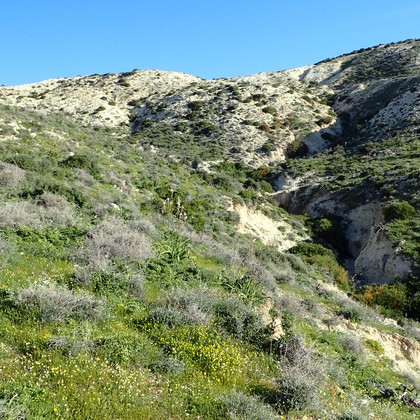
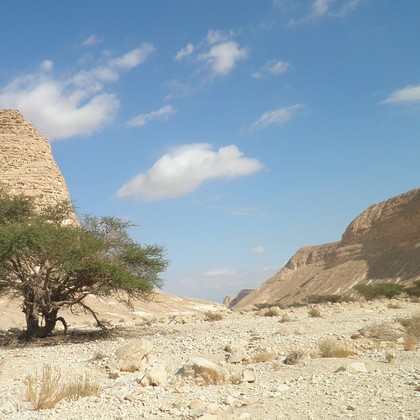
On passage in all kinds of open country with lookout perches: garrigue, bushes in wadis, field edges, coastal dunes, parks and gardens, also in kibbutzim and on village outskirts. Does not entirely avoid bare sand desert.
Where the bird is most at home, classified by the habitats of North Africa and the Middle East.

Range and movements
Passage migrant through Lebanon, western Syria, Israel, Samaria and Judea, Jordan (especially the Jordan Valley and the Arava) and Egypt, including Sinai, the Nile valley and the Red Sea coast; in autumn also in the far west of Saudi Arabia. A vagrant elsewhere in the region. Breeds only on Cyprus and winters in south-eastern Sudan and Ethiopia.
- Summer visitor (c. Apr–Sep)
- Passage (Mar–Apr, Oct–Nov)
- dark = core range, pale = thinly spread
How and when to look
Between late February and early April at Eilat, in the Arava or in Sinai: the Cyprus Wheatear is then one of the first wheatears on the move. Look for a black-and-white wheatear whose 'female' is almost as black as the male.
Conservation status
Not globally threatened. The Cyprus population is large and stable; within the region the species matters only as a passage migrant.
Scientific name
Oenanthe cypriaca | (Homeyer, 1885)
Homeyer described the species in 1885 as Saxicola cypriaca; because it was later moved to another genus, the author and year stand in brackets. The genus Oenanthe was introduced in 1816 by Vieillot. Oenanthe was used by Aristotle for a bird that can no longer be identified; the word comes from the Greek oinos, oinoē 'wine, vine' and anthos 'flower, bloom'. cypriaca means 'of Cyprus', the only island where the species breeds. The specimen the first description was based on came from Cyprus.