All species › Passerines › Chats and flycatchers › Eastern Black-Eared Wheatear
Eastern Black-Eared Wheatear | Oenanthe melanoleuca
Oostelijke blonde tapuit | Collalba rubia oriental
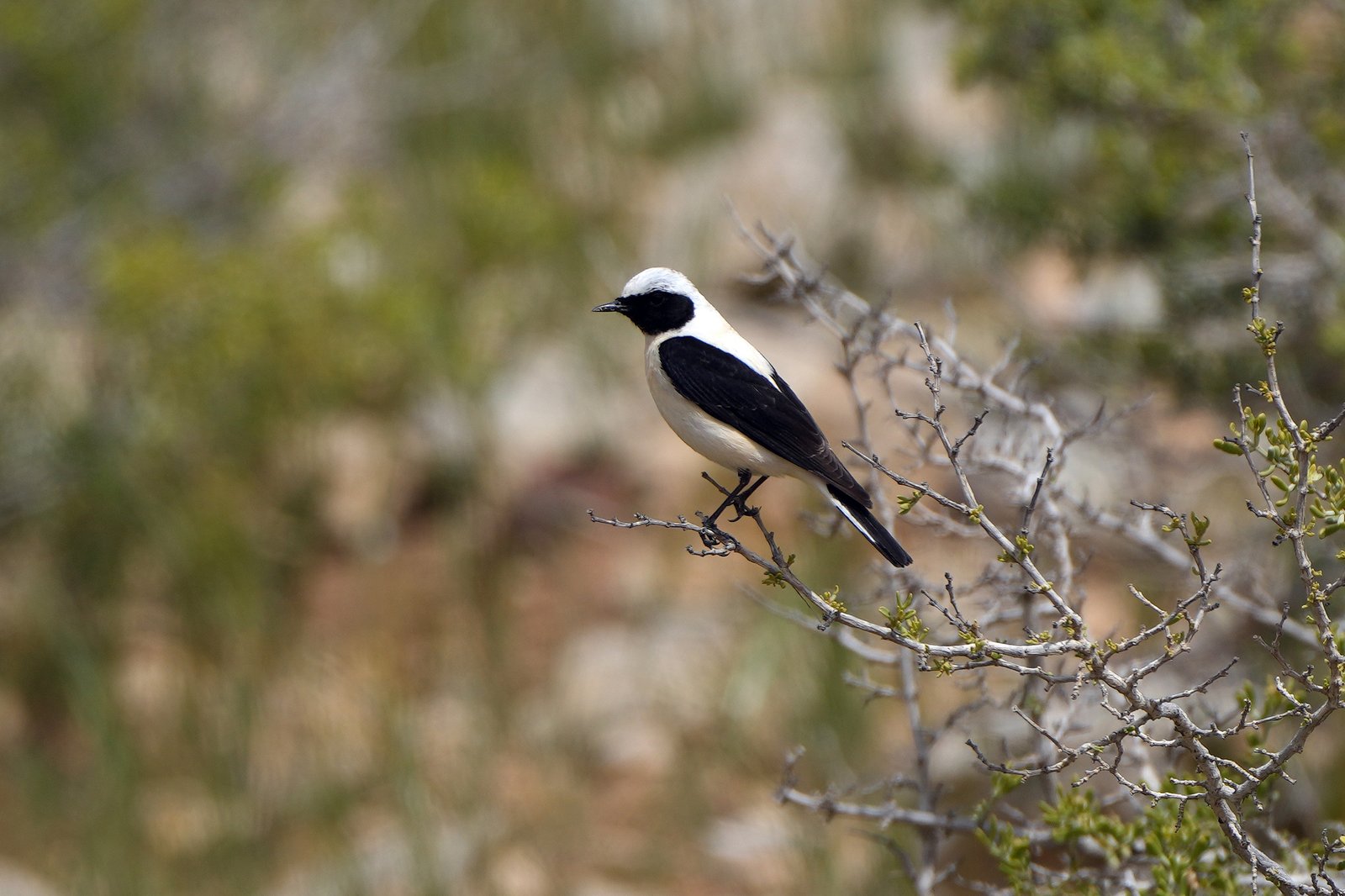
Eastern Black-eared Wheatear is the black-eared wheatear of the Levant: a slim, long-tailed wheatear of stony slopes with garrigue and low shrubs. It replaces Western Black-eared Wheatear east of Libya and migrates in large numbers through Sinai and Arabia to East Africa.
Voice
The call is a dry, grating chek and a soft whistled dyuu. The song is a short, scratchy, fast phrase with clear whistles and mimicry, from a boulder or in a short song flight.
Recording: Stanislas Wroza — CC BY-NC-SA 4.0 · shortened to the first 60 s, mono · xeno-canto
Identification
13.5–15.5 cm. Slim, with a fairly long tail. The breeding male has a white to very pale, cool cream crown, nape and mantle, black wings and a black mask that often runs narrowly across the base of the bill. There are white-throated and black-throated birds; in the black-throated form the black extends wider and deeper, almost to the shoulder. Underparts white with at most a faint buff wash on the breast. The tail is largely white with a narrow, often irregular black terminal band and black centre. The female is grey-brown to sandy brown with dark wings and often a vague dark throat. In autumn broad fringes obscure the black and birds are warmer in tone.
Confusion species
Western Black-eared Wheatear (Oenanthe hispanica) of the Maghreb is warmer ochre on back and breast in the male, and the black throat is smaller and does not reach the shoulder; females and autumn birds are usually not identifiable to species away from the breeding grounds. Pied Wheatear (Oenanthe pleschanka) has a black back joined to the black throat in the male; the two hybridise in Iran. Cyprus Wheatear (Oenanthe cypriaca), a passage migrant in the Levant, is smaller, with a black back, dark crown sides and a warmer buff breast. Northern Wheatear (Oenanthe oenanthe) is greyer on the back and has a broader, even black tail band.
Habitat
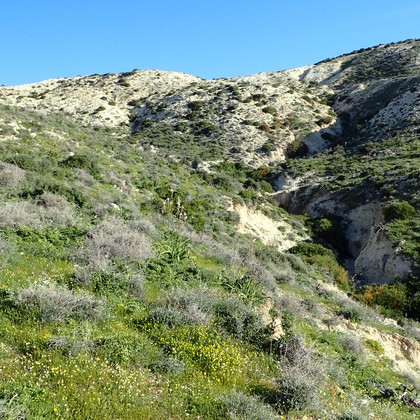
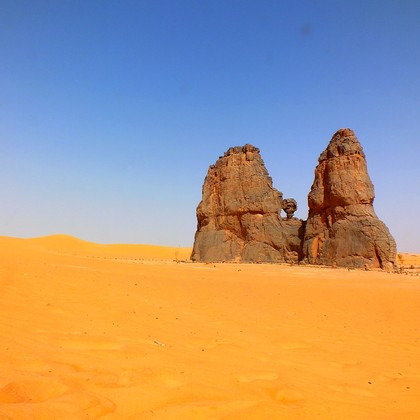
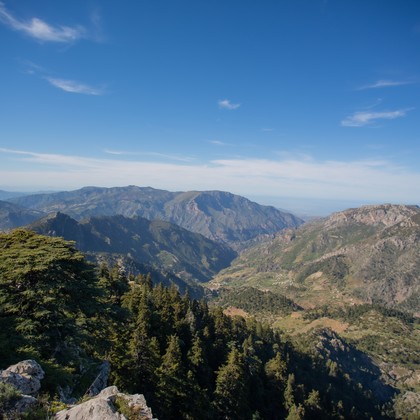
Dry, stony slopes and hills with garrigue, maquis and scattered shrubs, open oak woodland and juniper, vineyards and terraces, from sea level to about 2000 m. On passage in all kinds of open country, from semi-desert to field edges and wadis.
Where the bird is most at home, classified by the habitats of North Africa and the Middle East.
Range and movements
Breeds in Israel (mainly Galilee, the Golan and the Judean hills), Samaria and Judea, Lebanon, western Syria, north-west Jordan and the mountains of Kurdistan in northern Iraq. On passage, March – May and August – October, common in Sinai, the Negev and Eilat, and further through Egypt (mainly east of the Nile), Saudi Arabia, Yemen and the Gulf States. Beyond the region it breeds from Italy and the Balkans through Turkey and the Caucasus to Iran and Turkmenistan, and winters in the Sahel from Chad and Sudan to Ethiopia and Eritrea.
- Summer visitor (c. Oct–Mar)
- Winter visitor (c. Apr–Sep)
- Passage (Mar–Apr, Oct–Nov)
- dark = core range, pale = thinly spread
How and when to look
In April – May males sing on the stony slopes of the Golan and Galilee and in the mountains of Lebanon. During migration the wadis around Eilat are the best place to see many birds side by side, though females there often remain unidentifiable.
Conservation status
Not globally threatened. In the region it has declined locally through agricultural intensification and afforestation of open slopes. The split from the western species rests on genetic studies; the boundary between the two lies in the central Mediterranean.
Scientific name
Oenanthe melanoleuca | (Güldenstädt, 1775) (GBIF: Oenanthe hispanica)
Güldenstädt described the species in 1775 as Muscicapa melanoleuca; because it was later moved to another genus, the author and year stand in brackets. The genus Oenanthe was introduced in 1816 by Vieillot. Oenanthe was used by Aristotle for a bird that can no longer be identified; the word comes from the Greek oinos, oinoē 'wine, vine' and anthos 'flower, bloom'. melanoleuca is Greek, from melas 'black' and leukos 'white', after the contrasting plumage of the male. The specimen the first description was based on came from Tbilisi, Georgia.