All species › Passerines › Leaf warblers › Eastern Bonelli's Warbler
Eastern Bonelli's Warbler | Phylloscopus orientalis
Balkanbergfluiter | Mosquitero oriental
The Eastern Bonelli's Warbler is the eastern counterpart of the Western Bonelli's Warbler: a pale, grey-and-white leaf warbler of dry hillside woodland from the Balkans to Turkey and the Levant. In this region it breeds in the mountains of Lebanon and Syria, and in spring it passes in numbers through Sinai, Israel and Jordan to its winter quarters in Sudan and Ethiopia.
Voice
The song is a dry rattle on one pitch, srrrrrrr, on average slower and harder than that of Western Bonelli's. The call is decisive: a short, hard, flat chip, like a sparrow or young chaffinch, quite unlike the soft hoo-eet of Western Bonelli's.
Recording: Stanislas Wroza — CC BY-NC-SA 4.0 · converted to mono · xeno-canto
Identification
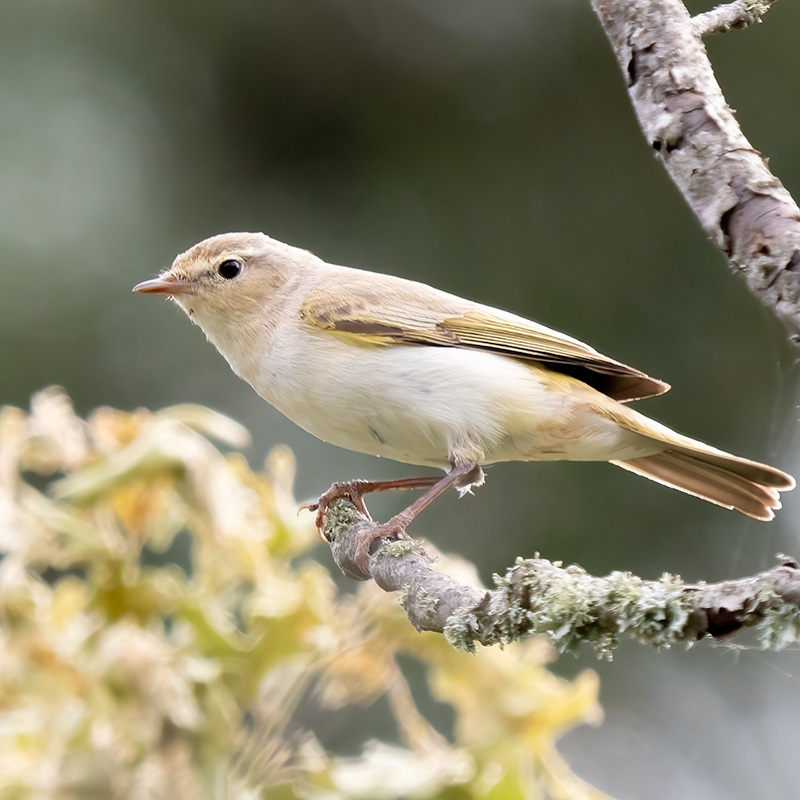
10.5–11.5 cm. Grey to grey-brown above and pure white below, with no yellow on throat or breast. The rump is yellow-green and a greenish panel on the folded wing stands out against the dull back, but both are less marked than in Western Bonelli's. The face is plain, with a short, faint pale supercilium, a narrow white eye-ring and a large dark eye. Bill relatively long and heavy, with an orange lower mandible; legs grey-brown. Sexes alike.
Confusion species
Western Bonelli's Warbler (Phylloscopus bonelli) is practically indistinguishable in the field and identified only by call; in the region the two species barely overlap. Wood Warbler (Phylloscopus sibilatrix) is larger with a bright yellow throat and breast. Willow Warbler (Phylloscopus trochilus), Common Chiffchaff (Phylloscopus collybita) and Green Warbler (Phylloscopus nitidus) lack the white underparts and yellow rump.
Habitat
Breeds on dry slopes with open oak, pine and cedar woodland and scrub, in the Lebanon and Anti-Lebanon ranges up to high altitude. On passage in any grove, park, oasis and wadi with acacias, even in the middle of the desert.
Where the bird is most at home, classified by the habitats of North Africa and the Middle East.



Range and movements
Breeds in the mountains of Lebanon and western Syria, possibly also in small numbers on Mount Hermon. On spring passage, from mid-March to early May, common through Egypt (Sinai, Eastern Desert, Nile Valley), Israel and Jordan, more scarcely through north-eastern Libya and western Saudi Arabia; less conspicuous in autumn. A vagrant to Iraq, Kuwait, the UAE and Oman. Winters in Sudan, Chad, Eritrea and Ethiopia. Beyond the region it breeds in the Balkans and Turkey.
- Summer visitor (c. Oct–Mar)
- Passage (Mar–Apr, Oct–Nov)
- dark = core range, pale = thinly spread
How and when to look
Between late March and mid-April at Eilat, in Sinai or in the Arava: the parks of Eilat and the acacias of the wadis then often hold several at once. Wait for the short chip call to separate it with certainty from Willow Warbler or Western Bonelli's.
Conservation status
Not globally threatened (BirdLife assessment 2024). In the region vulnerable to the loss of hillside woodland in Lebanon and Syria through logging, fire and development.
Scientific name
Phylloscopus orientalis | (Brehm, 1855)
Brehm described the species in 1855 as Phyllopneuste orientalis; because it was later moved to another genus, the author and year stand in brackets. The genus Phylloscopus was introduced in 1826 by Boie. Phylloscopus is Greek, from phullon 'leaf' and skopos 'seeker', from skopeō 'to watch': the bird that searches the foliage. orientalis is Latin for 'eastern', after the eastern range as against that of the western Bonelli's warbler. The specimen the first description was based on came from Wadi Halfa, Sudan.