All species › Passerines › Leaf warblers › Green Warbler
Green Warbler | Phylloscopus nitidus
Groene fitis | Mosquitero verde
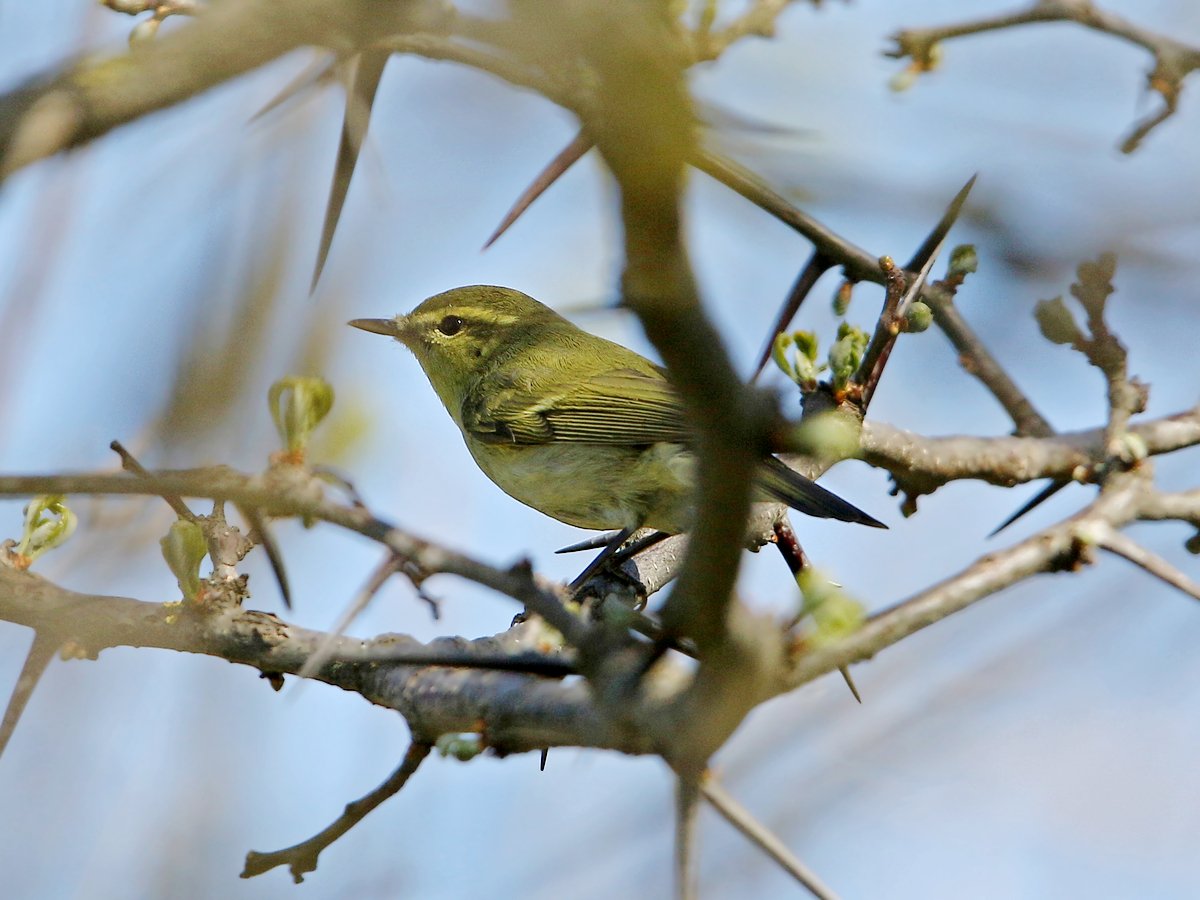
The Green Warbler is a bright green and yellow leaf warbler from the Caucasus, north-eastern Turkey and northern Iran that winters in southern India. Its migration route lies mostly east of the region; in Kuwait, the UAE, Oman and Israel it is a rare passage migrant, mainly in autumn. It is often regarded as a subspecies of Greenish Warbler (Phylloscopus trochiloides).
Voice
The call is a loud, disyllabic tsee-wee or chiwee, stronger and slightly deeper than in Greenish Warbler; often the first clue. The song, rarely heard on migration, is a fast, clear, rattling phrase.
Recording: Lukas Ehmke — CC BY-NC-SA 4.0 · converted to mono · xeno-canto
Identification
10–11.5 cm. A slight leaf warbler with bright olive-green upperparts and a yellow wash on throat, breast and often also supercilium and cheek. The long, prominent supercilium reaches above the ear-coverts and curves up slightly at the rear, above a dark eye-stripe. One narrow, yellowish-white wing-bar on the greater coverts, sometimes a faint second one. Bill fairly strong with an orange-yellow lower mandible; legs grey-brown. Juveniles in autumn are the yellowest.
Confusion species
Greenish Warbler (Phylloscopus trochiloides), at most a vagrant to the region, is greyer green above and whiter below, without a yellow wash. Yellow-browed Warbler (Phylloscopus inornatus) and Hume's Warbler (Phylloscopus humei) are smaller, with two wing-bars and pale tertial edges. Large-billed Leaf Warbler (Phylloscopus magnirostris) is larger, darker and drabber, with a longer, heavier bill. Willow Warbler (Phylloscopus trochilus) and Common Chiffchaff (Phylloscopus collybita) lack a wing-bar.
Habitat
On passage in parks, gardens and groves with tall trees, oases and riverine woodland; forages restlessly for insects in the canopy. Breeds outside the region in montane and broadleaved forest with undergrowth.
Where the bird is most at home, classified by the habitats of North Africa and the Middle East.


Range and movements
Rare passage migrant in the UAE (just over ten records up to 2014, mainly in parks around Dubai and Abu Dhabi), Oman and Kuwait (including Al Abraq), mainly from late August to October. In Israel a few autumn records, including a lingering bird in Jerusalem in October 2022; also single records in Saudi Arabia, Iraq and Lebanon. Breeds in north-eastern Turkey, the Caucasus and northern Iran, east to Afghanistan, and winters in southern India and Sri Lanka.
- Summer visitor (c. Apr–Sep)
- Passage (Mar–Apr, Oct–Nov)
- dark = core range, pale = thinly spread
How and when to look
In September and October in a city park with tall trees in Dubai or Abu Dhabi, or on a green farm in Kuwait: listen for a loud tsee-wee in the canopy and look for a yellowish leaf warbler with a single wing-bar.
Conservation status
Not globally threatened. Too rare in the region for a trend.
Scientific name
Phylloscopus nitidus | Blyth, 1843
Blyth described the species in 1843 and placed it straight away in the genus where it still stands. The genus Phylloscopus was introduced in 1826 by Boie. Phylloscopus is Greek, from phullon 'leaf' and skopos 'seeker', from skopeō 'to watch': the bird that searches the foliage. nitidus is Latin for 'shining, bright', after the fresh green and yellow of the plumage. The specimen the first description was based on came from Calcutta, India.