All species › Passerines › Leaf warblers › Plain Leaf Warbler
Plain Leaf Warbler | Phylloscopus neglectus
Dwergtjiftjaf | Mosquitero sencillo
The Plain Leaf Warbler is the smallest leaf warbler of the region: a drab, unmarked little bird from the mountains of Iran and Central Asia. It winters in lower-lying dry woodland and scrub, and in this region only in the far east, in the Hajar Mountains of Oman and the UAE and the plains at their foot.

Voice
The call is a hard, dry chrit or ticking tak, sometimes in a short series, unlike the soft whistle of Common Chiffchaff. The song, heard from late spring, is a short, fast, high-pitched twittering phrase.
Recording: Erik Wahlgren — CC BY-NC-SA 4.0 · converted to mono · xeno-canto
Identification
9–10 cm. Very small, compact and short-tailed, slightly larger than a Goldcrest. Upperparts uniform grey-brown, with no green or yellow; underparts off-white with a faint buff wash on breast and flanks. Short, faint buffish supercilium fading behind the eye, a narrow dark eye-stripe and a narrow pale eye-ring. No wing bar; wings short. Bill fine and dark, legs dark grey to blackish. Very active, often flicking its wings and dipping its tail.
Confusion species
Mountain Chiffchaff (Phylloscopus sindianus) is larger, longer-tailed and warmer brown on cheeks, breast and flanks. Common Chiffchaff (Phylloscopus collybita) is larger and more olive, with some yellow at the bend of the wing and a soft hweet. Hume's Warbler (Phylloscopus humei) has a long supercilium and a clear wing bar. Asian Desert Warbler (Curruca nana) is larger and sandy, with a yellow iris and a rufous tail.
Habitat
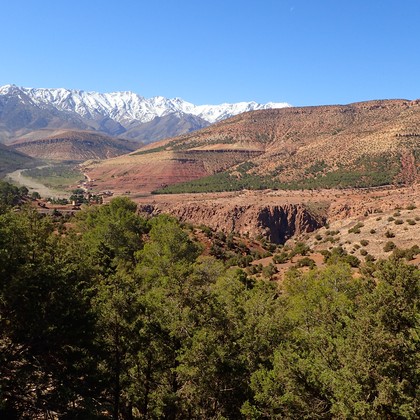
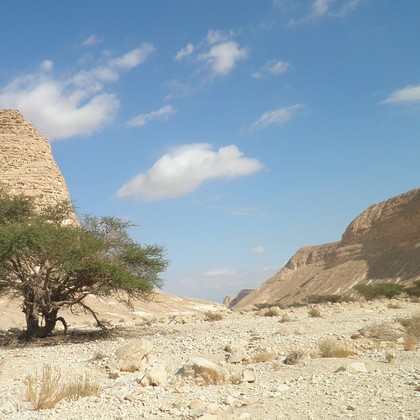
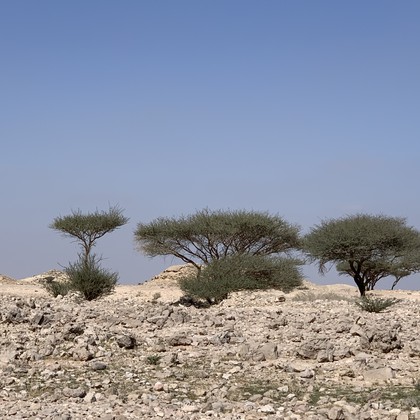
In winter dry open woodland and scrub: acacias and Prosopis in wadis and on the plains at the foot of the Hajar Mountains, orchards and vegetated mountain slopes, from sea level to about 1000 m. Breeds in oak and juniper woodland and alpine scrub high in the mountains, outside the region.
Where the bird is most at home, classified by the habitats of North Africa and the Middle East.
Range and movements
Winter visitor to northern Oman (Hajar Mountains and the Batinah plain, locally also inland) and the eastern UAE (Hajar, around Hatta and Masafi, and the Al Ain area with Green Mubazzarah and Jebel Hafeet); found there at few sites, but reliably. Elsewhere in the region at most a vagrant. Breeds in the mountains of Iran (Zagros and Elburz), Turkmenistan, Afghanistan, Pakistan and Tajikistan and winters in southern Iran, Pakistan, north-western India and north-eastern Arabia.
- Summer visitor (c. Apr–Sep)
- Winter visitor (c. Oct–Mar)
- Passage (Mar–Apr, Oct–Nov)
- dark = core range, pale = thinly spread
How and when to look
From December to February in the vegetated wadis of the Hajar Mountains or at Green Mubazzarah at the foot of Jebel Hafeet: search the acacias for a tiny grey bird with flicking wings and listen for the hard chrit. Often responds strongly to its own song.
Conservation status
Not globally threatened. In its Arabian wintering area vulnerable to the cutting of acacias and to overgrazing and drought in the wadis.
Scientific name
Phylloscopus neglectus | Hume, 1870
Hume described the species in 1870 and placed it straight away in the genus where it still stands. The genus Phylloscopus was introduced in 1826 by Boie. Phylloscopus is Greek, from phullon 'leaf' and skopos 'seeker', from skopeō 'to watch': the bird that searches the foliage. neglectus is Latin for 'overlooked' or 'neglected'. The specimen the first description was based on came from Bahawalpur, Punjab, Pakistan.