All species › Passerines › Sylvia warblers › Eastern Subalpine Warbler
Eastern Subalpine Warbler | Curruca cantillans
Balkanbaardgrasmus | Curruca carrasqueña oriental
Eastern Subalpine Warbler breeds from southern Italy and Sicily across the Balkans to western Turkey and winters in the Sahel. In the region it is a passage migrant: Italian birds cross via Tunisia and Libya, while Balkan and Turkish birds (albistriata) pass through the Levant and Egypt, where in spring they can turn up in any bush.
Voice
The call in Balkan and Turkish birds is a full, usually doubled and slightly rolling t-tret, in Italian birds an abrupt tek. The song is a fast, rattling twitter of two to four seconds, fuller than in Western Subalpine; migrant males sing regularly in spring.
Recording: András Schmidt — CC BY-NC-SA 4.0 · shortened to the first 60 s, mono · xeno-canto
Identification
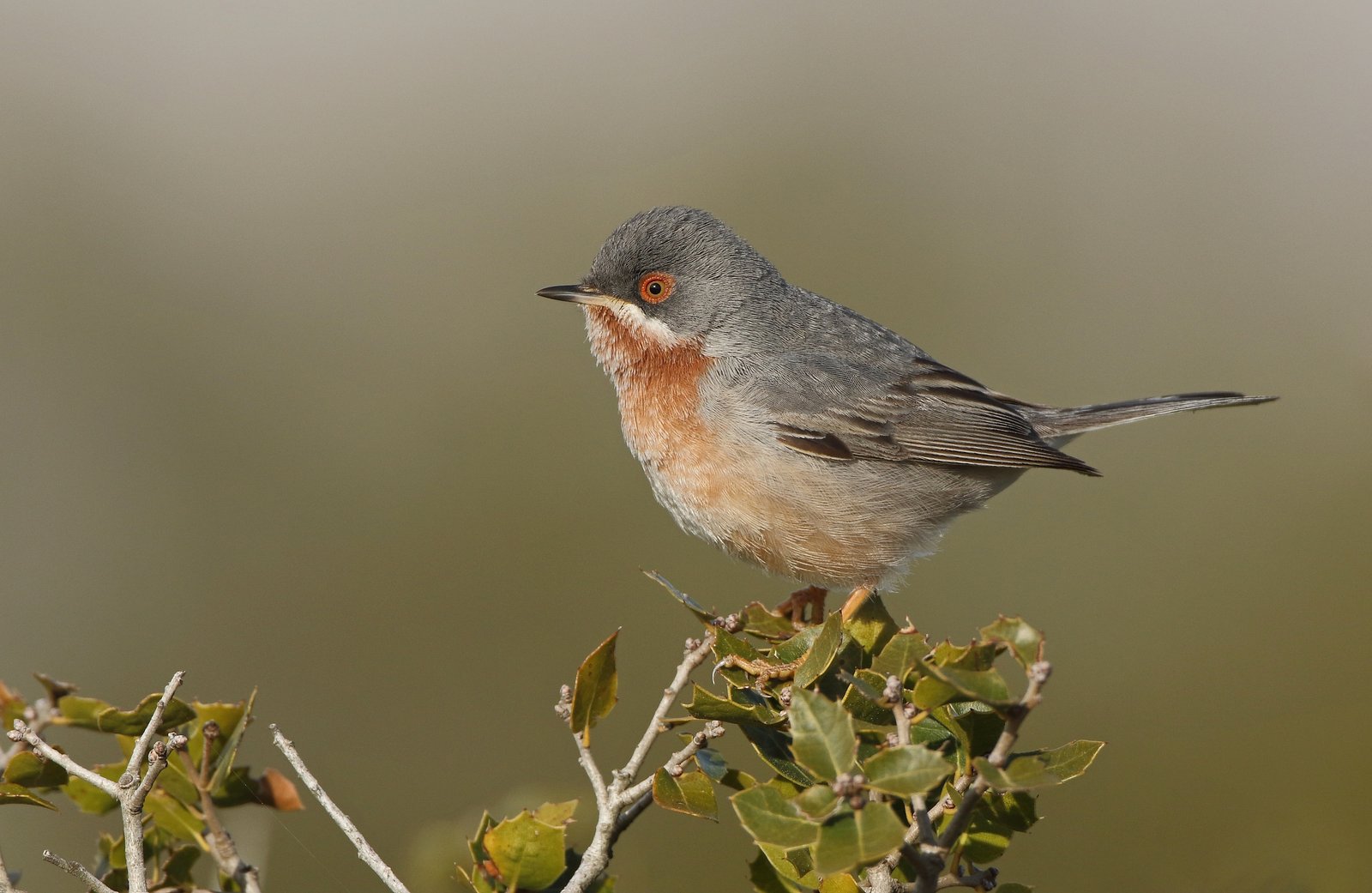
12–13 cm. Small, slim and long-tailed, with a red eye-ring. The male is dark slate-grey above and has a deep brick-red throat and breast sharply demarcated from a white belly. The white moustache is broad and conspicuous, especially in albistriata; in birds from southern Italy and Sicily the red is paler and the moustache narrower. The primary projection is long and the penultimate tail feather has a narrow white wedge along the shaft. The female is brownish grey above and off-white with a sandy-pink wash below.
Confusion species
Western Subalpine Warbler (Curruca iberiae) has a warmer orange-red extending to the belly without a border, a narrower moustache, a shorter primary projection and a square white tip on the penultimate tail feather; it overlaps in Tunisia and Libya. Moltoni's Warbler (Curruca subalpina) is pale salmon-pink and rattles. A female can resemble Lesser Whitethroat (Curruca curruca), which lacks the red eye-ring and has dark ear-coverts; Spectacled Warbler (Curruca conspicillata) has a white eye-ring and a rufous wing.
Habitat
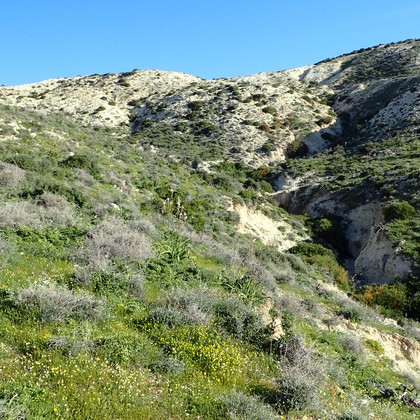
On migration in any scrub or clump of trees: coastal dunes, maquis and garrigue, wadis with acacia and tamarisk, oases, parks and gardens, even in mid-desert. Breeds in maquis, phrygana and open oak and pine woodland.
Where the bird is most at home, classified by the habitats of North Africa and the Middle East.


Range and movements
In spring a numerous passage migrant in Libya (especially Tripolitania and Cyrenaica) and Tunisia, through the Western Desert and the Nile Valley of Egypt, Sinai, Israel, Jordan, Lebanon and western Syria; less conspicuous in autumn. Scarce in north-west Saudi Arabia and Iraq, and a vagrant to Kuwait, Bahrain, the Emirates and Oman. Beyond the region it breeds in southern and central Italy, Sicily, the Balkans, Greece and western Turkey, and winters in the Sahel from Niger to Sudan.
- Summer visitor (c. Apr–Sep)
- Winter visitor (c. Oct–Mar)
- Passage (Mar–Apr, Oct–Nov)
- dark = core range, pale = thinly spread
How and when to look
Eilat in March and April, the scrub at Nizzana in the Negev and the coast of Cyrenaica around Benghazi are good places. A photograph of the spread tail or a recording of the call is the best evidence when Western Subalpine is a possibility.
Conservation status
Not globally threatened. The European breeding population is large and appears stable; on migration birds are vulnerable to trapping with nets and limesticks, which still occurs in parts of North Africa and the Levant.
Scientific name
Curruca cantillans | (Pallas, 1764)
Pallas described the species in 1764 as Motacilla (cantillans); because it was later moved to another genus, the author and year stand in brackets. The genus Curruca was introduced in 1802 by Bechstein. Curruca is Latin, the name of an unidentified small bird mentioned by the Roman poet Juvenal. cantillans is Latin for 'warbling', from canere 'to sing'. The specimen the first description was based on came from Italy.