All species › Passerines › Sylvia warblers › Eurasian Blackcap
Eurasian Blackcap | Sylvia atricapilla
Zwartkop | Curruca capirotada
In this region the Eurasian Blackcap is above all a winter visitor: large numbers from Europe spend the winter in the olive groves, gardens and maquis of the Maghreb and the Levant and in the Nile Delta. It also breeds in the forests of the Atlas and the Mediterranean zone, and migrates through the oases and along the desert edges.
Voice
The song starts with a fast, somewhat scratchy chatter and ends in a loud, clear fluty phrase; heard in the Maghreb from February to June, and softly from wintering birds from February. The call is a hard, repeated tak, like two pebbles knocked together; in winter the most frequently heard sound in gardens and olive groves.
Recording: David Darrell-Lambert — CC BY-NC 4.0 · converted to mono · xeno-canto
Identification
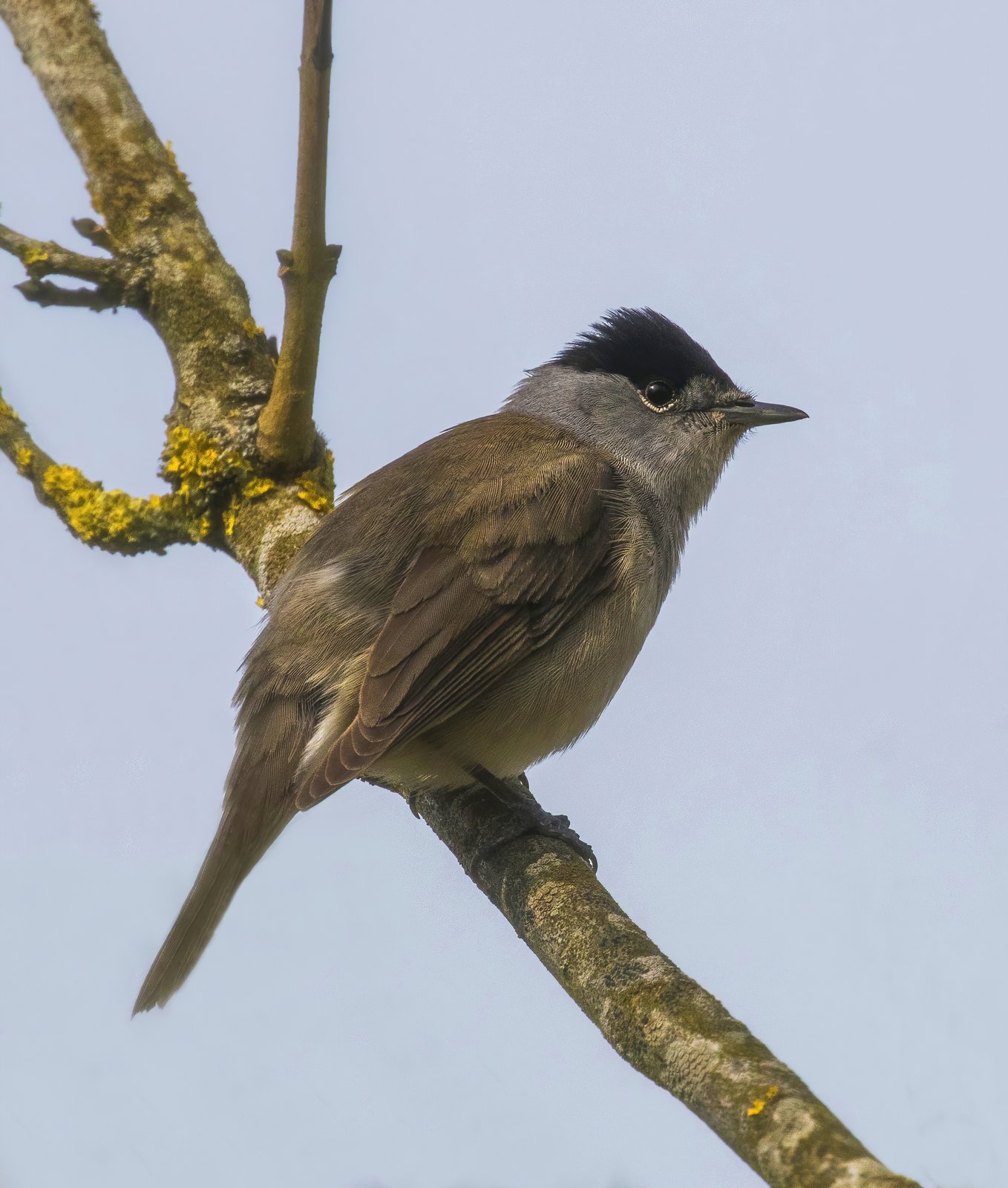
13–15 cm. A grey-brown warbler with a sharply defined cap and little other marking. The male has a glossy black cap reaching just above the eye, a grey nape and grey-brown upperparts; the underparts are pale grey. Females and juveniles have a rufous-brown cap and browner upperparts with warmer flanks; young males acquire a mixed brown-and-black cap in autumn. No white in the tail, no wing-bar, legs grey.
Confusion species
Sombre Tit (Poecile lugubris) also has a dark cap, but in addition a black throat and white cheeks. Males of Sardinian Warbler (Curruca melanocephala) and Ménétriés's Warbler (Curruca mystacea) have a black hood extending below the eye, a red eye-ring and white in the tail. Garden Warbler (Sylvia borin) has no cap. In Arabia and the Arava, Arabian Warbler (Curruca leucomelaena) also has a dark hood, but it is larger, the hood extends below the eye, and the long black tail has white sides.
Habitat
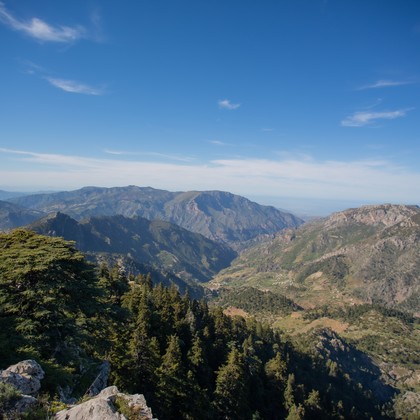
Breeds in moist broadleaved woodland and dense scrub: oak and cedar forest in the Atlas and the Rif, riparian woodland, dense maquis and large gardens. In winter in olive groves, citrus plantations, gardens and parks with berry-bearing shrubs and trees, and in maquis with mastic and myrtle; it then eats many olives, berries and figs. On passage also in oases and date-palm gardens.
Where the bird is most at home, classified by the habitats of North Africa and the Middle East.


Range and movements
Breeds year-round in northern Morocco (Rif, Middle and High Atlas, Atlantic lowlands), northern Algeria and Tunisia and the Jebel Akhdar in north-east Libya; in the Levant in small numbers in Lebanon and Syria. It formerly bred in Israel, but no nests have been found there in the last twenty years. In winter, from October to March, very common throughout the Maghreb, northern Libya, the Nile Delta and Nile Valley, Israel, Jordan, Lebanon and Syria, and in smaller numbers in Iraq, Saudi Arabia, Kuwait and the Gulf states. Passage migrant through the Sahara and Sinai; scarce in Yemen and Oman. Beyond the region it breeds from Macaronesia and Europe to western Siberia and Iran; many birds also winter in the Sahel and East Africa.
- Resident
- Summer visitor (c. Apr–Sep)
- Winter visitor (c. Oct–Mar)
- Passage (Mar–Apr, Oct–Nov)
- dark = core range, pale = thinly spread
How and when to look
In winter in almost any olive grove or city park in Morocco, Tunisia or Israel: listen for the hard tak and check berry bushes and olive trees. In the breeding season it is easy to hear in the cedar forests near Azrou and Ifrane in the Middle Atlas.
Conservation status
Not globally threatened; the species is increasing in Europe. In this region large numbers are illegally trapped with nets and limesticks on migration and in winter, including along the Egyptian coast and in Lebanon and Syria, where it is considered a delicacy. On Israel's national Red List it is listed as Data Deficient.
Scientific name
Sylvia atricapilla | (Linnaeus, 1758)
Linnaeus described the species in 1758 as Motacilla Atricapilla; because it was later moved to another genus, the author and year stand in brackets. The genus Sylvia was introduced in 1769 by Scopoli. Sylvia is Modern Latin silvia, a woodland nymph, related to silva 'wood'; the name passed to small songbirds of scrub and undergrowth. atricapilla is Latin, from ater 'black' and capillus 'hair of the head', after the male's black crown. The specimen the first description was based on came from Sweden.