All species › Passerines › Sylvia warblers › Barred Warbler
Barred Warbler | Curruca nisoria
Sperwergrasmus | Curruca gavilana
The Barred Warbler is the largest warbler of the region and a scarce, skulking passage migrant. It breeds in central and eastern Europe and Central Asia and winters in East Africa; its migration route runs mainly across the Arabian Peninsula in autumn and more through the Levant and Egypt in spring.

Voice
Migrants are usually silent. The call is a dry, rattling trrrrr, louder and longer than that of Lesser Whitethroat, and a hard chek. The song, sometimes heard in spring, resembles that of Garden Warbler but is shorter, choppier and interrupted by rattles.
Recording: Grzegorz Lorek — CC BY-NC-SA 4.0 · shortened to the first 60 s, mono · xeno-canto
Identification
15.5–17 cm. Large, heavy and long-tailed, with a thick bill. Adult males are grey above, with dark crescent-shaped bars across the entire underparts, a bright yellow iris, two narrow white wing-bars, white tertial fringes and white tips to the outer tail feathers; females are browner and less barred. First-year birds, the ones most often seen in autumn, are drab grey-brown with a dark eye and almost no barring, but with pale fringes to the wing-coverts and tertials and dark crescents on the undertail-coverts.
Confusion species
Young birds resemble a large Garden Warbler (Sylvia borin), but that has no pale wing fringes or scaled undertail-coverts and is smaller and shorter-tailed. Arabian Warbler (Curruca leucomelaena) and Eastern Orphean Warbler (Curruca crassirostris) have a dark hood and no barring. Red-backed Shrike (Lanius collurio), which often shares the same bushes on migration, is also barred in juvenile plumage but has a hooked bill, a dark ear-mask and a rufous tail.
Habitat
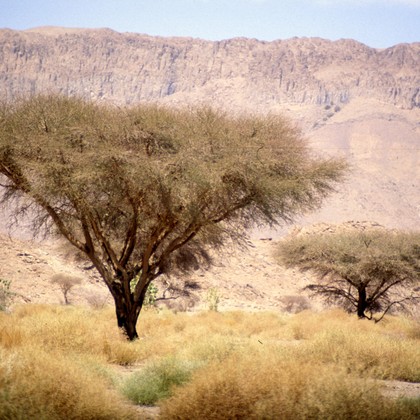
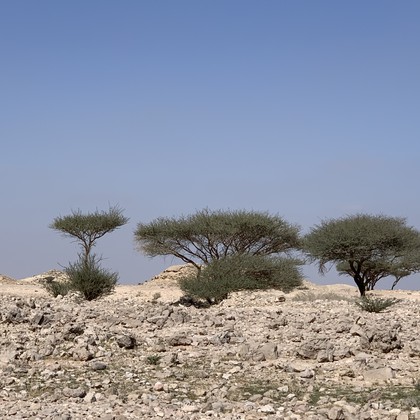
On passage in dense scrub and rank vegetation: acacia scrub, tamarisk and thorn bushes in wadis and on the Arabian plains, coastal vegetation, oases, gardens and hedges in farmland. Often stays hidden for long periods and moves slowly and clumsily through the branches. Eats insects and in autumn many berries.
Where the bird is most at home, classified by the habitats of North Africa and the Middle East.

Range and movements
Scarce passage migrant in the eastern part of the region. In autumn, from August to October, mainly across the Arabian Peninsula: in Kuwait, eastern Saudi Arabia, Bahrain, Qatar, the UAE, Oman and Yemen, and also in Iraq; in spring, late April and May, more in Egypt, Sinai, Israel, Jordan and Syria and less in Arabia. In Libya, Tunisia, Algeria and Morocco only a rare migrant or vagrant. Beyond the region it breeds from Germany and Scandinavia through eastern Europe, Turkey and the Caucasus to Central Asia and Mongolia, and winters in East Africa, from Sudan to Kenya and Tanzania.
- Summer visitor (c. Oct–Mar)
- Winter visitor (c. Apr–Sep)
- Passage (Mar–Apr, Oct–Nov)
- dark = core range, pale = thinly spread
How and when to look
Best chances in September in the coastal parks and gardens of Kuwait, the UAE and Oman, and in May at Eilat and in Sinai. Search dense acacias and thorn bushes for a large, heavy warbler with pale wing fringes and listen for the rattling call.
Conservation status
Not globally threatened. Declined in parts of Europe through the loss of scrub and hedgerows in farmland; in this region no specific threats are known, although trapping on migration also affects this species.
Scientific name
Curruca nisoria | (Bechstein, 1792) (GBIF: Sylvia nisoria)
Bechstein described the species in 1792 as Motacilla nisoria; because it was later moved to another genus, the author and year stand in brackets. The genus Curruca was introduced in 1802 by Bechstein. Curruca is Latin, the name of an unidentified small bird mentioned by the Roman poet Juvenal. nisoria is Medieval Latin for the Eurasian sparrowhawk, which is barred in the same way. The specimen the first description was based on came from central and northern Germany.