All species › Passerines › Sylvia warblers › Greater Whitethroat
Greater Whitethroat | Curruca communis
Grasmus | Curruca zarcera
The Greater Whitethroat is Europe's common long-tailed scrub warbler. In the region it breeds in the mountains of the Maghreb and the Levant, and in spring and autumn it passes in large numbers through the whole area on its way to and from the Sahel. A lively bird with a rufous wing and a white throat that flutters up singing above a bramble.

Voice
A short, hurried, scratchy chatter of two to three seconds, cher-witcher-witcher-chewee, sung from a prominent twig or in a display flight in which the bird flutters up at an angle and drops back singing. The call is a hard chek and a rasping, drawn-out chairr when agitated; migrants also give a soft wed-wed.
Recording: David Darrell-Lambert — CC BY-NC 4.0 · converted to mono · xeno-canto
Identification
13–15 cm. Slim and long-tailed, with a broad rufous wing panel formed by wide fringes to the secondaries and tertials. The throat is bright white, the legs pale straw to flesh, the tail has white outer feathers. The male has an ash-grey head with a narrow white eye-ring and a pink wash on the breast; females and young are browner-headed and duller buff below. The eastern form icterops in the Levant and Iraq is greyer above, with a less warm wing panel. Often raises the crown feathers, giving an angular head.
Confusion species
Lesser Whitethroat (Curruca curruca) has dark grey legs, a plain grey-brown wing without rufous and dark ear-coverts against a grey crown. Spectacled Warbler (Curruca conspicillata) is smaller and shorter-winged, with dark lores, a broad white eye-ring and an even brighter rufous wing panel. Tristram's Warbler (Curruca deserticola) has orange-brown underparts down to the belly. Barred Warbler (Curruca nisoria) is much bulkier, with a yellow iris and pale wing bars.
Habitat
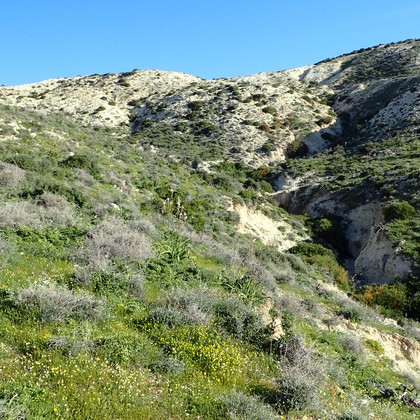
Open country with dense low scrub: maquis, brambles and thorn bushes along fields, hedges, hillside scrub to over 2000 m in the Atlas and Lebanon, and rank edges of orchards. On passage in any scrub, gardens, oases, palm groves, tamarisks and even small bushes in the middle of the desert.
Where the bird is most at home, classified by the habitats of North Africa and the Middle East.


Range and movements
Breeds in the Maghreb from northern Morocco and the Atlas through northern Algeria to northern Tunisia, and in north-east Libya (Jebel Akhdar in Cyrenaica). In the east (form icterops) in Lebanon, Syria, northern Israel (Golan, Hermon), north-west Jordan and northern Iraq (Kurdistan). On passage throughout the region: in large numbers across the Sahara, Egypt and the Nile valley, Sinai and Israel, and through all of Arabia to Yemen and Oman, in spring mainly in April and May. Winters in the Sahel and East Africa; in the region at most an odd wintering bird in Yemen. Beyond the region it breeds across almost all of Europe, Turkey and western and Central Asia.
- Summer visitor (c. Apr–Sep)
- Winter visitor (c. Oct–Mar)
- Passage (Mar–Apr, Oct–Nov)
- dark = core range, pale = thinly spread
How and when to look
In May in the scrub of the Middle Atlas or the mountains of Lebanon, where singing males fly up from the bushes. On passage in April–May and September it can be found in every bush around Eilat, in the oases of the Western Desert and in the gardens of the Gulf states; listen for the hard chek.
Conservation status
Not globally threatened. Crashed in Europe after the great Sahel drought of the late 1960s and has since largely recovered. In the region locally declining through loss of hedges and scrub and agricultural intensification; on passage vulnerable to bird trapping along the Libyan and Egyptian coasts.
Scientific name
Curruca communis | (Latham, 1787) (GBIF: Sylvia communis)
Latham described the species in 1787 as Sylvia communis; because it was later moved to another genus, the author and year stand in brackets. The genus Curruca was introduced in 1802 by Bechstein. Curruca is Latin, the name of an unidentified small bird mentioned by the Roman poet Juvenal. communis is Latin for 'common'. The specimen the first description was based on came from Kent, England.