All species › Cranes, rails and allies › Rails and crakes › Eurasian Coot
Eurasian Coot | Fulica atra
Meerkoet | Focha común
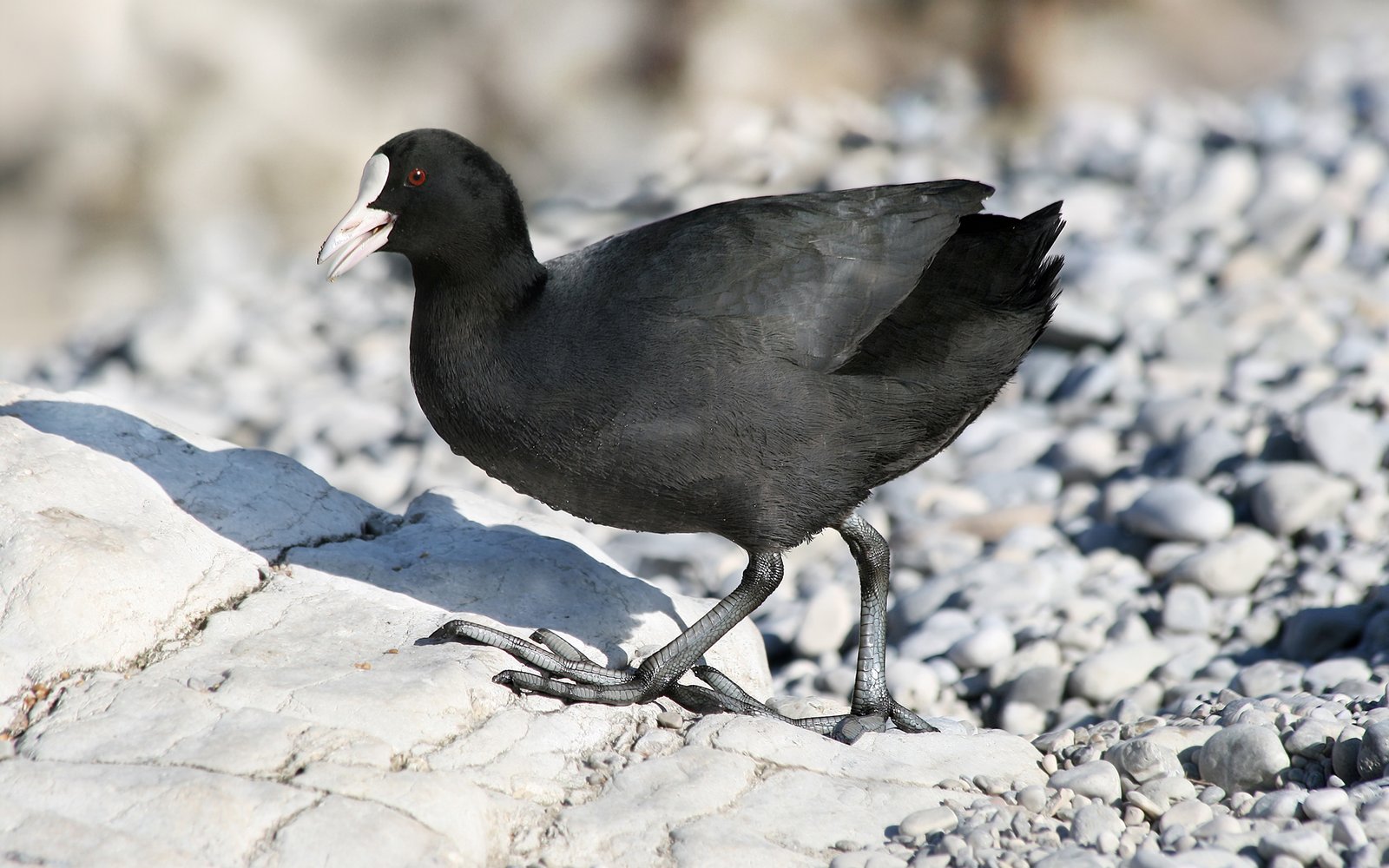
A compact, all-black waterbird with a gleaming white bill and frontal shield, which spends the winter in huge numbers on the lakes of North Africa, the Nile Delta and Iraq. On Ichkeul in Tunisia and the Egyptian delta lakes tens of thousands gather; in Arabia it is a scarcer but increasing visitor.
Voice
A loud, short kut or pitt and an explosive, high pix; also hoarse, trumpeting calls. Winter flocks often keep up a constant babble of calls and splashing during squabbles.
Recording: Dag Österlund — CC BY-NC-SA 4.0 · converted to mono · xeno-canto
Identification
Entirely dull black, with a slightly glossier head, a white bill and a white frontal shield; eye red. Legs greyish-green with broad lobed toes. Swims low with a nodding head and dives with a little jump. Juveniles are greyish-brown with a white throat and foreneck and a smaller shield. In flight a narrow white trailing edge to the inner wing.
Confusion species
Red-knobbed Coot (Fulica cristata), in the Maghreb, has two red knobs above the shield (small and hard to see outside the breeding season), a shield that ends rounded rather than pointed into the feathering, no white wing edge and a slightly longer neck. Eurasian Moorhen (Gallinula chloropus) is smaller, with a red shield and a white flank line. Juveniles may recall a young Great Crested Grebe (Podiceps cristatus), which has a dagger-shaped bill.
Habitat
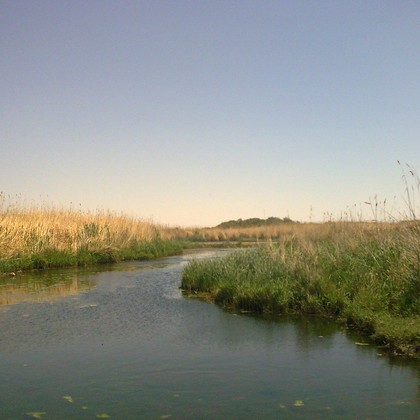
Open fresh and brackish water with marginal vegetation and water plants: lakes, reservoirs, coastal lagoons, fish ponds and the marshes of southern Iraq. In winter in large flocks on open lakes and lagoons, also on sheltered bays and harbours. Feeds on water plants brought up by diving, but also grazes on banks.
Where the bird is most at home, classified by the habitats of North Africa and the Middle East.


Range and movements
Breeds in Morocco, northern Algeria and Tunisia, in the Nile Delta, in the Levant and Syria and in Iraq; on the Arabian Peninsula a local breeder at reservoirs and sewage ponds, including in Saudi Arabia and the United Arab Emirates. In winter common throughout the Maghreb, with especially large concentrations on Ichkeul and the Tunisian sebkhas, on the Egyptian delta lakes Manzala, Burullus and Idku, in Israel and in the Iraqi marshes. Scarce in Libya, Kuwait, the Gulf states, Saudi Arabia and Oman, rare in Yemen. Elsewhere from Europe and north-west Africa to East Asia, and in Australia and New Guinea.
- Resident
- Summer visitor (c. Apr–Sep)
- Winter visitor (c. Oct–Mar)
- Passage (Mar–Apr, Oct–Nov)
- dark = core range, pale = thinly spread
How and when to look
In December and January the largest numbers are on Ichkeul and the delta lakes of Egypt, often with big flocks of ducks. In Morocco the lakes of the Middle Atlas and Merja Zerga are ideal for comparing Eurasian and Red-Knobbed Coots side by side: note the shape of the shield and the lack of a white wing edge in Red-Knobbed.
Conservation status
Not threatened. In the region it is hunted on many wetlands, especially in the Nile Delta and Iraq. Drought, drainage and pollution of lakes and lagoons have strong local effects, while reservoirs offer it new opportunities elsewhere.
Scientific name
Fulica atra | Linnaeus, 1758
Linnaeus described the species in 1758 and placed it straight away in the genus where it still stands. He introduced the genus Fulica in that same work. Fulica is the Latin word for a coot. atra is Latin for 'black', after the dark plumage. The specimen the first description was based on came from Sweden.