All species › Cranes, rails and allies › Rails and crakes › Western Swamphen
Western Swamphen | Porphyrio porphyrio
Purperkoet | Calamón común
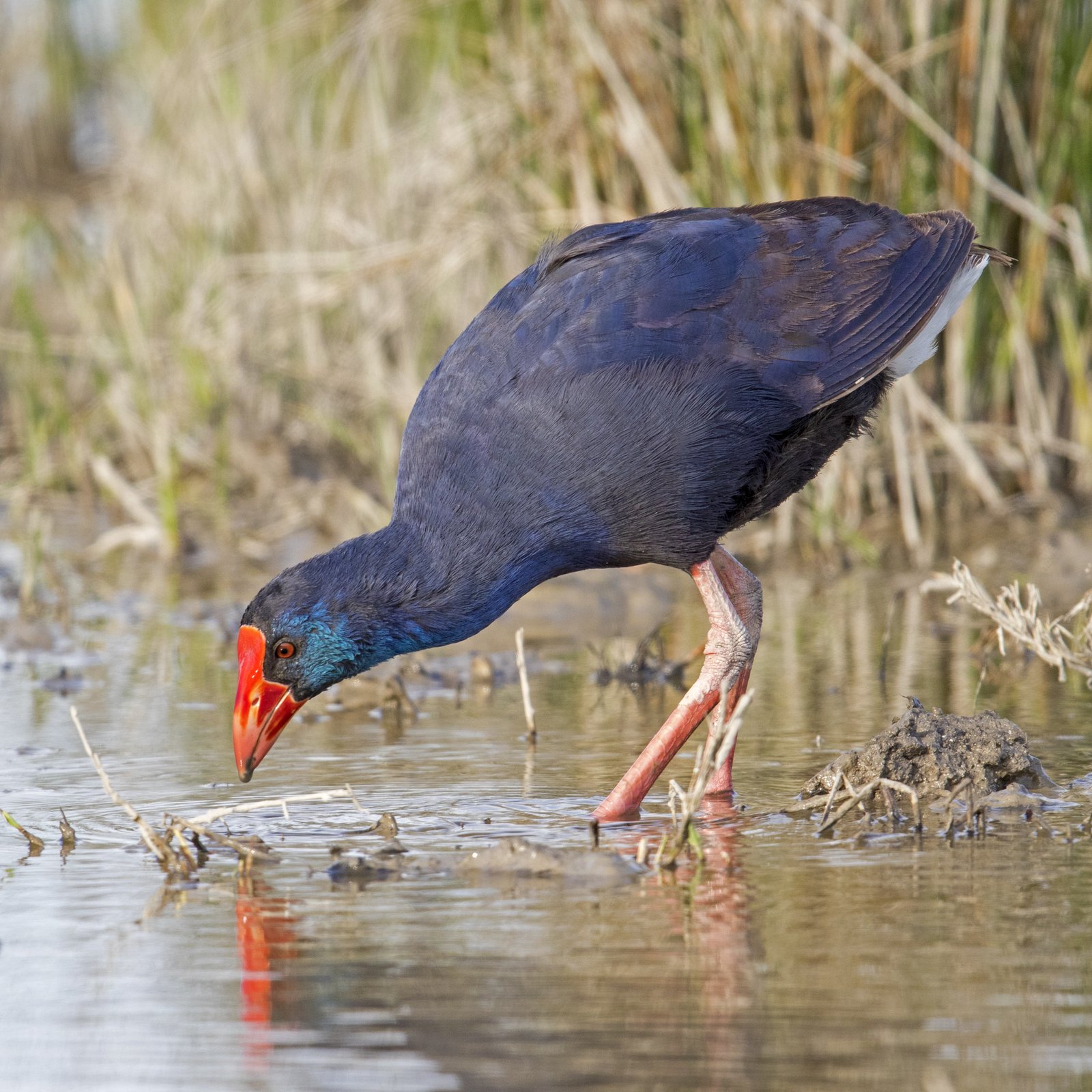
A large, colourful rail, like a giant purple-blue moorhen with a bright red bill, living locally in the reed marshes of the Maghreb, the Nile Delta and Iraq. Birds in the region belong to three clearly different forms, which some authorities treat as separate species.
Voice
Loud and varied: a nasal, trumpeting kweeh-kweeh, cackling and a deep, groaning grunt, often in duet. Loudest at dusk; at a distance it recalls bleating goats.
Recording: Thierry THOMAS — CC BY-NC-SA 4.0 · converted to mono · xeno-canto
Identification
Large and heavy, with a massive red bill and frontal shield, long red legs with very long toes and a white undertail that flashes when it flicks its tail. In the Maghreb (nominate porphyrio) entirely deep purple-blue with a violet gloss. In Egypt (madagascariensis) a greenish to bronze back and blue underparts. In Iraq and the east (caspius/seistanicus, the grey-headed group) a pale grey-blue head and neck and lighter blue tones. Juveniles are duller greyish-blue with a dark bill. Flies heavily with dangling legs.
Confusion species
Hardly confusable thanks to its size and colour. Eurasian Moorhen (Gallinula chloropus) is much smaller and slaty, with a red shield and yellow bill tip and a white flank line. Eurasian Coot (Fulica atra) is black with a white bill. Escaped or feral swamphens of other forms sometimes turn up: with a bird outside the known range, check head and back colour.
Habitat
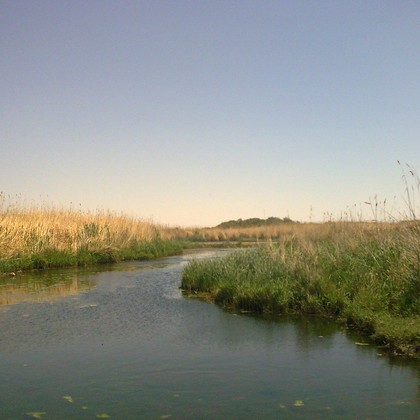
Extensive, dense reedbeds and reedmace marshes with open patches and shallow water, often at the edge of lakes, canals and rice fields. Emerges to graze on banks and among young rice; holds a stem in one foot and eats it as if from a hand.
Where the bird is most at home, classified by the habitats of North Africa and the Middle East.

Range and movements
Morocco: locally in the marshes of the Atlantic coastal plain (Merja Zerga, Sidi Bou Ghaba, Bas-Loukkos) and at the Moulouya mouth. Algeria: in the north-east, around El Kala (Lac Tonga) and Guerbes. Tunisia: rare and irregular, mainly in the north. Egypt: resident in the Nile Delta and Faiyum (form madagascariensis). Iraq: common in the southern marshes, along the Euphrates and Tigris; rare in Syria. On the Arabian Peninsula a rare wanderer, including in Kuwait and the Gulf states; birds in the Emirates may also be escapes. Outside the region in southern Europe and Sardinia, sub-Saharan Africa and Madagascar, and from the Caspian Sea to South-East Asia.
- Resident
- Summer visitor (c. Oct–Mar)
- Winter visitor (c. Apr–Sep)
- Passage (Mar–Apr, Oct–Nov)
- dark = core range, pale = thinly spread
How and when to look
In Morocco, the Bas-Loukkos marshes near Larache and the Moulouya mouth are the best sites: scan the reed edges at dawn. In Egypt it is often found simply along the canals and in the rice fields of the Nile Delta. A swamphen grazing on an open bank gives itself away by the white undertail flicked up at every step.
Conservation status
Not globally threatened. In the region it is declining in the Maghreb and the Nile Delta through drainage, hunting and the loss of reed marshes; in Iraq the population recovered with the partial reflooding of the marshes after 2003. The taxonomy is in flux: many lists split the African and Asian forms as separate species.
Scientific name
Porphyrio porphyrio | (Linnaeus, 1758)
Linnaeus described the species in 1758 as Fulica Porphyrio; because it was later moved to another genus, the author and year stand in brackets. The genus Porphyrio was introduced in 1760 by Brisson. Porphyrio is Latin, from the Greek porphuriōn, the classical authors' name for the swamphen, from porphura 'purple'. The specific epithet repeats the genus name. The specimen the first description was based on came from the lands around the western Mediterranean.