All species › Cranes, rails and allies › Rails and crakes › Eurasian Moorhen
Eurasian Moorhen | Gallinula chloropus
Waterhoen | Gallineta común
The commonest rail in the region, found almost anywhere with fresh water and some waterside vegetation: from the canals of the Nile Delta to a pool in an oasis or a sewage works in the middle of Arabia. It has increased considerably in the region with the building of reservoirs, irrigation schemes and sewage ponds.
Voice
A sudden, loud, bubbling kurruk or krrrek, often from waterside cover, and a sharp kik-kik-kik when alarmed. At night in the breeding season sometimes a repeated kek in flight.
Recording: Roger Ahlman — CC BY-NC-SA 4.0 · converted to mono · xeno-canto
Identification
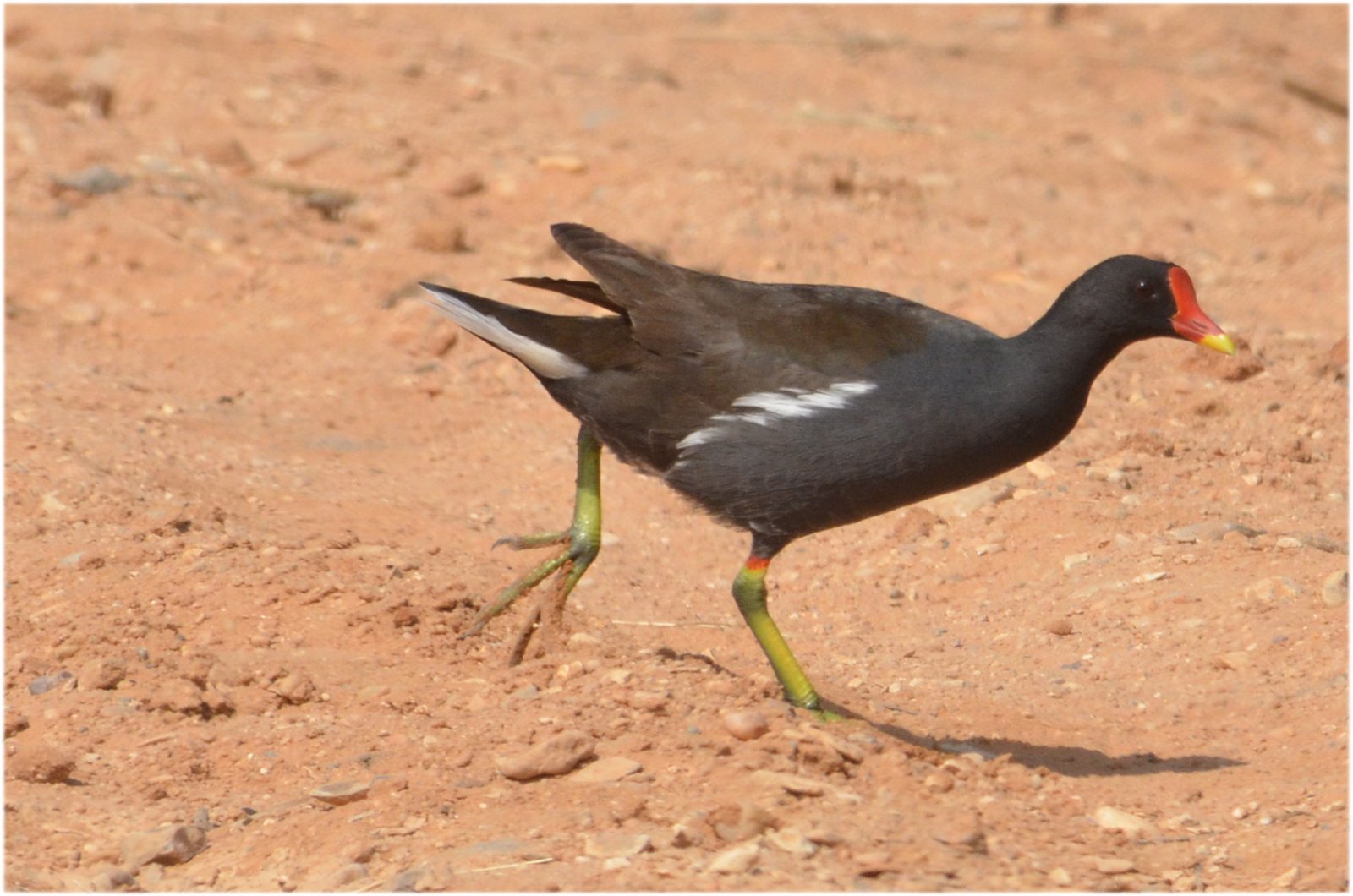
Slaty blackish with an olive-brown back, a red frontal shield and a red bill with a yellow tip. A white line along the flank and white undertail coverts with a black centre, conspicuous when it flicks its tail. Legs yellowish-green with a red 'garter' and long, unlobed toes. Juveniles are greyish-brown with a pale throat, a whitish flank line and a dull greenish bill.
Confusion species
Eurasian Coot (Fulica atra) is larger and all black, with a white bill and white frontal shield. A juvenile moorhen may be confused with Water Rail (Rallus aquaticus), which has a long bill and barred flanks, or with Spotted Crake (Porzana porzana), which is smaller and spotted white. White-breasted Waterhen (Amaurornis phoenicurus) has a white face and breast.
Habitat
All kinds of fresh water with marginal vegetation: canals, irrigation ditches, riverbanks, pools in oases and parks, fish ponds, reservoirs and sewage ponds, also in towns. Feeds while swimming and walking on banks and lawns.
Where the bird is most at home, classified by the habitats of North Africa and the Middle East.



Range and movements
Resident in Morocco, northern Algeria, Tunisia and coastal Libya, in the Nile Delta, valley and Faiyum and in the oases of Egypt, in the Levant, Syria and Iraq. On the Arabian Peninsula locally resident, greatly increased thanks to artificial water: in Saudi Arabia (including around Riyadh and in Asir), Yemen, Oman, the United Arab Emirates, Bahrain, Qatar and Kuwait. In winter birds from Europe join them, mainly in the north. Elsewhere almost throughout the Old World, from Europe and Africa to South and East Asia.
- Resident
- Summer visitor (c. Apr–Sep)
- Winter visitor (c. Oct–Mar)
- Passage (Mar–Apr, Oct–Nov)
- dark = core range, pale = thinly spread
How and when to look
Any sewage works, park pond or oasis with a fringe of reeds may hold a moorhen. In the Arabian desert it is a good gauge of the water: where it breeds, the water is permanent. Watch for the juveniles in summer, which look brown and are often mistaken for other rails.
Conservation status
Not threatened and in many places in the region increasing thanks to irrigation and artificial water. Locally it suffers from pollution and the filling-in of canals and ditches in the Nile Delta.
Scientific name
Gallinula chloropus | (Linnaeus, 1758)
Linnaeus described the species in 1758 as Fulica Chloropus; because it was later moved to another genus, the author and year stand in brackets. The genus Gallinula was introduced in 1760 by Brisson. Gallinula is Latin for 'little hen', a diminutive of gallina 'hen'. chloropus combines Greek khlōros 'green' and pous 'foot', for the greenish legs. The specimen the first description was based on came from England.