All species › Nightjars › Nightjars › Eurasian Nightjar
Eurasian Nightjar | Caprimulgus europaeus
Nachtzwaluw | Chotacabras europeo
The familiar nightjar of Europe and Asia, in the region a breeder in the montane woodlands of the Maghreb and the Levant and otherwise mainly a migrant that can turn up anywhere on its way to and from Africa, from Sinai to the Gulf states.
Voice
A sustained, dry churr, errrrrrrrr, lasting for minutes and shifting pitch every few seconds. Starts shortly after sunset. When flushed a nasal coo-ic, often with wing-clapping. Migrants are usually silent.
Recording: Benjamin Drillat — CC BY-NC-SA 4.0 · converted to mono · xeno-canto
Identification
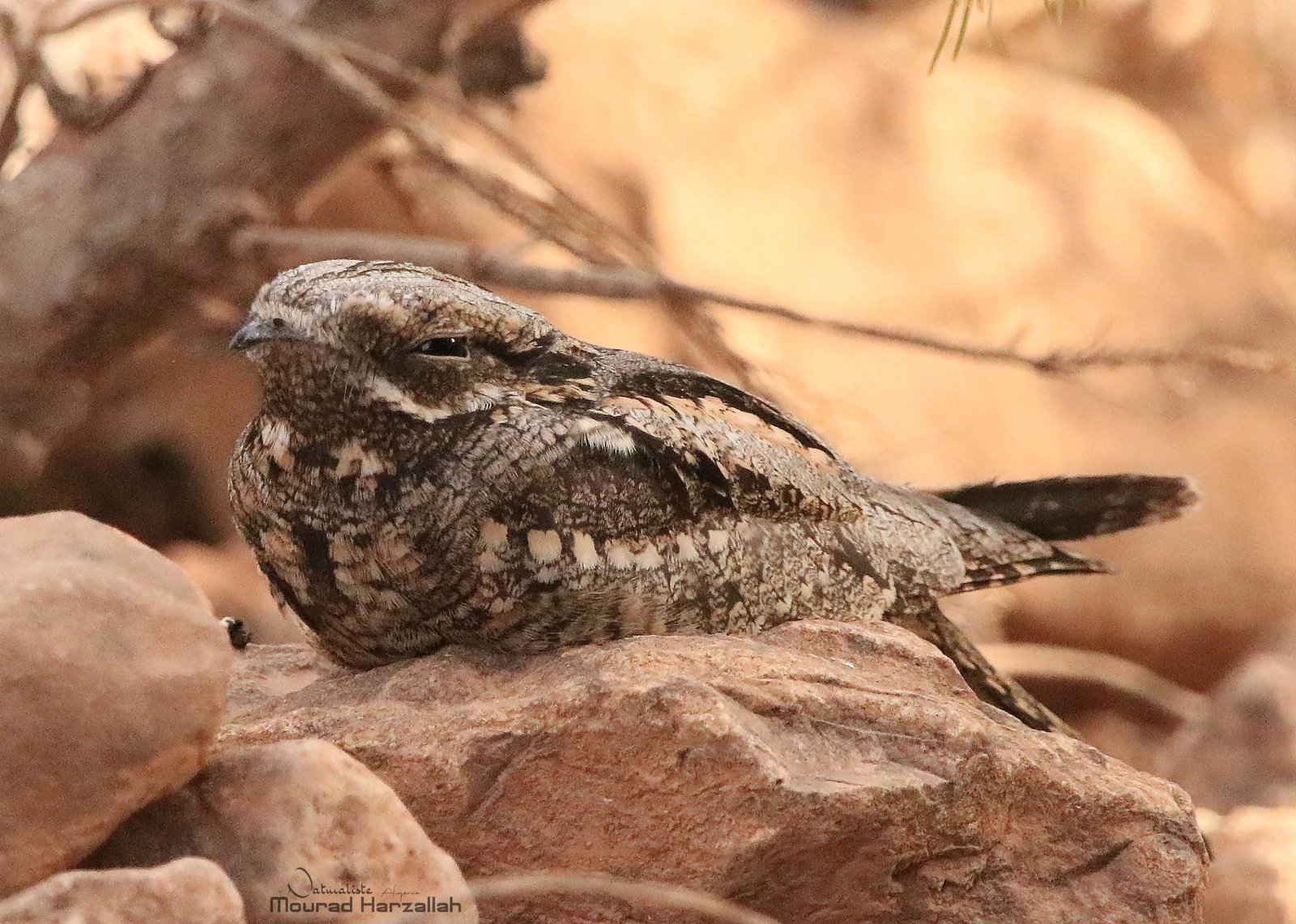
Long-winged and long-tailed, with a flat head, large dark eyes and a tiny bill over a wide gape. Grey-brown with fine vermiculation, a dark line across the scapulars and a pale moustachial stripe. The male has white spots on the three outer primaries and white tail corners; the female lacks them. The eastern subspecies passing through Arabia (unwini, plumipes) are paler and greyer than European birds. Flight falcon-like, rocking and silent.
Confusion species
Red-necked Nightjar (Caprimulgus ruficollis) is larger and paler, with a rufous collar and a large white throat patch. Egyptian Nightjar (Caprimulgus aegyptius) is uniformly sandy, without a dark scapular line and with little white. Nubian Nightjar (Caprimulgus nubicus) is smaller, with a rusty nape band and large white wing spots in both sexes.
Habitat
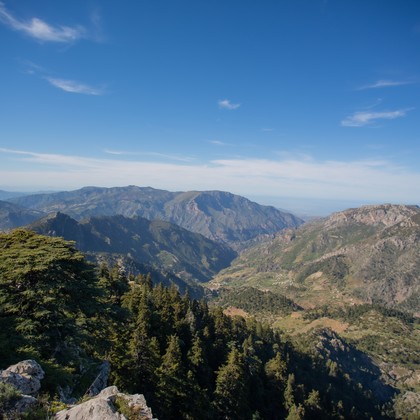
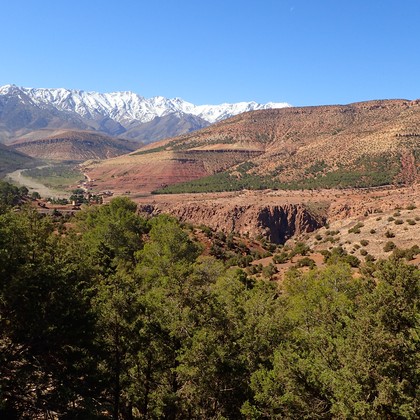
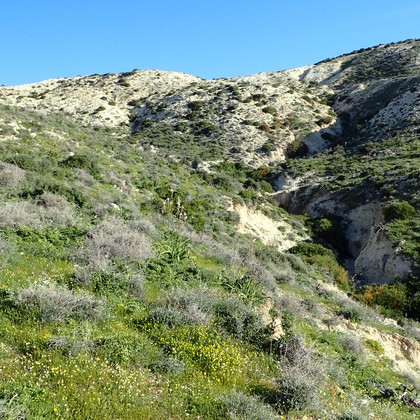
Breeds in open montane woodland of cedar, oak and pine with clearings, felled areas and heath, in the Atlas to above 2,000 m, and in the Levant in garrigue and open oak woodland. On migration in all kinds of landscape: oases, palm groves, parks, scrub in wadis and even bare desert, where it rests by day on the ground under a bush.
Where the bird is most at home, classified by the habitats of North Africa and the Middle East.
Range and movements
In Morocco it breeds in the Rif and the Middle and High Atlas, in northern Algeria in the Tell Atlas and the Aurès, in northern Tunisia and in small numbers in north-east Libya (Jebel Akhdar). In the east it breeds in northern Israel (Galilee, Carmel, Golan), Lebanon, western Syria, northern Jordan and the mountains of Kurdistan in northern Iraq. On migration it occurs throughout the region: numerous in Egypt and Sinai, through the Jordan Valley and the Arava, and scattered across the Arabian Peninsula from Kuwait to Oman and Yemen, mainly in April–May and September–October. Beyond the region it breeds from Europe to Mongolia and winters in Africa south of the Sahara.
- Summer visitor (c. Apr–Sep)
- Winter visitor (c. Oct–Mar)
- Passage (Mar–Apr, Oct–Nov)
- dark = core range, pale = thinly spread
How and when to look
In the cedar forests around Ifrane and Azrou in the Middle Atlas it churrs along the forest edges on June evenings. On migration look for it resting by day in the palm groves and bushes around Eilat and in the Sinai oases; in Arabia parks and coastal woods are good on an early-morning walk.
Conservation status
Not globally threatened, but strongly declined in Europe. In the region the breeding populations are small and vulnerable to the loss and fragmentation of montane woodland, overgrazing and road deaths; for migrants the decline of large insects is a problem.
Scientific name
Caprimulgus europaeus | Linnaeus, 1758
Linnaeus described the species in 1758 and placed it straight away in the genus where it still stands. He introduced the genus Caprimulgus in that same work. Caprimulgus is Latin, from capra 'nanny goat' and mulgere 'to milk', after the old belief that nightjars suckled goats at night. europaeus is Latin for 'European'. The specimen the first description was based on came from Sweden.