All species › Nightjars › Nightjars › Montane Nightjar
Montane Nightjar | Caprimulgus poliocephalus
Ethiopische nachtzwaluw | Chotacabras abisinio
A small, dark montane nightjar of the East African highlands, resident in the region in the juniper woodlands and terraces of the Asir mountains and the Yemen highlands. Its high, plaintive whistle is a familiar night sound above the mountain villages.

Voice
A high, piercing and rather plaintive whistle, pee-yoo-wirr, often repeated at short intervals, especially at dusk and by moonlight, from a branch, rock or roof. Most often heard from March to May.
Recording: David Moyer — CC BY-NC-SA 4.0 · converted to mono · xeno-canto
Identification
Fairly small and dark, with grey-brown, heavily speckled and spotted upperparts, an indistinct rufous nape band and a dark breast with fine pale spots; a white patch on each side of the throat. The male has white spots on the four outer primaries and much white in the tail: the outer tail feathers are largely white. In the female the wing spots are paler and the white in the tail more restricted and duller.
Confusion species
Eurasian Nightjar (Caprimulgus europaeus), which passes through the mountains on migration, is larger and longer-tailed, with a dark scapular line, and the male has white only in the tail corners. Plain Nightjar (Caprimulgus inornatus) of the lower slopes is plainer and paler brown, without bold spotting, and has less white in the tail. Nubian Nightjar (Caprimulgus nubicus) lives in the hot lowlands of the Tihama.
Habitat
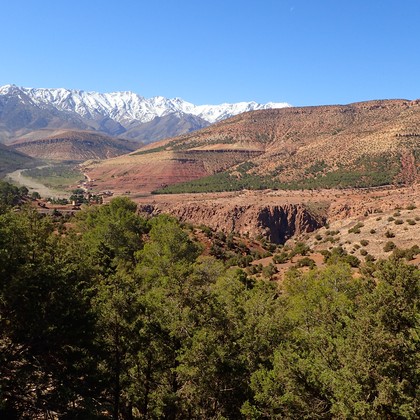
Montane woodland of juniper and acacia, steep slopes with bushes and rocks, terraced fields and orchards around mountain villages, between about 1,200 and 3,000 m. Hunts over clearings, fields and roads and roosts by day on the ground in the leaf litter under trees.
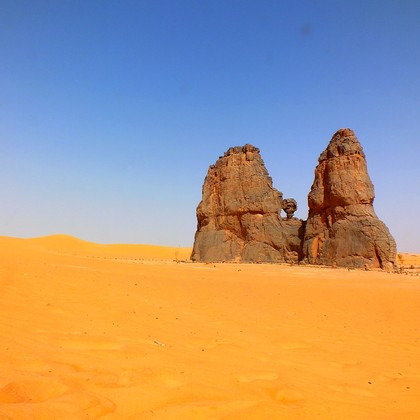
Where the bird is most at home, classified by the habitats of North Africa and the Middle East.

Range and movements
In the region only in south-west Arabia: in Saudi Arabia on the western slopes and plateaus of the Asir mountains, from the Yemen border via Abha and Al Baha north to Al Shafa near Taif, known since its discovery in 1982 and locally common; in Yemen widespread in the western and central highlands. Beyond the region it occurs in the highlands of Ethiopia, Kenya and Tanzania.
- Resident
- Summer visitor (c. Apr–Sep)
- Winter visitor (c. Oct–Mar)
- Passage (Mar–Apr, Oct–Nov)
- dark = core range, pale = thinly spread
How and when to look
The Raydah escarpment near Abha and the juniper woods around Tanoumah are the known sites; birds are present all year but most active in spring. Go to a viewpoint at the forest edge at sunset and listen for the high whistles.
Conservation status
Not globally threatened. In Arabia it is confined to the highlands, where juniper woodland is declining through tree die-back, grazing, felling and the spread of buildings and roads; little recent information exists on the Yemeni population.
Scientific name
Caprimulgus poliocephalus | Rüppell, 1840
Rüppell described the species in 1840 and placed it straight away in the genus where it still stands. The genus Caprimulgus was introduced in 1758 by Linnaeus. Caprimulgus is Latin, from capra 'nanny goat' and mulgere 'to milk', after the old belief that nightjars suckled goats at night. poliocephalus comes from Greek polios, 'grey', and kephalē, 'head': 'grey-headed'. The specimen the first description was based on came from Kulla, Ethiopia.