All species › Passerines › Finches › European Greenfinch
European Greenfinch | Chloris chloris
Groenling | Verderón común
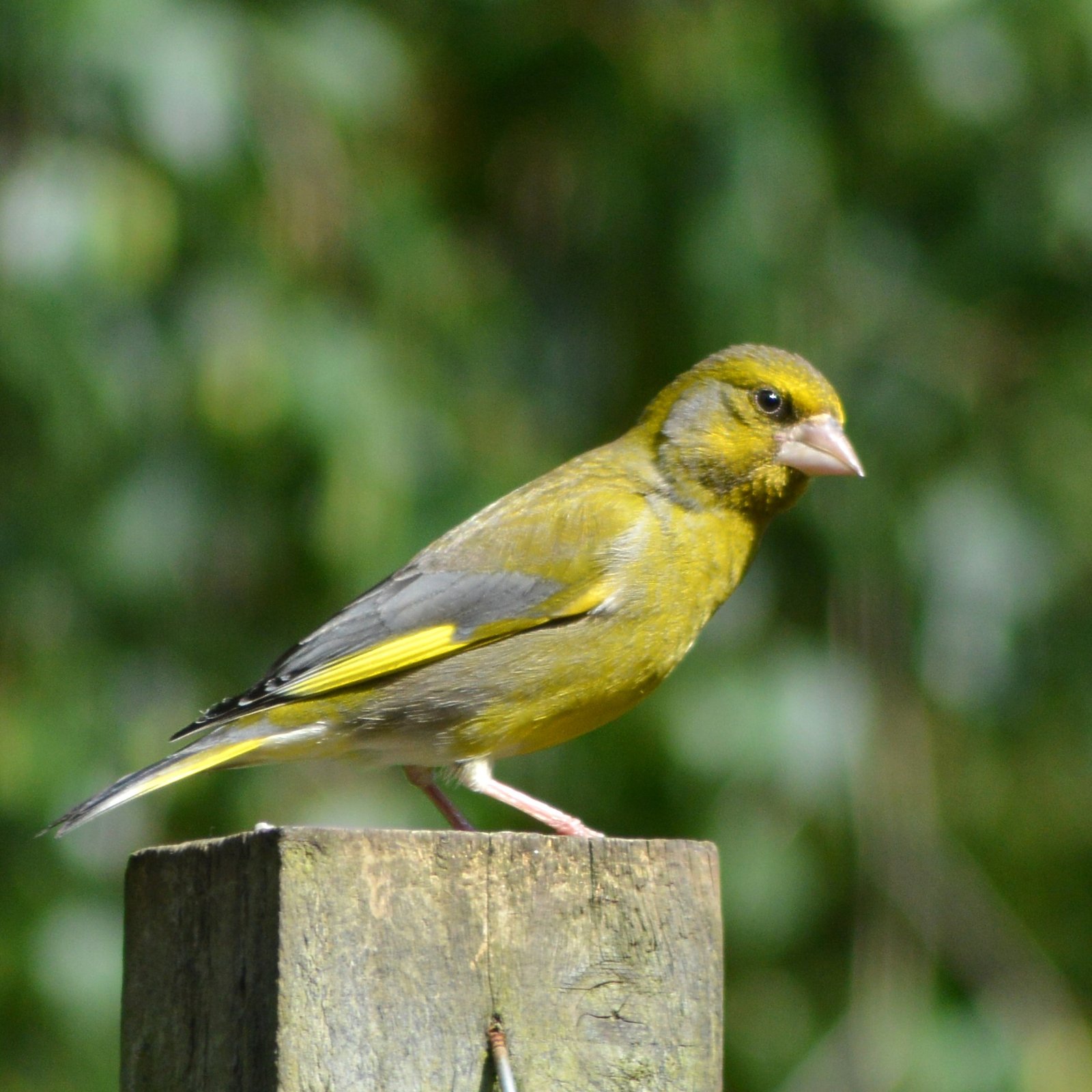
European Greenfinch is a stocky, olive-green finch with yellow wing and tail patches, in the region a common breeder in gardens, orchards and woodland edges of the Maghreb and the Levant. In winter birds from the north and east also arrive.
Voice
The song has two parts: a fast, jingling trill from a treetop or in a slow, bat-like song flight, and a drawn-out, nasal, wheezing dzweee. The flight call is a fast, rattling chup-chup-chup.
Recording: Stanislas Wroza — CC BY-NC-SA 4.0 · shortened to the first 60 s, mono · xeno-canto
Identification
14.5–16 cm, stocky, with a large head, a short forked tail and a thick, pale pink conical bill. The male is olive-green with a greyish wash on the cheek and wing, a yellower breast and rump, bright yellow edges to the primaries and yellow patches at the tail base; in flight those yellow patches are the best feature. The female is greyer green and faintly streaked on the back, with less yellow. Juveniles are brownish and clearly streaked, but already show yellow in wing and tail. Males in the Maghreb are often strikingly yellow to orange-yellow below; those of the Levant are smaller and paler.
Confusion species
Eurasian Siskin (Spinus spinus), a winter visitor to the north of the region, is much smaller, heavily streaked on the flanks, with a thin pointed bill and a yellow bar across the wing. European Serin (Serinus serinus) and Syrian Serin (Serinus syriacus) are smaller, with a tiny bill and, in European Serin, heavily streaked flanks. Juvenile greenfinches can recall a female House Sparrow, but the yellow in wing and tail settles it.
Habitat
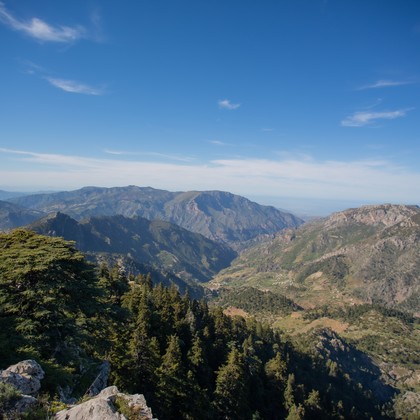
Gardens, parks, orchards, olive groves, tree lines and open woodland with shrubs, from the coast up into the middle mountains of the Atlas and the Levant; also cypresses and ornamental trees in villages and towns. In winter in flocks on fields, fallow land and seed-rich weedy ground. It eats mainly seeds, including sunflower and crucifer seeds.
Where the bird is most at home, classified by the habitats of North Africa and the Middle East.


Range and movements
Breeds in Morocco, northern Algeria, northern Tunisia, north-western Libya and Cyrenaica, and in the Levant: Israel, Samaria and Judea, Lebanon, north-western Jordan and western Syria, east to northern Iraq. In winter scarce in Egypt (mainly the north coast and Nile Delta) and central and southern Iraq; a rare winter visitor to Kuwait and northern Saudi Arabia, and a vagrant further south. Beyond the region across almost all of Europe, Turkey, the Caucasus and Iran to Central Asia.
- Resident
- Summer visitor (c. Oct–Mar)
- dark = core range, pale = thinly spread
How and when to look
In the Maghreb and the Levant it can be found all year in parks and gardens with tall trees; in spring the wheezing dzweee gives away singing males. In winter check finch flocks on fields and fallow land.
Conservation status
Not threatened. In parts of Europe it has declined sharply because of the parasite Trichomonas; little is known of trends in the region, but it is common. It is also trapped for the cage-bird trade in the Maghreb and the Levant.
Scientific name
Chloris chloris | (Linnaeus, 1758)
Linnaeus described the species in 1758 as Loxia chloris; because it was later moved to another genus, the author and year stand in brackets. The genus Chloris was introduced in 1800 by Cuvier, GLCFD. Chloris is the Ancient Greek name for this bird, khloris, from khloros 'green'. The specific name repeats the genus name. The specimen the first description was based on came from Sweden.