All species › Gannets and cormorants › Cormorants › European Shag
European Shag | Gulosus aristotelis
Kuifaalscholver | Cormorán moñudo
A slim, dark marine cormorant of rocky coasts and islands, never far from salt water. In the region it breeds along the coasts of Morocco, Algeria and Tunisia, with its own subspecies on Morocco's Atlantic coast; further east it is rare.

Voice
Almost silent away from the colony. At the nest males give a clicking, coughing ark-ark and hissing sounds; females only hiss.
Recording: Stanislas Wroza — CC BY-NC-SA 4.0 · converted to mono · xeno-canto
Identification
Clearly smaller and slimmer than Great Cormorant, with a shorter tail and a steep, almost angular forehead above a thin, evenly narrow bill with a fine hook. Only a yellow gape line shows of the bare skin; there is no white chin patch. Adults are black with a bottle-green gloss, in late winter and spring with a short, forward-curled crest. The Mediterranean form desmarestii has a thinner bill with more yellow at the base and juveniles with an almost white belly; the Atlantic form riggenbachi is closer to northern birds. Flies low over the waves with fast beats, a straight neck and a compact silhouette; dives with a little jump.
Confusion species
Great Cormorant (Phalacrocorax carbo) is larger and heavier, with a sloping forehead, a heavy wedge-shaped bill, a white chin patch and yellow throat skin; young Great Cormorants are browner above and fly with a kinked neck. Pale-bellied young shags can resemble young Great Cormorants, but the thin bill and steep forehead are decisive. At sea a diving bird can be confused at distance with a diver or merganser.
Habitat
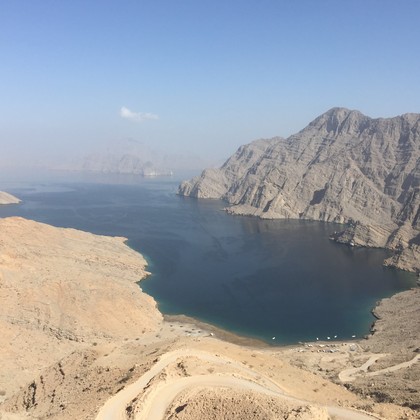
Strictly marine: rocky coasts, cliffs and rocky islets with clear, not too deep water, where it hunts fish on the bottom. Breeds on ledges and in caves and crevices of cliffs, often in loose groups. Rests on rocks at the waterline and avoids lagoons, fresh water and the open sea far offshore.
Where the bird is most at home, classified by the habitats of North Africa and the Middle East.

Range and movements
In Morocco on the Mediterranean coast (including the Chafarinas Islands and the coast near Al Hoceima) and, as the subspecies riggenbachi, on the Atlantic coast from about Casablanca to Cape Juby; in Algeria scattered along the rocky coast from Oran to Annaba, with colonies on the Habibas Islands among others; in Tunisia on the rocky islands of the north, such as La Galite and Zembra, and along Cap Bon. Scarce in Libya and not certainly proven to breed. A rare vagrant to the Mediterranean coasts of Egypt, Israel and Lebanon; it may formerly have bred in Egypt. Beyond the region it breeds along the coasts of Iceland, north-western Europe and Norway to north-western Russia, and patchily around the Mediterranean and Black Seas.
- Resident
- Summer visitor (c. Apr–Sep)
- Winter visitor (c. Oct–Mar)
- Passage (Mar–Apr, Oct–Nov)
- dark = core range, pale = thinly spread
How and when to look
The rocky coast and islets at Essaouira and between Safi and Agadir are good sites for the Atlantic form; in Tunisia the coast of Cap Bon at El Haouaria and the waters around Zembra are worth trying. Scan rocks at the waterline for slim, dark birds with a thin little bill.
Conservation status
Not globally threatened. The Mediterranean population is small, and the North African colonies often number no more than a few dozen to a few hundred pairs. Threats are drowning in gillnets and fish traps, disturbance of breeding islands by tourism and rats, overfishing and oil pollution; in Morocco there are moreover few recent counts of the Atlantic subspecies.
Scientific name
Gulosus aristotelis | (Linnaeus, 1761) (GBIF: Phalacrocorax aristotelis)
Linnaeus described the species in 1761 as Pelecanus aristotelis; because it was later moved to another genus, the author and year stand in brackets. The genus Gulosus was introduced in 1813 by Montagu. Gulosus is Latin for 'gluttonous'. aristotelis commemorates the Greek philosopher Aristotle (384–322 BC), who described birds in his zoological writings. The specimen the first description was based on came from Sweden.