All species › Passerines › Wagtails and pipits › Forest Wagtail
Forest Wagtail | Dendronanthus indicus
Boskwikstaart | Lavandera forestal
The Forest Wagtail is an East Asian woodland bird and the only wagtail that swings its tail sideways rather than up and down. In the region it is a rare winter visitor: almost every year one or a few winter in shady parks and gardens of the Gulf states, especially in Abu Dhabi.
Voice
The call is a sharp, metallic pink or double pink-pink, often on take-off. The song, rarely heard on the wintering grounds, is a repeated sawing dzhe-dzhe-dzhe.
Recording: Jiahua X. — CC BY-NC-SA 4.0 · converted to mono · xeno-canto
Identification
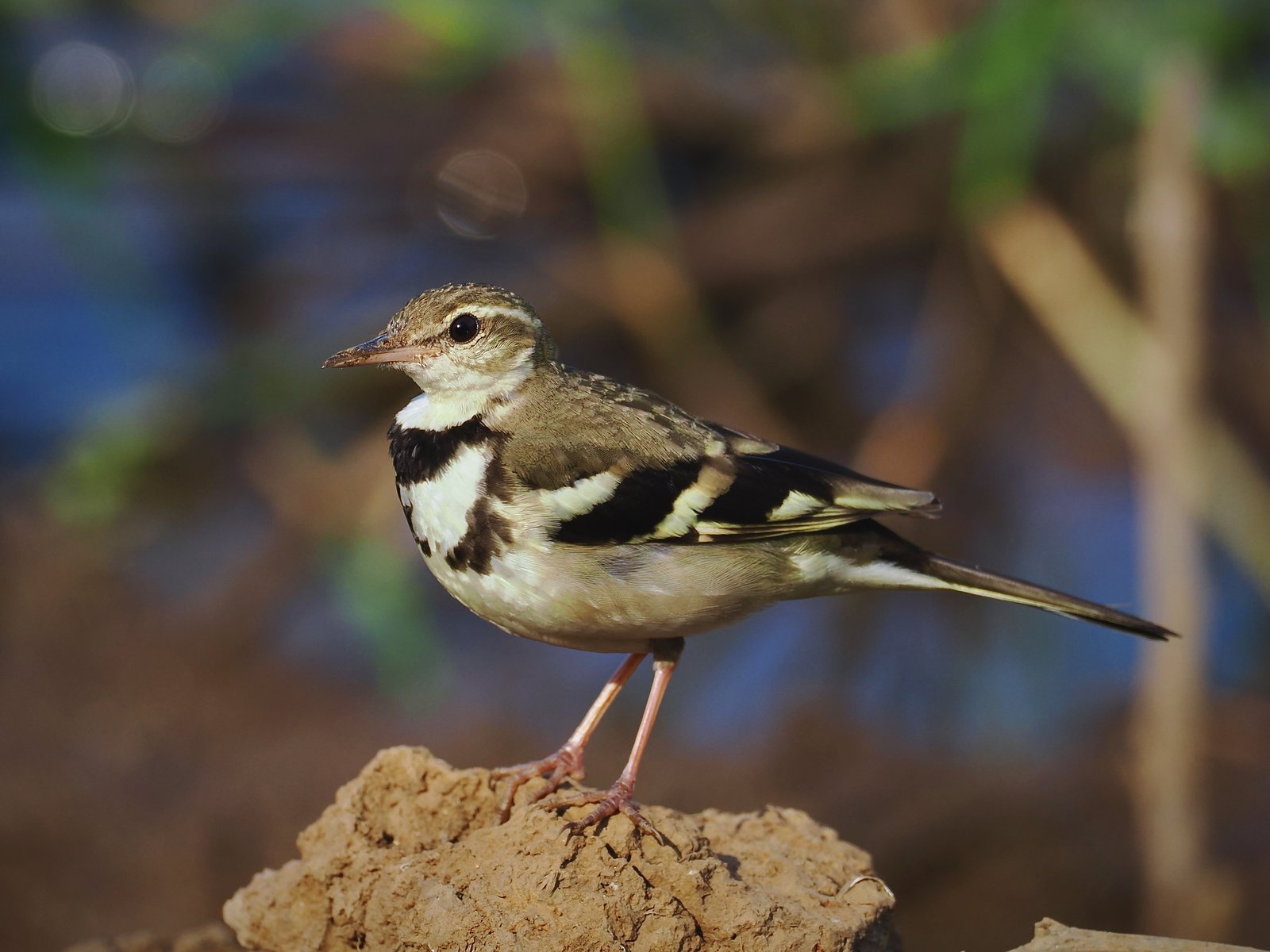
16–18 cm. A slender, rather short-tailed wagtail with olive-brown upperparts, a narrow white supercilium and a dark eye. The wing is blackish brown with two broad yellowish-white wingbars and a pale patch on the secondaries, so the wing looks banded black and white. The underparts are white with a striking double black breast band: a broad band across the upper breast and a narrower, often broken band below it, joined to the first like an inverted T. The legs are flesh-coloured. The sexes are alike; juveniles have a fainter, incomplete lower breast band. In flight the banded wings and white outer tail feathers stand out.
Confusion species
No other wagtail or pipit in the region combines an olive-brown back with such boldly banded wings and a double black breast band. A White Wagtail has a grey back and a single black breast patch, and Tree Pipit (Anthus trivialis) and Olive-backed Pipit (Anthus hodgsoni), which use the same shaded lawns under trees, are streaked and lack a breast band. The sideways tail-swinging is diagnostic even at distance.
Habitat
On the wintering grounds, shaded lawns and leaf litter under trees: old parks, palace gardens, orchards and plantations with a dense canopy, where it walks quietly over the ground picking insects from the litter. When disturbed it flies up into a branch. In the breeding range open broadleaf forest, woodland edge and lines of trees along streams.
Where the bird is most at home, classified by the habitats of North Africa and the Middle East.


Range and movements
In the United Arab Emirates a rare but almost annual winter visitor since the 1990s, with more than a dozen records and returning winterers in Abu Dhabi (Mushrif Palace Gardens), also in private gardens inland and on Dalma Island. In addition a few records in Oman and Kuwait (November 2006 and December 2020); elsewhere around the Gulf at most a vagrant. Beyond the region it breeds in eastern China, Korea, south-eastern Russia and Japan, and winters in India, Sri Lanka and South-East Asia to Indonesia.
- Winter visitor (c. Apr–Sep)
- dark = core range, pale = thinly spread
How and when to look
The best-documented site is a large old park with trees and lawns in Abu Dhabi, from November to March. Search the shade under the trees for a wagtail walking silently over the ground and swinging its tail sideways; the short pink often gives it away before it is seen. Follow local sightings reports.
Conservation status
Not globally threatened. In the region a rare winter visitor from East Asia: almost annual in the United Arab Emirates since the 1990s, recorded only a few times in Oman and Kuwait.
Scientific name
Dendronanthus indicus | (Gmelin, 1789)
Gmelin described the species in 1789 as Motacilla indica; because it was later moved to another genus, the author and year stand in brackets. The genus Dendronanthus was introduced in 1844 by Blyth. Dendronanthus is Greek, from dendron 'tree' and Anthus 'pipit': a tree pipit. indicus is Latin for 'Indian', after India. The specimen the first description was based on came from India.