All species › Nightjars › Nightjars › Golden Nightjar
Golden Nightjar | Caprimulgus eximius
Goudnachtzwaluw | Chotacabras dorado
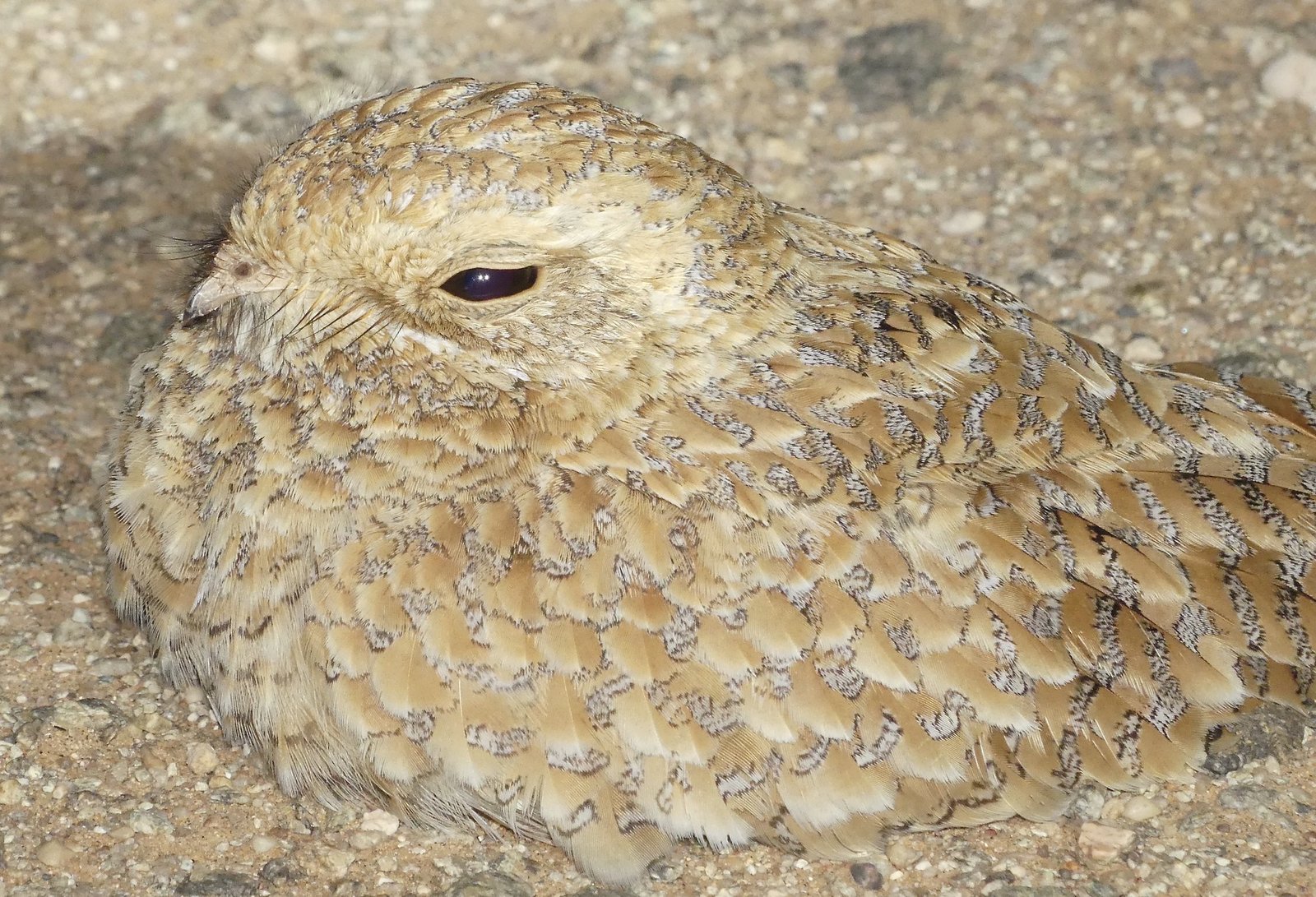
A pale, golden-yellow nightjar of the southern Sahara and the Sahel, first found in the region in 2015 in Western Sahara near Aousserd. Breeding there was proven in 2019, and the species has become one of the most sought-after birds of the region.
Voice
A long, low, even churr, urrrrrrr, slower and deeper than that of Eurasian Nightjar, from the ground; in flight sometimes a soft kwik.
Recording: Vuillermet Vincent — CC BY-NC-SA 4.0 · converted to mono · xeno-canto
Identification
Medium-sized and fairly long-winged. The upperparts are strikingly golden to orange-buff, sprinkled with small white and black spots that give the plumage a speckled, almost jewelled appearance; the underparts are paler with fine barring and the belly is white. The male has large white primary spots and white tail corners; in the female these are smaller. On sand the colour and spots merge into perfect camouflage.
Confusion species
Egyptian Nightjar (Caprimulgus aegyptius) is uniformly sandy to greyish-buff, without the golden tone and the bold white and black spots, and has almost no white in the tail. Red-necked Nightjar (Caprimulgus ruficollis) is larger and greyer, with a rufous collar.
Habitat
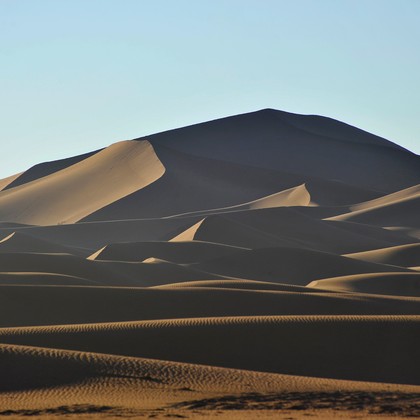
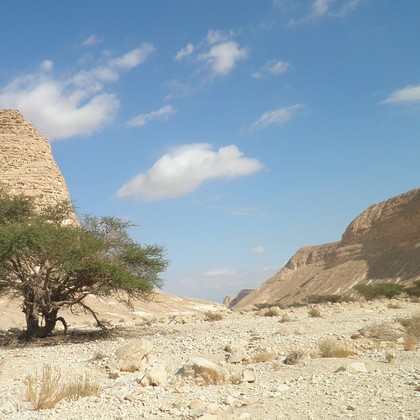
Flat sand and gravel desert with scattered grass tussocks and low bushes, often in or near broad wadis with acacias. Roosts by day on open sand or among stones, relying on its camouflage.
Where the bird is most at home, classified by the habitats of North Africa and the Middle East.
Range and movements
In the region known only from southern Western Sahara: in May 2015 a road casualty was found on the road from Dakhla to Aousserd, in 2016–2018 birds were seen and heard in the Oued Jenna, about 20 km north-west of Aousserd, and in March 2019 a female with two chicks was found, the first breeding record. Most records fall between February and May; whether birds stay year-round is unknown. Beyond the region it breeds in the Sahel from Mauritania and Senegal to Sudan.
- Winter visitor (c. Oct–Mar)
- Passage (Mar–Apr, Oct–Nov)
- dark = core range, pale = thinly spread
How and when to look
The Oued Jenna near Aousserd is the known site; the area is remote and a local guide who knows the terrain is all but essential. Search at dusk in February–April and do not disturb roosting or breeding birds.
Conservation status
Not globally threatened, but extremely local and vulnerable in the region. Disturbance by birders at the few known sites, off-road traffic and road deaths on desert roads are the main risks.
Scientific name
Caprimulgus eximius | Temminck, 1826
Temminck described the species in 1826 and placed it straight away in the genus where it still stands. The genus Caprimulgus was introduced in 1758 by Linnaeus. Caprimulgus is Latin, from capra 'nanny goat' and mulgere 'to milk', after the old belief that nightjars suckled goats at night. eximius is Latin for 'exceptional' or 'distinguished'. The specimen the first description was based on came from Sennar, Sudan.