All species › Nightjars › Nightjars › Plain Nightjar
Plain Nightjar | Caprimulgus inornatus
Effen nachtzwaluw | Chotacabras sencillo
A medium-sized, strikingly plain nightjar of the African Sahel and thorn savanna, which breeds as a scarce summer visitor in the thorn scrub of the Tihama and the lower slopes of the Asir mountains and Yemen.
Voice
A long, sustained churr, churrrrrr, recalling the song of Eurasian Nightjar but without the clear pitch changes, from the ground or a low branch. When flushed a short chuk.
Recording: Gregory Askew — CC BY-NC-SA 4.0 · converted to mono · xeno-canto
Identification
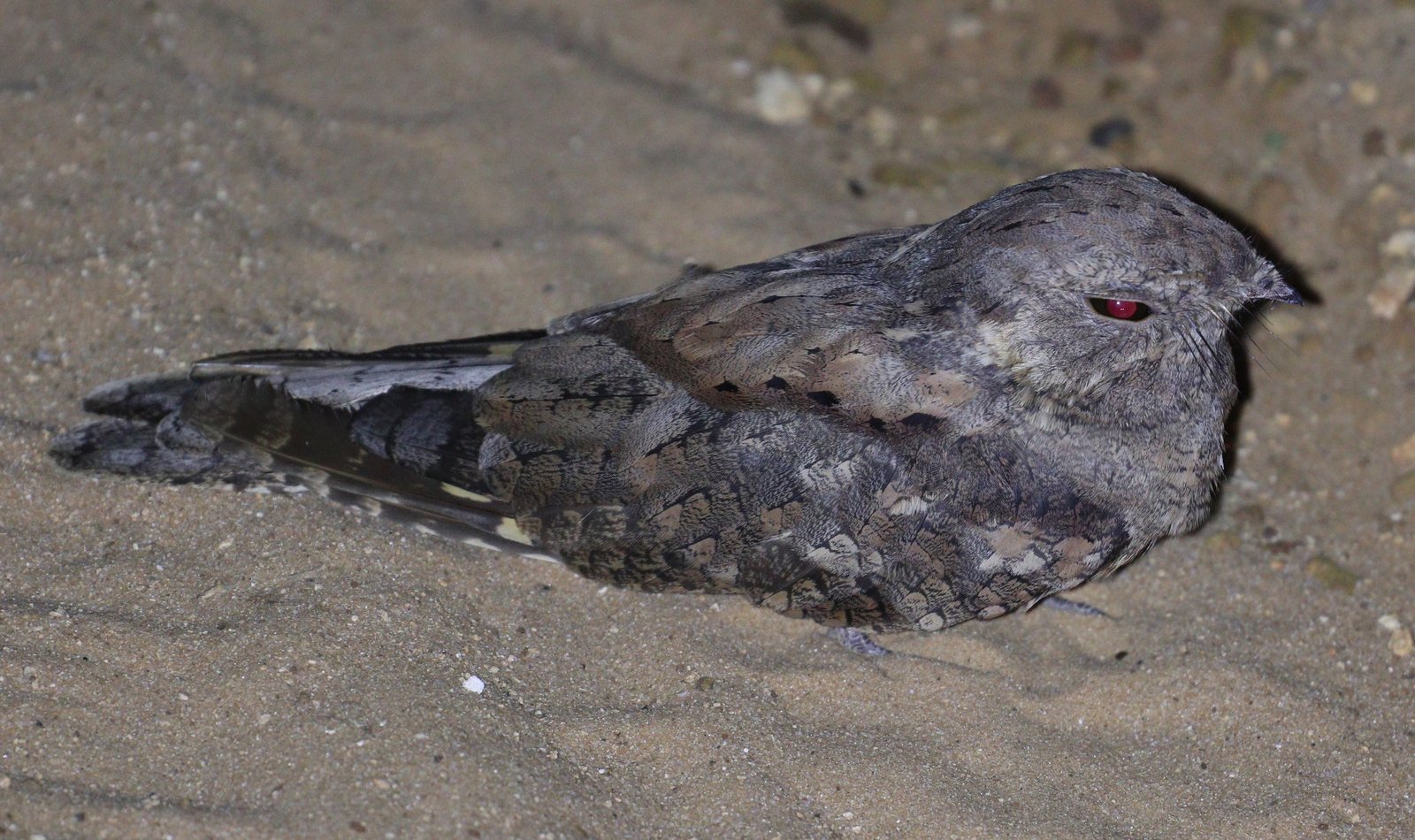
Slim and fairly long-tailed, with exceptionally plain upperparts: grey-brown, warm brown or rufous depending on the individual, with only fine dark streaks on the crown and few or no bold spots on scapulars and wing-coverts. The throat has a small white or buff patch. The male has white spots on the four outer primaries and white tail corners; in the female the wing spots are buff and white tail corners are absent.
Confusion species
Nubian Nightjar (Caprimulgus nubicus) is smaller, with a rusty nape band and large drop-shaped spots on the wing. Montane Nightjar (Caprimulgus poliocephalus) of the highlands is darker and heavily spotted, with much white in the tail. Eurasian Nightjar (Caprimulgus europaeus) has a dark scapular line and a much more variegated pattern.
Habitat
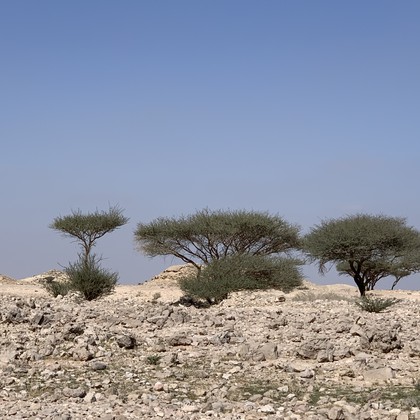
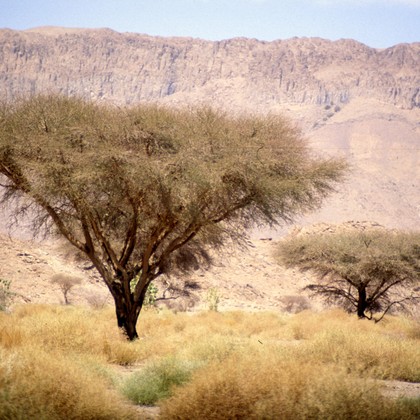
Dry thorn scrub and acacia savanna with bare patches, stony plains and the lowest mountain slopes, also along fields and sandy tracks. Roosts by day on the ground, often in the open sun, where its plain colour matches the substrate.
Where the bird is most at home, classified by the habitats of North Africa and the Middle East.
Range and movements
In the region it breeds in south-west Saudi Arabia, in the Tihama and the thorn scrub at the foot of the Asir mountains between Al Baha, Abha and Jizan (including at Abu Arish), and in Yemen in the Tihama and the lower slopes; present mainly from April to September. In 2025 there were reports from the far south of Algeria, on the edge of the Sahel. Beyond the region it breeds in the Sahel from Mauritania to Sudan and in East Africa, moving south outside the rainy season.
- Summer visitor (c. Oct–Mar)
- Passage (Mar–Apr, Oct–Nov)
- dark = core range, pale = thinly spread
How and when to look
Look for it in summer in the acacia scrub of the Tihama around Abu Arish and Jizan, or at the foot of the escarpment west of Abha. Drive slowly along sandy tracks after sunset: roosting birds light up in the headlights.
Conservation status
Not globally threatened and widespread in Africa. In Arabia the species is scarce and little studied; conversion of thorn scrub to farmland and overgrazing in the Tihama reduce its habitat.
Scientific name
Caprimulgus inornatus | Heuglin, 1869
Heuglin described the species in 1869 and placed it straight away in the genus where it still stands. The genus Caprimulgus was introduced in 1758 by Linnaeus. Caprimulgus is Latin, from capra 'nanny goat' and mulgere 'to milk', after the old belief that nightjars suckled goats at night. inornatus is Latin for 'unadorned' or 'plain'. The specimen the first description was based on came from Bogosland, Eritrea.