All species › Passerines › Larks › Greater Hoopoe-Lark
Greater Hoopoe-Lark | Alaemon alaudipes
Witbandleeuwerik | Alondra ibis
The Greater Hoopoe-Lark is the largest and most distinctive lark of the desert: a pale, long-legged bird with a long decurved bill that runs across bare plains like a small wader. Only when it takes off does the striking black-and-white wing appear. From the Atlantic to the Persian Gulf it is one of the birds that define the true desert.

Voice
The song is a series of pure, mournful whistles that rise and accelerate, ti-ti-tuu-tuu-tuuu..., delivered in a short, steep song flight from a bush: the bird rises, flashes its wings and tumbles back down. It also sings from the ground. The call is a drawn-out, plaintive tsiew and a soft zrrr when disturbed.
Recording: David Darrell-Lambert — CC BY-NC-SA 4.0 · converted to mono · xeno-canto
Identification
19–22 cm, slim and long-legged, with a long neck and a long, gently decurved dark bill. Plain sandy brown to greyish sand above, white below with a band of black drop-shaped spots across the breast. The head shows a dark eye-stripe and a dark moustachial stripe around a pale cheek. In flight the wing shows a broad white band across the black primaries and secondaries, above and below; the tail is dark with pale sides. The male is larger and longer-billed than the female. Juveniles are paler, shorter-billed and almost unspotted. Arabian birds average greyer than the warm-brown birds of the western Sahara.
Confusion species
Eurasian Hoopoe (Upupa epops) shares the black-and-white wings and curved bill, but has an orange-buff body, a crest and a floppy flight. Cream-colored Courser (Cursorius cursor) uses the same bare ground and is equally pale, but has a short curved bill, a black-and-white stripe behind the eye and all-black underwings in flight without a white band. Dupont's Lark (Chersophilus duponti) also has a curved bill but is much smaller, streaked and shows no white in the wing. Desert Lark (Ammomanes deserti) and Bar-tailed Lark (Ammomanes cinctura) are far smaller, short-billed and plain.
Habitat
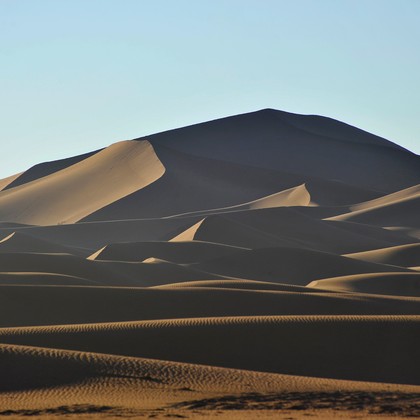
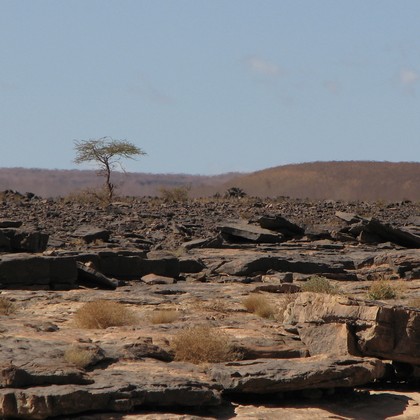
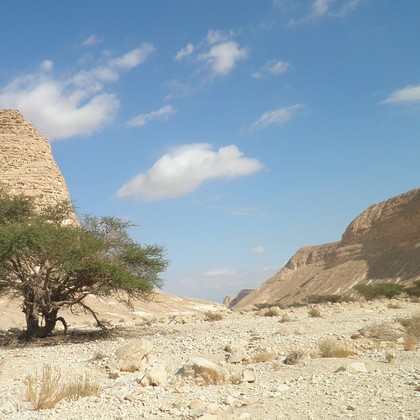
Flat sand and gravel desert with scattered low bushes, sandy wadi beds, the edges of dune fields and salt flats, and sandy coastal plains along the Atlantic, the Red Sea and the Gulf. It avoids dense vegetation, farmland and steep rock. It feeds by digging in sand with the bill for insect larvae, snails and lizards.
Where the bird is most at home, classified by the habitats of North Africa and the Middle East.
Range and movements
Found across almost all the desert of the region: Morocco south of the Atlas and Western Sahara, the Algerian and Tunisian Sahara, Libya and Egypt both west and east of the Nile, Sinai, the Negev and Arava, southern Jordan, Saudi Arabia, inland Kuwait, Qatar, Bahrain, the Emirates and Oman, the deserts of Iraq and eastern Syria, and the coastal plains of Yemen. In Algeria, Libya, Yemen and Iraq it is certainly more widespread than records suggest. Beyond the region it occurs on the Cape Verde Islands, in the Sahel and east to Iran, Pakistan and north-west India.
- Resident
- Summer visitor (c. Apr–Sep)
- Winter visitor (c. Oct–Mar)
- Passage (Mar–Apr, Oct–Nov)
- dark = core range, pale = thinly spread
How and when to look
An early-morning drive along a desert track in southern Morocco, the Arava or inland Emirates gives the best chances. Look for a pale bird running ahead of the car and stopping abruptly. In the winter months the whistled song carries a long way; wait near a bush and the song flight will follow.
Conservation status
Not threatened. The species has a vast range but occurs everywhere at low density. Habitat is lost locally to irrigated farming, overgrazing and off-road driving, especially around the fast-growing cities of the Gulf.
Scientific name
Alaemon alaudipes | (Desfontaines, 1789)
Desfontaines described the species in 1789 as Upupa alaudipes; because it was later moved to another genus, the author and year stand in brackets. The genus Alaemon was introduced in 1840 by Keyserling & Blasius. Alaemon is Greek, from alēmōn 'wanderer', from alaomai 'to wander'. alaudipes is Latin, from alauda 'lark' and pes 'foot': lark-footed. The specimen the first description was based on came from between Gafsa and Tozeur, Tunisia.