All species › Waders, gulls and terns › Plovers and lapwings › Greater Sand-Plover
Greater Sand-Plover | Anarhynchus leschenaultii
Woestijnplevier | Chorlitejo mongol grande
The larger of the sand plovers, and on the mudflats of the Red Sea, the Persian Gulf and the Arabian Sea one of the most numerous waders. It also breeds in the deserts of Jordan and Syria, far from the coast, on bare plains.

Voice
A soft, rolling trill, trrri or prrrp, longer and softer than the call of Tibetan Sand Plover; in the breeding season a melodious, repeated display call.
Recording: David Darrell-Lambert — CC BY-NC-SA 4.0 · converted to mono · xeno-canto
Identification
Large for a plover, with a large head, long legs and a long, heavy black bill with a swollen tip; the bill is at least as long as the distance from bill base to the rear of the eye. The legs are grey-green to yellowish. The breeding male has a black mask, a white forehead and a narrow orange-rufous breast band; in Levant breeders (columbinus) the band is broader and extends onto the flanks. In winter plumage plain grey-brown above, with a white supercilium and grey-brown breast patches. In flight a clear white wingbar and toes projecting beyond the tail.
Confusion species
Tibetan Sand Plover (Anarhynchus atrifrons) is smaller and rounder, with a shorter, blunt bill, a smaller head and shorter, dark legs whose toes do not project beyond the tail in flight; in mixed flocks the size difference is the best guide. Caspian Plover (Anarhynchus asiaticus) is slimmer, with a thin bill and a complete breast band. Common Ringed Plover (Charadrius hiaticula) has orange legs and a complete collar; Kentish Plover (Anarhynchus alexandrinus) is smaller, with a white hind collar.
Habitat
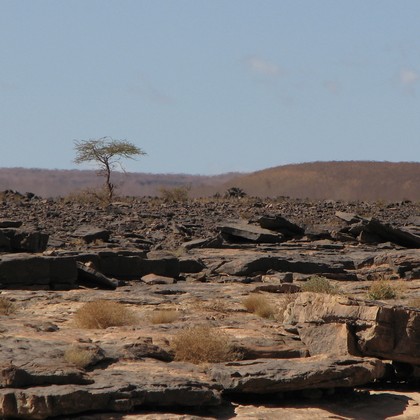
In winter tidal mudflats, sand and mud banks, lagoons, mangrove creeks and salt pans, at high tide on beaches and shingle ridges. Breeds on dry, open plains: stony and clay desert, edges of salt flats and bare steppe with sparse vegetation, often far from water.
Where the bird is most at home, classified by the habitats of North Africa and the Middle East.


Range and movements
Breeds in eastern Jordan (including around Azraq) and in the desert steppe of Syria. As a winter visitor numerous along the Red Sea coast of Egypt, Saudi Arabia and Yemen, on Socotra and the Gulf of Aden, along the Arabian Sea in Oman (Barr al Hikman, Masirah, Dhofar) and along the Persian Gulf from Kuwait and southern Iraq to the Emirates. In Israel a fairly common migrant at Eilat and a scarce winter visitor; on the Mediterranean coast of Egypt, Libya and Tunisia a scarce winter visitor. Rare in Algeria and Morocco. Beyond the region it breeds from Turkey and the Caucasus through Iran to Mongolia and winters on the coasts of East and southern Africa, South Asia and Australia.
- Resident
- Summer visitor (c. Oct–Mar)
- Winter visitor (c. Apr–Sep)
- Passage (Mar–Apr, Oct–Nov)
- dark = core range, pale = thinly spread
How and when to look
Barr al Hikman in Oman holds tens of thousands of waders in winter, with this species among the most numerous; the lagoons of Abu Dhabi and the bays of eastern Saudi Arabia are also good. Go on a rising tide, when the birds come closer to the shore. Look for breeders from March to May on the stony plains around Azraq.
Conservation status
Not globally threatened, but decreasing. In the region coastal development, reclamation of Gulf mudflats, disturbance and pollution threaten the wintering areas; the breeding grounds in the Levant suffer from overgrazing and land conversion.
Scientific name
Anarhynchus leschenaultii | (Lesson, 1826) (GBIF: Charadrius leschenaultii)
Lesson described the species in 1826 as Charadrius Leschenaultii; because it was later moved to another genus, the author and year stand in brackets. The genus Anarhynchus was introduced in 1832 by Quoy & Gaimard. Anarhynchus is Greek, from ana- 'backward' and rhunkhos 'bill', after the sideways-bent bill of the wrybill, the type species of the genus. leschenaultii honours the French botanist and ornithologist Jean-Baptiste Leschenault de La Tour (1773–1826), who collected in Java and India. The specimen the first description was based on came from Pondicherry, India.