All species › Waterfowl › Ducks, geese and swans › Greylag Goose
Greylag Goose | Anser anser
Grauwe gans | Ánsar común
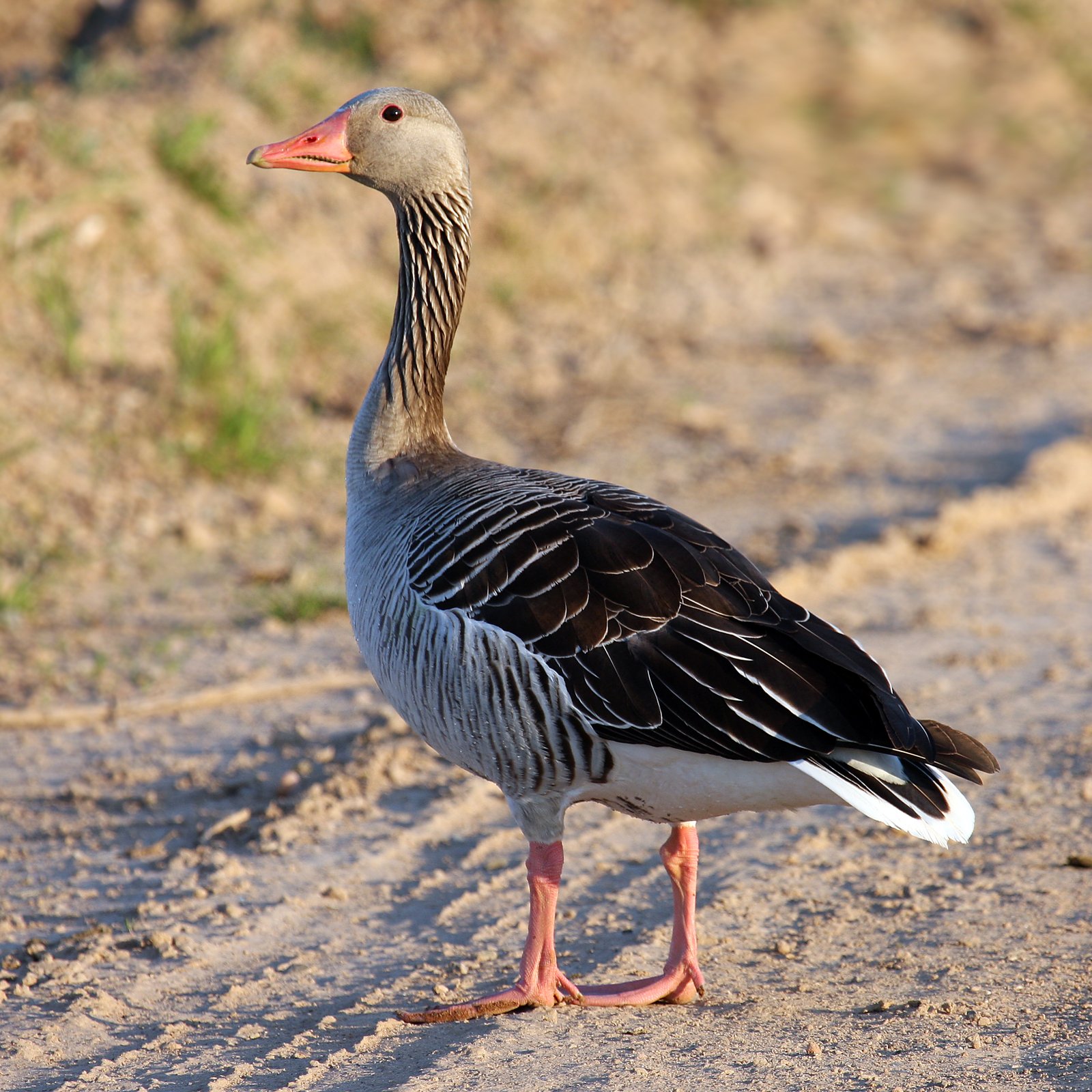
The large, grey-brown ancestor of the farmyard goose, with a heavy orange or pink bill. Greylag Goose is the most widespread wild goose in the region: it winters in the marshes of Mesopotamia, around the lakes of northern Tunisia and north-eastern Algeria, and in smaller numbers in Morocco, Egypt and the Levant.
Voice
The familiar loud, nasal cackling of the farmyard goose, aahng-ung-ung, deep and resonant; flocks call continuously in flight.
Recording: David Darrell-Lambert — CC BY-NC-SA 4.0 · converted to mono · xeno-canto
Identification
Large, heavy and coarsely built, with a thick head and neck. The plumage is uniform grey-brown with pale fringes on the upperparts and a few dark spots on the belly in older birds. The bill is large and lacks black; in the western form (anser), which winters in North Africa, it is orange, in the eastern form (rubrirostris) of the Middle East pink, and that form is also larger and paler. The legs are flesh-pink. In flight the pale blue-grey forewing and the pale underwing stand out sharply against the dark flight feathers.
Confusion species
Greater White-fronted Goose (Anser albifrons) is smaller and darker, with a white blaze at the bill base, black belly bars and orange legs. Tundra Bean-Goose (Anser serrirostris) and Taiga Bean-Goose (Anser fabalis) have a dark head and neck and a black bill with an orange band. Feral farmyard geese are often heavier, with a sagging belly or white patches.
Habitat
Large marshes with reeds and open water, freshwater lakes, floodplains and river deltas, with nearby fields of winter cereals, clover or rice stubble. Roosts on open water and flies to the feeding areas at dusk and dawn.
Where the bird is most at home, classified by the habitats of North Africa and the Middle East.



Range and movements
Winter visitor to Iraq, especially the Mesopotamian marshes and along the Tigris and Euphrates, and to Syria; scarce in Kuwait and north-eastern Saudi Arabia. In Israel small numbers in the Hula Valley and the Jordan Valley. In North Africa mainly around Lake Ichkeul in Tunisia and the lakes near El Kala and Fetzara in north-eastern Algeria; in smaller numbers in Morocco (including Merja Zerga) and in the Nile Delta in Egypt, and rare in Libya. Feral birds live locally in parks and on reservoirs, including in the Gulf States. Breeds from Iceland and western Europe to northern China and winters from north-west Europe and the Mediterranean to India and China.
- Resident
- Summer visitor (c. Apr–Sep)
- Winter visitor (c. Oct–Mar)
- Passage (Mar–Apr, Oct–Nov)
- dark = core range, pale = thinly spread
How and when to look
Ichkeul in Tunisia is the best site in North Africa from December to February; look out over the lake from the hill by the visitor centre. In Israel the Hula Valley is worthwhile, in Iraq the marshes around Chibayish. In the Middle East, note the pink bill of the eastern form.
Conservation status
Not threatened. Wintering in the region in numbers that were formerly larger, owing to drainage of wetlands (as in Mesopotamia in the 1990s), hunting and disturbance. Since the partial restoration of the Iraqi marshes and the protection of Ichkeul, prospects have locally improved.
Scientific name
Anser anser | (Linnaeus, 1758)
Linnaeus described the species in 1758 as Anas Anser; because it was later moved to another genus, the author and year stand in brackets. The genus Anser was introduced in 1760 by Brisson. Anser is the Latin word for 'goose'. The specific name repeats the genus name: anser is Latin for 'goose'. The specimen the first description was based on came from Sweden.