All species › Gamebirds › Pheasants and partridges › Harlequin Quail
Harlequin Quail | Coturnix delegorguei
Harlekijnkwartel | Codorniz arlequín
An African quail with its own, barely known Arabian outpost. In the Tihama, the hot coastal plain of south-western Arabia, it was recorded only a handful of times after the nineteenth century, until it was found again in 2015 in green, irrigated fields near Jizan. Whether this is a settled breeding population or visitors from Africa is not yet certain.

Voice
The male's call is a metallic, rapidly repeated whit-whit-whit, louder, sharper and more often in series of three or more than the call of Common Quail, frequently at dusk and at night. When flushed a soft krr-ip.
Recording: Paul Lenrumé — CC BY-NC-SA 4.0 · converted to mono · xeno-canto
Identification
About 17 cm, slightly smaller and darker than Common Quail. The male is striking: a black-and-white striped head with a white supercilium, a white throat with a black anchor mark, a black breast running into a black belly stripe, and deep chestnut flanks streaked black. The upperparts are dark brown with creamy-white streaks, as in Common Quail. The female closely resembles a female Common Quail but is smaller, darker, with a paler, less spotted breast and a darker throat band. Arabian birds are described as the subspecies C. d. arabica, slightly paler than African birds, although its validity is disputed.
Confusion species
Common Quail (Coturnix coturnix) is slightly larger; the male has a rufous breast without black and flanks with pale streaks, never deep chestnut. Females of the two are hard to separate in the field: note the smaller size, darker upperparts and plainer breast of Harlequin Quail, and above all the call. Common Buttonquail (Turnix sylvaticus) does not occur in Arabia.
Habitat
In Arabia mainly irrigated lowland farmland: fields of tall grass and fodder crops under centre-pivot irrigation, maize and cereals, with a single record higher in the mountains. In Africa open grassland with scattered bushes, often after rain, where the species wanders nomadically.
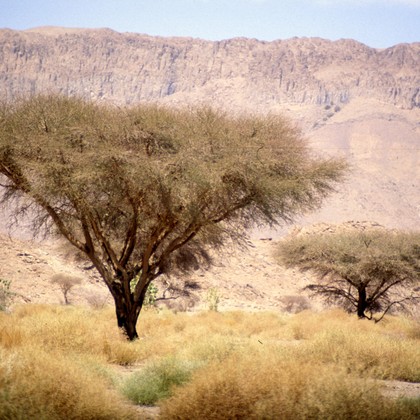
Where the bird is most at home, classified by the habitats of North Africa and the Middle East.

Range and movements
Within the region only in the Tihama of south-western Saudi Arabia and Yemen. In 1895 four birds were collected at Lahej in Yemen and called 'common' there; after that came scattered records in Saudi Arabia in 1974, 1976 and between 1981 and 1983 in the lowlands near Jizan, one in 1992 near the Yemeni border, and from 2015 several calling birds every year (at least ten in July 2017) in irrigated fields near Husayni, on the road to Sabya. Records in all months and pairs in June and July point to a settled breeding population. Not reliably recorded elsewhere in the region. Beyond the region widespread in sub-Saharan Africa, also on São Tomé and Madagascar.
- Summer visitor (c. Oct–Mar)
- Passage (Mar–Apr, Oct–Nov)
- dark = core range, pale = thinly spread
How and when to look
In June and July along the edges of green, sprinkler-irrigated fodder fields near Sabya in Jizan province, early in the morning and in the evening: listen for the sharp, metallic call. Seeing one usually only works when a bird flushes or dust-bathes on a bare strip.
Conservation status
Not globally threatened. The Arabian population is small, isolated and little studied; the new records are linked to the spread of irrigated farming in the Tihama, which may therefore help the species. In this guide it is listed as a vagrant, but recent data point rather to a rare resident.
Scientific name
Coturnix delegorguei | Delegorgue, 1847
Delegorgue described the species in 1847 and placed it straight away in the genus where it still stands. The genus Coturnix was introduced in 1764 by De Garsault. Coturnix is the Latin word for the quail. delegorguei honours the French explorer and hunter Adulphe Delegorgue (1814–1850), who collected in Natal and Transvaal. The specimen the first description was based on came from Oury, upper Limpopo River, Transvaal (South Africa).