All species › Gamebirds › Pheasants and partridges › Chukar Partridge
Chukar Partridge | Alectoris chukar
Aziatische steenpatrijs | Perdiz chukar
The gamebird of bare stony slopes in the Levant, Iraq and Sinai. A calling male on a boulder fills a whole valley with the call that gave it its name, yet once you look for it it is just another grey stone among the stones. In this region it reaches the south-western edge of a range that extends to China.

Voice
The name is the call: a series of hard chak notes that accelerates into a rolling chak-chak-chukar-chukar, often answered by males on the surrounding slopes. When flushed, a sharp pitchoo.
Recording: Stanislas Wroza — CC BY-NC-SA 4.0 · converted to mono · xeno-canto
Identification
Rotund grey-brown partridge with coral-red bill, red eye-ring and red legs. Throat and cheeks creamy, enclosed by a continuous black band running across the forehead and through the eye and ending on the breast. Crown and nape grey-brown with a vinous tinge, a rufous ear patch behind the eye. The flanks show a series of narrow black, white and chestnut bars. Birds of Sinai, the Negev and southern Jordan (subspecies sinaica) are paler and sandier than those of Lebanon and Kurdistan. Flight short and low, showing rufous tail sides.
Confusion species
Arabian Partridge (Alectoris melanocephala) of western and southern Arabia is larger, with a black crown, white supercilium and white throat; the ranges do not meet. Philby's Partridge (Alectoris philbyi) in south-west Arabia has a black throat and black cheeks. Barbary Partridge (Alectoris barbara) of north-west Africa lacks the black band and has a chestnut, white-spotted collar. Sand Partridge (Ammoperdix heyi), which shares the same slopes in Sinai, the Negev and Jordan, is smaller and sandy, without a black band and with finely striped flanks.
Habitat
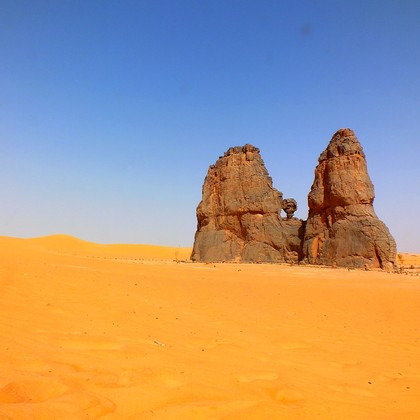
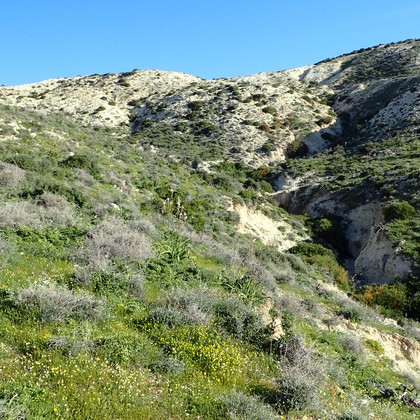
Dry stony slopes with low thorn scrub and batha (low Levantine herb garrigue), scree, rocky wadis and abandoned terraces, from the Dead Sea below sea level to above 2,000 m in the Kurdish mountains and on Mount Hermon. In the Negev and Sinai in rocky desert with some vegetation, provided water is within walking distance. Feeds on seeds, buds, greens and in summer also insects.
Where the bird is most at home, classified by the habitats of North Africa and the Middle East.
Range and movements
Within the region widespread in Lebanon, Syria and northern and eastern Iraq (Kurdistan, the Zagros foothills), in Israel, Samaria and Judea from Galilee to the Negev and the Judean Desert, in the highlands and along the edges of the Jordan Valley in Jordan, in the mountains of southern Sinai in Egypt and locally in the far north of Saudi Arabia. Beyond the region from the eastern Balkans and Turkey through Iran and Central Asia to north-east China; introduced elsewhere, including North America.
- Resident
- Summer visitor (c. Apr–Sep)
- Winter visitor (c. Oct–Mar)
- Passage (Mar–Apr, Oct–Nov)
- dark = core range, pale = thinly spread
How and when to look
In March and April, shortly after sunrise, at a viewpoint above a rocky slope: Ein Gedi, the Ramon area, Wadi Rum or the mountains of Lebanon. Wait for the call, then scan the rock tops; the male often stands on top of a boulder. In summer groups come to springs and drinking spots just before dark.
Conservation status
Not globally threatened. In the region numbers have fallen sharply in places through hunting, especially in Syria, Lebanon and Iraq, where the species is traditionally shot and trapped. In Israel and Jordan it remains common in protected areas. Releases of captive-bred birds blur the origin of birds at some sites.
Scientific name
Alectoris chukar | (Gray, 1830)
Gray described the species in 1830 as Perdix Chukar; because it was later moved to another genus, the author and year stand in brackets. The genus Alectoris was introduced in 1829 by Kaup. Alectoris is Greek, from alektoris 'farmyard hen', from alektōr 'cockerel'. chukar imitates the call, by way of Hindi chakor; the word already occurs in Sanskrit. The specimen the first description was based on came from Srinagar, Kumaon.