All species › Gamebirds › Pheasants and partridges › Barbary Partridge
Barbary Partridge | Alectoris barbara
Barbarijse patrijs | Perdiz moruna
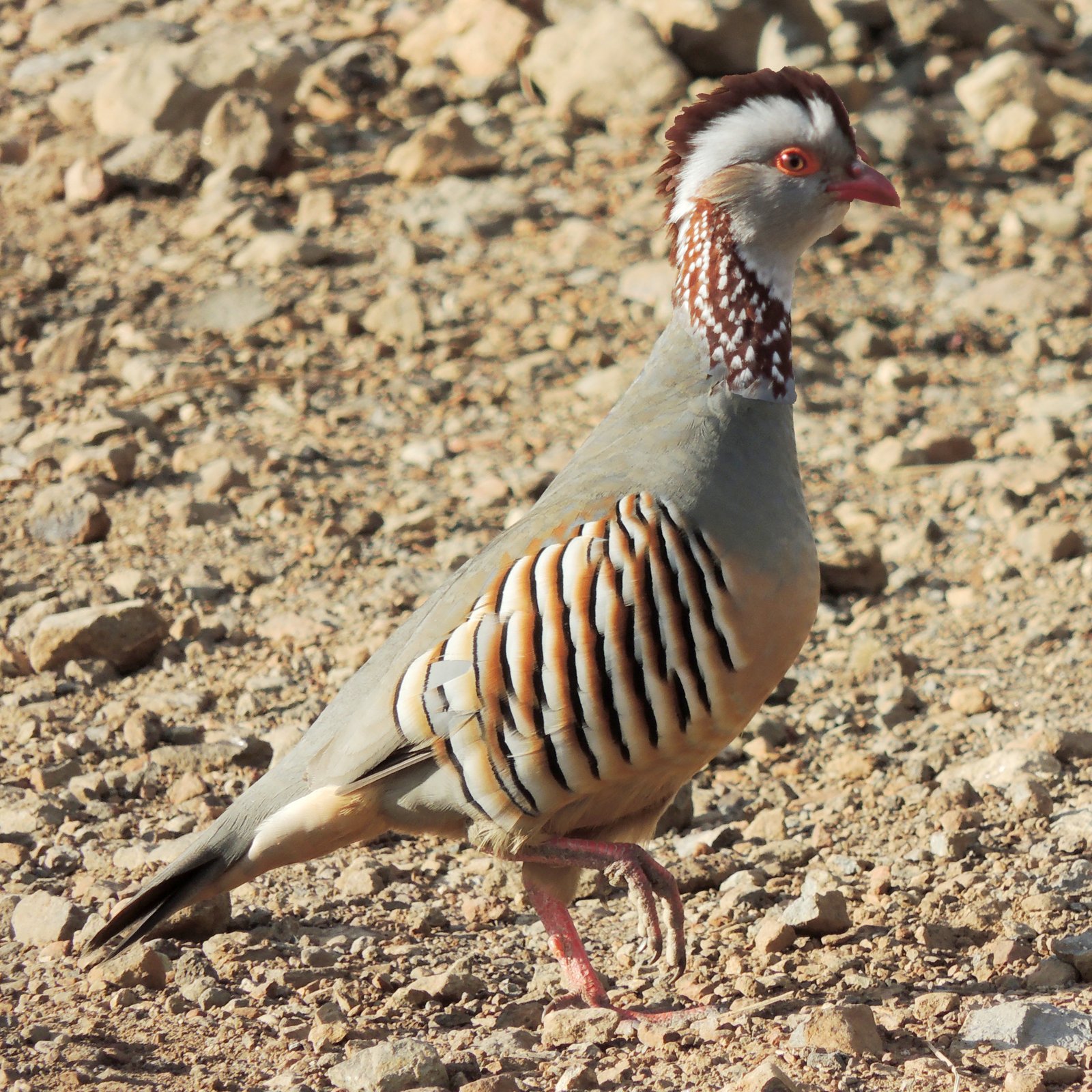
The partridge of the Maghreb: from the cork-oak woods by the Mediterranean to the bare slopes of the High Atlas and the Saharan mountains. It is the only Alectoris without a black necklace; instead it wears a chestnut collar full of white specks. In spring its shrill, grating call rings out from every dry valley from Morocco to Tunisia.
Voice
Noisy and far-carrying. The call is a shrill, grating kchek-kchek-kchek-kerrrr or kakelak-kakelak that rises in tempo and pitch, often from several males at once on rocks and walls. When uneasy a short, hard chek; within a covey a soft chatter.
Recording: Stanislas Wroza — CC BY-NC-SA 4.0 · converted to mono · xeno-canto
Identification
About 33 cm, round and sturdy, with coral-red bill, eye-ring and legs. Face, throat and cheeks blue-grey with a rufous stripe behind the eye; crown and a narrow central stripe down the nape chestnut. Around the neck a broad chestnut collar densely spotted with white. Breast and upperparts blue-grey with a brown wash, the shoulder rusty; the belly buff. The flanks carry broad bars of blue-grey, chestnut, black and white. Sexes alike, the male slightly larger and with a knob or spur on the tarsus. Birds from the Saharan mountains are paler and sandier. Flies low and straight with rapid beats and glides, showing rufous tail sides.
Confusion species
No real confusion in the region: Chukar Partridge (Alectoris chukar) and the other rock partridges live only east of the Nile. Double-spurred Spurfowl (Pternistis bicalcaratus), confined to a small area of Morocco south of Rabat, is brown and streaked, with a long white supercilium, dark bill and greenish-grey legs. Common Quail (Coturnix coturnix) is much smaller and streaked. In Morocco and Algeria watch for released captive-bred birds and hybrids with Red-legged Partridge (Alectoris rufa) or Chukar, which may show a white throat and a black necklace.
Habitat
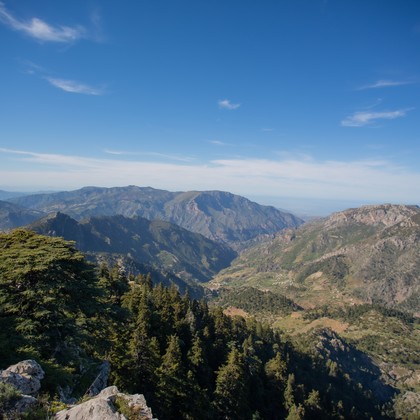
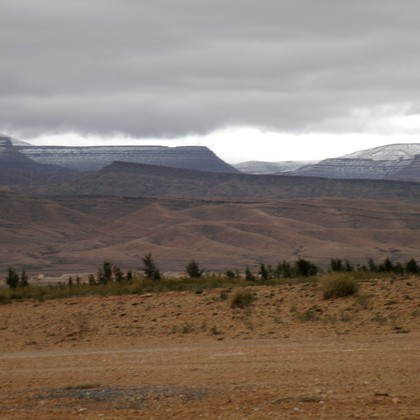
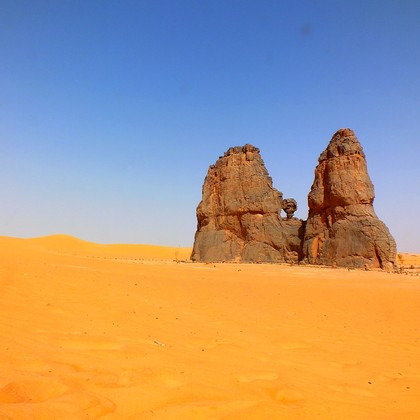
Dry, open terrain with scrub and rocks: maquis and garrigue, open cork-oak, holm-oak and juniper woodland, alfa steppe on the high plateaus, rocky slopes and gorges to above 3,000 metres in the High Atlas, and in the south mountain desert with scattered shrubs around springs and gueltas (natural rock pools in the Sahara). Comes to feed in cereal fields, stubble, olive groves and terraces. Eats seeds, buds, greens and in summer many insects.
Where the bird is most at home, classified by the habitats of North Africa and the Middle East.
Range and movements
Within the region in Morocco (from the Rif and Atlas to the Anti-Atlas and the western edge of the Sahara), northern Algeria and northern and central Tunisia, north-western Libya, and in isolation in the central Sahara in the Ahaggar and Tassili mountains of southern Algeria. Four subspecies, including A. b. barbara in the north and the pale A. b. spatzi in the Saharan mountains. Also in Ceuta and Melilla. Beyond the region on Sardinia, on the Rock of Gibraltar and, through introduction, on the Canary Islands and Madeira.
- Resident
- Summer visitor (c. Apr–Sep)
- Winter visitor (c. Oct–Mar)
- Passage (Mar–Apr, Oct–Nov)
- dark = core range, pale = thinly spread
How and when to look
In March and April at dawn in a dry valley of the Middle Atlas (near Ifrane or Azrou), in the Ziz Valley or on the slopes around Oukaïmeden in the High Atlas: listen for the grating call, then scan the rocks and walls. In summer coveys come to springs and troughs in the evening.
Conservation status
Not globally threatened, but declining in much of North Africa through intensive hunting, loss of scrub to farming and overgrazing. In Morocco and Tunisia captive-bred birds are released for shooting, bringing disease and genetic mixing with other Alectoris species. Little is known about numbers in Libya and the Saharan mountains.
Scientific name
Alectoris barbara | (Bonnaterre, 1790)
Bonnaterre described the species in 1790 as Perdix Barbara; because it was later moved to another genus, the author and year stand in brackets. The genus Alectoris was introduced in 1829 by Kaup. Alectoris is Greek, from alektoris 'farmyard hen', from alektōr 'cockerel'. barbara is Latin for 'foreign' and points here to the Barbary Coast of North Africa. The specimen the first description was based on came from Morocco.