All species › Gamebirds › Pheasants and partridges › Arabian Partridge
Arabian Partridge | Alectoris melanocephala
Arabische steenpatrijs | Perdiz árabe
The largest and heaviest of the Alectoris partridges, an endemic of the mountains of western and southern Arabia. Where the juniper woods of the Asir give way to terraces and rocky wadis it calls in groups from boulders and walls; in the villages of Yemen and Dhofar it sometimes walks right past the houses.

Voice
A loud, rolling, accelerating series, chook-chook-chook-chukar-chukar, fuller and rougher than that of Chukar Partridge, often from several birds at once, especially early in the morning. When alarmed a sharp, repeated chik, and on flushing a hoarse cackle.
Recording: Stanislas Wroza — CC BY-NC-SA 4.0 · converted to mono · xeno-canto
Identification
About 39 cm, large, long-legged and long-tailed for a rock partridge. The head is distinctive: a black crown and black stripe through the eye, separated by a broad white supercilium, and a pure white throat outlined by a black band. Below the band a narrow zone of black and white streaks runs across the neck sides. Nape and breast grey, belly warm buff; flanks boldly barred black and chestnut on grey. Upperparts greyish brown. Bill, eye-ring and legs red. Sexes alike, the male larger and spurred. The eastern subspecies A. m. guichardi is paler and sandier.
Confusion species
Philby's Partridge (Alectoris philbyi) shares the highlands of the Asir and northern Yemen but is smaller, with an all-black throat and black cheeks and a blue-grey crown; it usually keeps higher, in open rocky terrain. Sand Partridge (Ammoperdix heyi) is much smaller, sandy, without a black throat band and with an orange bill. Chukar Partridge (Alectoris chukar) occurs only in the north of the region.
Habitat
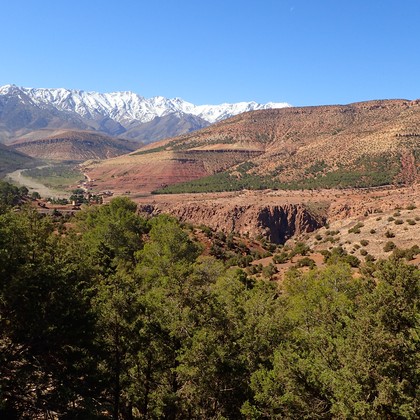
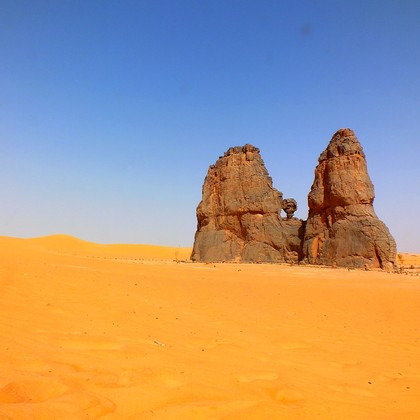
Wooded and scrubby mountain slopes: open juniper woodland, acacia scrub, rocky wadis with dense growth, and the edges of terraced fields and mountain villages, from the foothills above the Tihama to over 2,500 metres in the Asir. In Dhofar on the wooded monsoon slopes and in dry wadis on the landward side of the mountains. Needs more cover than the other rock partridges. Eats seeds, berries, greens and invertebrates.
Where the bird is most at home, classified by the habitats of North Africa and the Middle East.

Range and movements
Endemic to Arabia. In Saudi Arabia along the mountains of the Hejaz and Asir, from the Taif and Al Baha area south to the Yemeni border, with a northern population discovered in 2022 in Harrat Uwayrid; in Yemen across the western and southern highlands to the Hadhramaut; and in Oman in the Dhofar mountains. Eastern Yemen holds the subspecies A. m. guichardi. Found nowhere else in the world; reports from the Emirates refer to released birds.
- Resident
- Summer visitor (c. Oct–Mar)
- Winter visitor (c. Apr–Sep)
- Passage (Mar–Apr, Oct–Nov)
- dark = core range, pale = thinly spread
How and when to look
In the Asir mountains near Abha and Tanomah or around Al Baha, just after sunrise along terraces and juniper woodland: the call carries far. In Dhofar, Wadi Darbat and the wadis around Ayn Hamran and Ayn Razat are reliable, where coveys come to water early in the morning.
Conservation status
Not threatened; the species is locally common within its range and numbers appear stable. Hunting, overgrazing and the abandonment of old terraces depress numbers locally, while protection in areas such as Asir National Park helps. Little is known about numbers in Yemen.
Scientific name
Alectoris melanocephala | (Rüppell, 1835)
Rüppell described the species in 1835 as Perdix melanocephala; because it was later moved to another genus, the author and year stand in brackets. The genus Alectoris was introduced in 1829 by Kaup. Alectoris is Greek, from alektoris 'farmyard hen', from alektōr 'cockerel'. melanocephala is Greek for 'black-headed', from melas 'black' and kephalē 'head'. The specimen the first description was based on came from the mountains near Jeddah, Saudi Arabia.