All species › Gamebirds › Pheasants and partridges › Philby's Partridge
Philby's Partridge | Alectoris philbyi
Philby's steenpatrijs | Perdiz de Philby
A rock partridge confined to the highlands of south-west Arabia, from Al Baha in Saudi Arabia into northern Yemen. Its black face makes it the most striking of the Alectoris partridges, but in open rocky terrain above the juniper woods it is hard to find.

Voice
A rolling series of chak notes similar to that of Chukar Partridge but slightly higher and faster, mainly in the early morning from a boulder. When flushed, a hoarse cackle.
Recording: Zsombor Károlyi — CC BY-NC-SA 4.0 · converted to mono · xeno-canto
Identification
Grey-brown partridge with red bill, red eye-ring and red legs, built like Chukar Partridge. Diagnostic are the black cheeks and black throat, forming a black mask, bordered by a narrow white stripe running from the bill over and behind the eye. Crown and nape bluish grey. Breast grey, belly warm buff; the flanks show bold black and chestnut bars on a grey ground. Sexes alike, the male slightly larger and with a tarsal knob.
Confusion species
Arabian Partridge (Alectoris melanocephala) lives in the same mountains but is larger, with a black crown and a pure white throat bordered black; it usually occurs lower and in denser vegetation. Sand Partridge (Ammoperdix heyi) is smaller, sandy and lacks the black mask, living lower in rocky wadis. Confusion with Chukar Partridge does not arise in the field: that species occurs only some 1,500 km further north.
Habitat
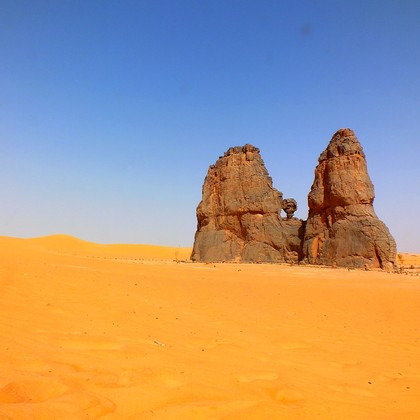
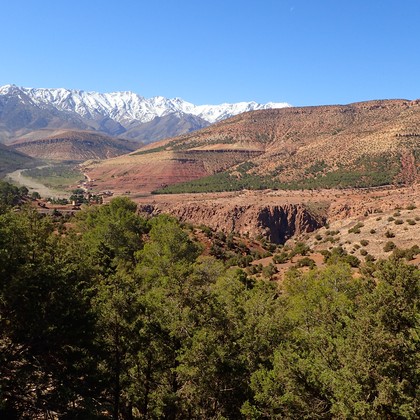
Rocky slopes and bare knolls with scattered bushes, terraces, clearings and the edges of juniper woodland, mostly between 1,500 and 3,000 m. Feeds on seeds and greens on abandoned and still-cultivated terrace fields around mountain villages.
Where the bird is most at home, classified by the habitats of North Africa and the Middle East.
Range and movements
Endemic to the highlands of south-west Arabia: in Saudi Arabia from the Al Baha area south through Tanomah and the Asir mountains (including Jebel Soudah) to the Yemen border, and in Yemen on the northern and western highlands. Found nowhere else in the world.
- Resident
- Summer visitor (c. Oct–Mar)
- Passage (Mar–Apr, Oct–Nov)
- dark = core range, pale = thinly spread
How and when to look
Search terraces and rocky knolls around Tanomah or near Al Baha shortly after sunrise, when birds call from a vantage point. Drive slowly along the mountain roads and scan open terraces. On Jebel Soudah the chances have fallen markedly because of crowds.
Conservation status
Not threatened, but its entire range is small. Hunting, growing recreation and construction in the Asir mountains and the abandonment or conversion of old terraces depress numbers locally; around Jebel Soudah the species has clearly declined. Little is known of its status in Yemen.
Scientific name
Alectoris philbyi | Lowe, 1934
Lowe described the species in 1934 and placed it straight away in the genus where it still stands. The genus Alectoris was introduced in 1829 by Kaup. Alectoris is Greek, from alektoris 'farmyard hen', from alektōr 'cockerel'. philbyi honours Harry St John Philby (1885-1960), British explorer and Arabist. The specimen the first description was based on came from Taif, Makkah Province, Saudi Arabia.