All species › Gamebirds › Pheasants and partridges › Double-Spurred Spurfowl
Double-Spurred Spurfowl | Pternistis bicalcaratus
Barbarijse frankolijn | Francolín biespolado
A brown, streaked gamebird of tropical West Africa, with a single small, isolated population in the region in Morocco south of Rabat, the only birds north of the Sahara. They form their own subspecies, P. b. ayesha, regarded as critically endangered. In the first light of March a harsh, grating call from the scrub betrays its presence.
Voice
The best clue. From a stone, earth mound or low branch a harsh, hoarse, far-carrying grating of three to five rough syllables, like a rusty saw, repeated in series, mainly at sunrise and towards sunset. Surveys use playback in the first days of March, when calling peaks.
Recording: Étienne Leroy — CC BY-NC-SA 4.0 · converted to mono · xeno-canto
Identification
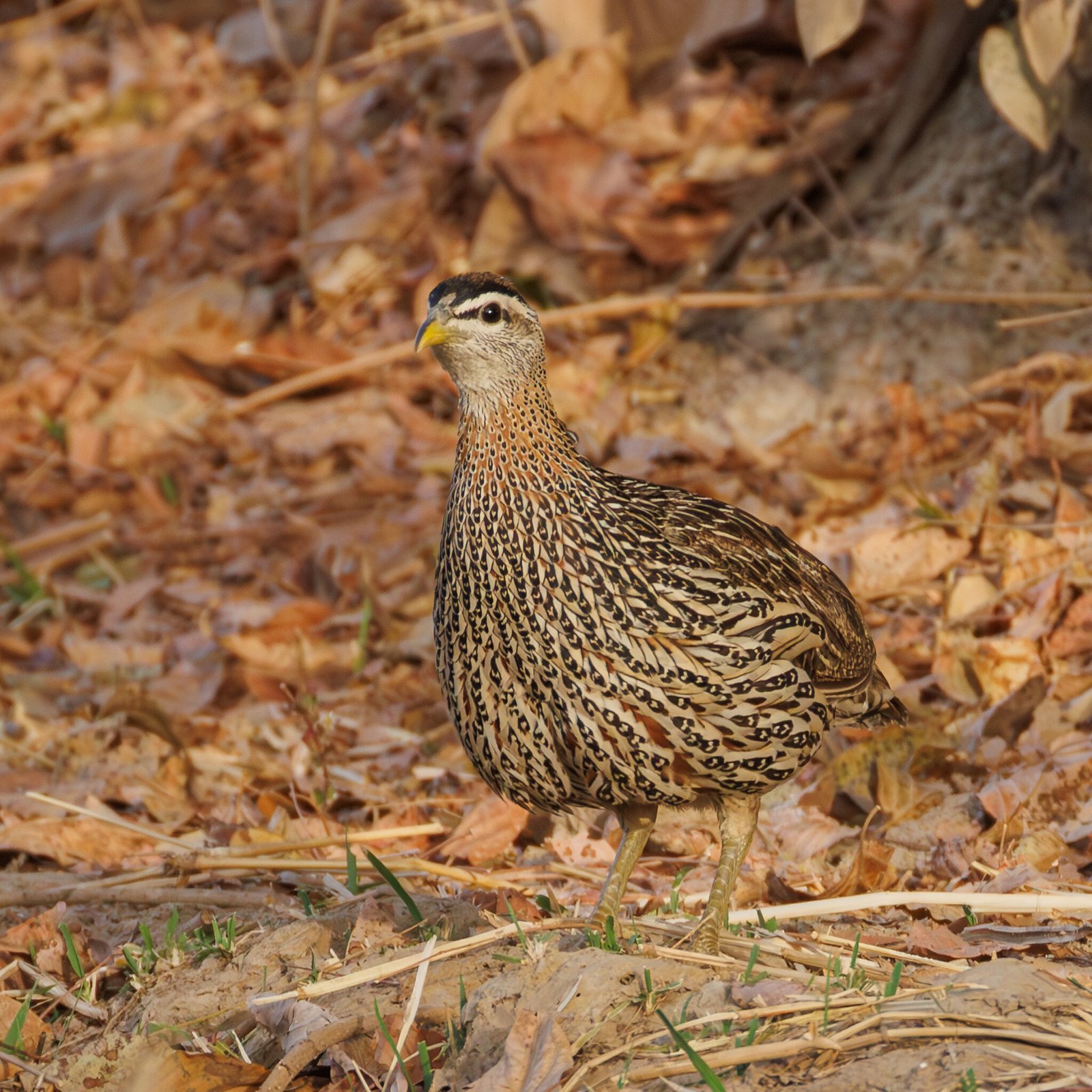
Slender, long-legged gamebird in brown and cream. A long creamy-white supercilium above a dark eye-stripe; cheek and throat pale, crown chestnut. Upperparts brown with pale shaft streaks, underparts creamy with dark drops and arrowheads, densest on the breast. Bill dark, legs greenish grey. Upright stance with a long neck. The male carries two spurs on each tarsus; the female is smaller and usually has none.
Confusion species
In Morocco it lives alongside Barbary Partridge (Alectoris barbara), which is grey with a chestnut, white-spotted collar, red bill and red legs, and unstreaked. Common Quail (Coturnix coturnix) is much smaller and flies off rather than running. The other francolins of the region, Black Francolin (Francolinus francolinus) and Gray Francolin (Ortygornis pondicerianus), occur only in the east, thousands of kilometres away.
Habitat
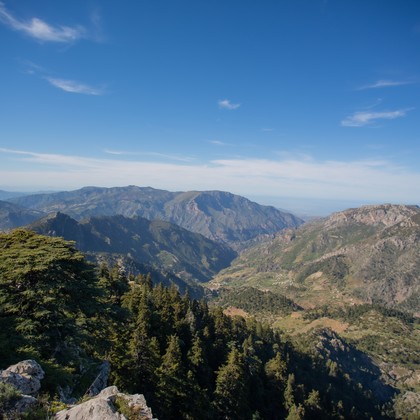
Matorral (Mediterranean scrub) of dwarf palm, jujube (a thorny North African shrub), mastic and wild olive, with clearings and sandy tracks; the more tall shrubs and low trees, the more birds. Also the edges of cork oak forest and the cereal fields, fallows and stubbles between the scrub, where it feeds on seeds, tubers and insects.
Where the bird is most at home, classified by the habitats of North Africa and the Middle East.

Range and movements
Within the region only in Morocco, on the plateau south of Rabat, in the area of Sidi Yahya Zaër, Sidi Bettache and Benslimane. In the twentieth century the range was larger and included the Maâmora forest; a separate group in the Souss disappeared in the 1980s. Released birds from a breeding programme now live again in the Maâmora and in Souss-Massa National Park. Beyond the region in the Sahel and savannas of West Africa, from Senegal east to Cameroon.
- Resident
- Summer visitor (c. Apr–Sep)
- Winter visitor (c. Oct–Mar)
- Passage (Mar–Apr, Oct–Nov)
- dark = core range, pale = thinly spread
How and when to look
In early March stand before sunrise on a sandy track in the matorral near Benslimane or Sidi Bettache and listen for half an hour without moving. Then scan the open ground and low stones between the palm clumps: at first sunlight birds step up onto a vantage point. Do not walk into the scrub; they run faster than you can follow.
Conservation status
Not globally threatened thanks to the large West African population, but the Moroccan subspecies has been reduced to a small area and is regarded as critically endangered. Clearance of matorral for cereals, grazing and hunting are the main pressures. Since 2011 birds hatched in captivity from eggs from the Aïn Sferjla reserve have been released in the Maâmora, on the central plateau and in Souss-Massa.
Scientific name
Pternistis bicalcaratus | (Linnaeus, 1766)
Linnaeus described the species in 1766 as Tetrao bicalcaratus; because it was later moved to another genus, the author and year stand in brackets. The genus Pternistis was introduced in 1832 by Wagler. Pternistis comes from Greek pternistēs 'one who strikes with the heel', from pterna 'heel', after the spurs on the legs. bicalcaratus is Latin, from bi 'two' and calcar, genitive calcaris, 'spur': the male carries two spurs on each leg. The specimen the first description was based on came from Senegal.