All species › Passerines › Buntings › House Bunting
House Bunting | Emberiza sahari
Huisgors | Escribano sahariano
The House Bunting is the bunting of North African villages and towns: a small, cinnamon-brown bird that trots like a sparrow across yards, courtyards and market squares and sings from roofs and walls. It is the western counterpart of the Striolated Bunting and is now usually treated as a separate species.
Voice
The song is a short, high, slightly twanging ditty of five or six notes with a falling ending, witchee-witchee-weechoo, from a roof edge, an aerial or a low wall; it can be heard almost all year and is loudest in the early morning. The call is a thin, nasal tcheep or tchooo.
Recording: Guido O. Keijl — CC BY-NC-SA 4.0 · shortened to the first 60 s, mono · xeno-canto
Identification
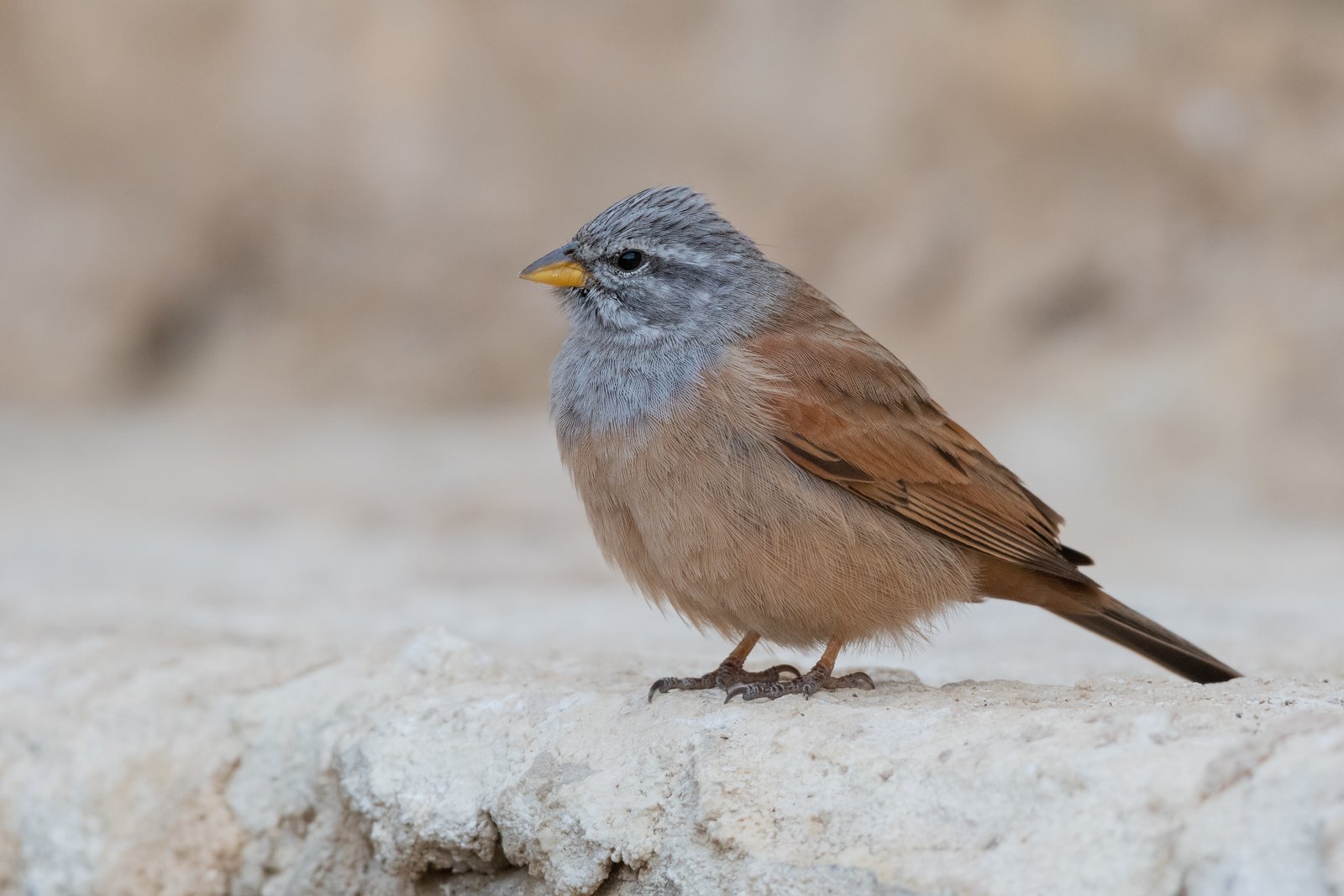
14 cm, a small, short-tailed bunting without white in the tail. The male has a grey head with fine pale stripes: an indistinct pale crown stripe, a pale supercilium and a pale stripe below the cheek, with a grey, barely streaked throat and breast. Back and underparts are warm cinnamon to orange-brown and almost unstreaked; the wings are rufous. The upper mandible is dark, the lower orange-yellow. The female is duller, with a browner, streaked head and less contrast. Juveniles resemble the female.
Confusion species
Striolated Bunting (Emberiza striolata), from Sinai eastwards, has a more sharply black-and-white striped head with a clear white supercilium and cheek stripe, a streaked throat and a streaked back; the two species barely overlap in the region. Rock Bunting (Emberiza cia) in the Atlas has a silver-grey head with black stripes, white in the tail and a rufous belly. Female House Sparrow (Passer domesticus) lacks the cinnamon tones and has no orange-yellow lower mandible.
Habitat
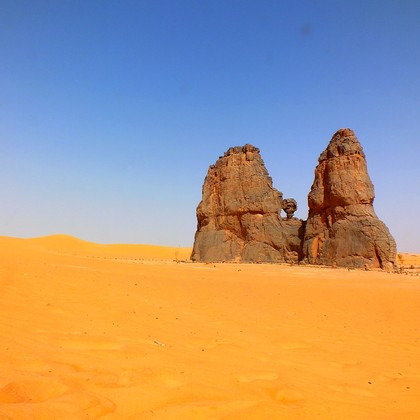
Villages, ksour and kasbahs, old town quarters and medinas, oases and farmyards, and beyond them rocky slopes, gorges and dry wadis in the mountains and on the desert edge. It nests in holes and crevices in walls, under roofs and in rocks. It feeds on the ground on seeds, crumbs and insects, often fearlessly close to people.
Where the bird is most at home, classified by the habitats of North Africa and the Middle East.


Range and movements
Widespread in Morocco, from the Middle and High Atlas and the Anti-Atlas to the desert edge and the southern oases, and in recent decades spreading north into the towns of the Atlantic lowlands and the Rif. In Algeria in the Saharan Atlas, the oases and the Saharan massifs (Hoggar, Tassili), in southern Tunisia and in south-western Libya (Fezzan). Beyond the region in the mountains of the Sahara and the Sahel, from Mauritania to Chad; since the 2000s also a few settlements in southern Spain.
- Resident
- Summer visitor (c. Apr–Sep)
- Winter visitor (c. Oct–Mar)
- Passage (Mar–Apr, Oct–Nov)
- dark = core range, pale = thinly spread
How and when to look
In any Moroccan town with old buildings: in the medina of Marrakech, around the kasbahs of the Drâa and Dadès valleys and in the villages of the High Atlas. Look in courtyards, on roofs and low walls, and listen for the short song; it often allows close views, even on café terraces.
Conservation status
Not globally threatened. Common and spreading in Morocco, probably helped by the growth of villages and towns. Away from settlements the species is less numerous, and it is thinly spread in the central Sahara.
Scientific name
Emberiza sahari | Levaillant, 1850
Levaillant described the species in 1850 and placed it straight away in the genus where it still stands. The genus Emberiza was introduced in 1758 by Linnaeus. Emberiza comes from Old German Embritz, a name for a bunting. sahari means 'of the Sahara', after the desert edge where the species lives. The specimen the first description was based on came from southern Algeria.