All species › Passerines › Sylvia warblers › Hume's Whitethroat
Hume's Whitethroat | Curruca althaea
Hume's braamsluiper | Curruca de Hume
Hume's Whitethroat is a dark, robust relative of Lesser Whitethroat from the mountains of Iran and Central Asia, wintering in India and Pakistan. In the region it is a rare passage migrant and winter visitor on the eastern edge of Arabia, and one of the most difficult warblers of the area.
Voice
The call is a dry, hard tsek, as in Lesser Whitethroat. The song is more varied and more melodious than the rattling final trill of Lesser Whitethroat, with clear whistles; it is rarely heard in the region.
Recording: Arend Wassink — CC BY-NC-SA 3.0 · shortened to the first 60 s, mono · xeno-canto
Identification
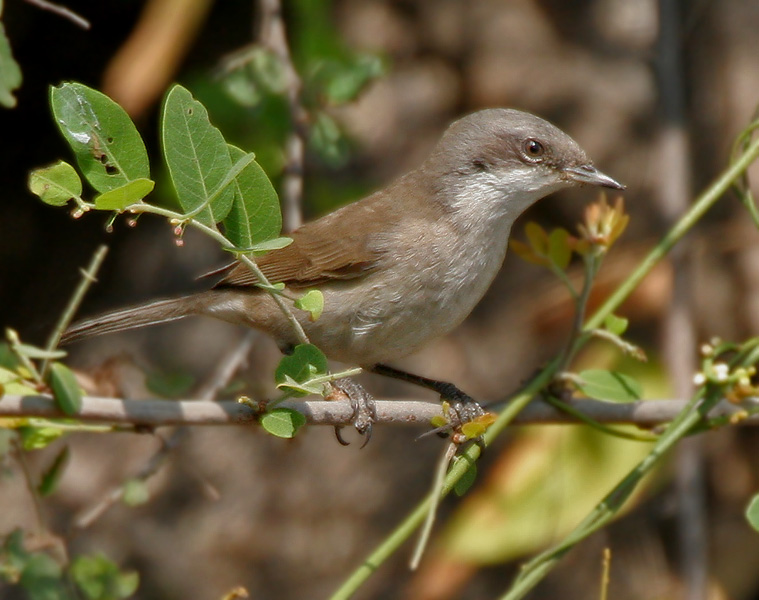
13–14 cm, slightly larger and more heavily built than Lesser Whitethroat, with a stouter bill. The crown is dark slate-grey and merges without a clear border into the dark ear-coverts, so that the bird seems to wear a dark hood. The upperparts are dark grey-brown, without a rufous wing panel, and the contrast between head and back is smaller than in Lesser Whitethroat. Throat bright white, underparts white with a greyish wash on the flanks. Outer tail feathers white; legs dark slate-grey; iris dark. Sexes alike.
Confusion species
Lesser Whitethroat (Curruca curruca) is smaller and paler, with a lighter grey crown against which the dark ear-coverts stand out clearly, and a finer bill; the pale Central Asian forms that winter in Arabia are paler still. Eastern Orphean Warbler (Curruca crassirostris) is clearly larger, with a heavier bill, a pale iris in adults and a dark tail with white sides. Female Ménétriés's Warbler (Curruca mystacea) has pale legs, a pale eye-ring and no dark mask. Because of the overlap, a certain identification is often impossible without good photographs or a sound recording.
Habitat
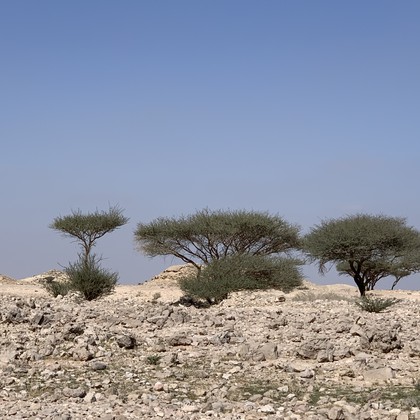
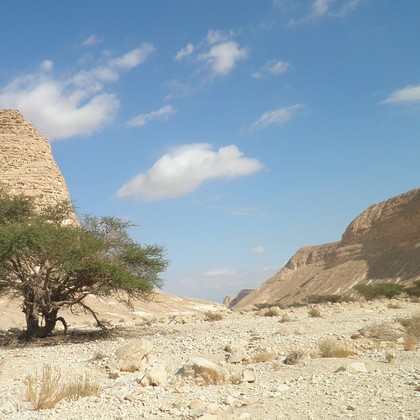
In the region in thorn scrub, acacias and prosopis on plains and in wadis, and in well-vegetated gardens and parks. On the breeding grounds in juniper and scrub on mountain slopes to above 3000 m.
Where the bird is most at home, classified by the habitats of North Africa and the Middle East.
Range and movements
In the region a rare passage migrant and winter visitor: in the United Arab Emirates only a few accepted records (March and September), in Kuwait a rare passage migrant in the west at Al Abraq, and in Oman and eastern Saudi Arabia very scarce and probably overlooked. Not known from the Levant or North Africa. Beyond the region it breeds in the mountains of north-east Iran, Afghanistan, Pakistan and Central Asia to the Tien Shan, and winters in Pakistan, India and Sri Lanka.
How and when to look
In March and in autumn look for strikingly dark-headed whitethroats in gardens and scrub along the east coast of Arabia, and try to photograph call and head well; records are assessed by the national rarities committees.
Conservation status
Not globally threatened; IUCN still assesses it as part of Lesser Whitethroat. The taxonomy of the Lesser Whitethroat complex is in flux, and confusion with dark Lesser Whitethroats makes its true status in the region uncertain.
Scientific name
Curruca althaea | (Hume, 1878)
Hume described the species in 1878 as Sylvia althaea; because it was later moved to another genus, the author and year stand in brackets. The genus Curruca was introduced in 1802 by Bechstein. Curruca is Latin, the name of an unidentified small bird mentioned by the Roman poet Juvenal. althaea refers to Althaea, in Greek mythology the mother of Meleager; why Hume chose this name is not recorded.