All species › Passerines › Sylvia warblers › Dartford Warbler
Dartford Warbler | Curruca undata
Provençaalse grasmus | Curruca rabilarga
The Dartford Warbler is a dark, long-tailed warbler of dense low scrub, found in the region in the coastal mountains and hills of the northern Maghreb. The North African form toni is slightly paler than European birds. A shy scrub-dweller that is heard more often than seen.

Voice
The song is a short, fast, scratchy chatter of one and a half to two seconds, cher-witcher-chi-cherry, from a bush top or in a short, dancing song flight. More characteristic is the call: a rasping, drawn-out chairr, repeated endlessly by an anxious bird, and a short tuk.
Recording: Chèvremont Fabian — CC BY-NC-SA 4.0 · converted to mono · xeno-canto
Identification
12–13 cm, almost half of it tail. Head and upperparts dark slate-grey, underparts wine-red to reddish brown with fine white speckles on the throat. Eye-ring and iris red to orange-red, legs orange-brown, bill dark with a pale base. The wing is short and rounded, the long narrow tail blackish with narrow white tips, often cocked. The female is browner above and duller pinkish brown below; juveniles are drab and almost lack the red. The form toni is slightly paler and greyer above and a little lighter below than European birds.
Confusion species
Marmora's Warbler (Curruca sarda), in winter in Tunisia, is uniformly slate-grey above and below, without wine-red and without throat speckles. Tristram's Warbler (Curruca deserticola) has a rufous wing panel and a white moustache. Sardinian Warbler (Curruca melanocephala), everywhere in the same scrub, is bulkier, with a black hood and a pure white throat. Western Subalpine Warbler (Curruca iberiae) is shorter-tailed and has an orange throat with a white moustache.
Habitat
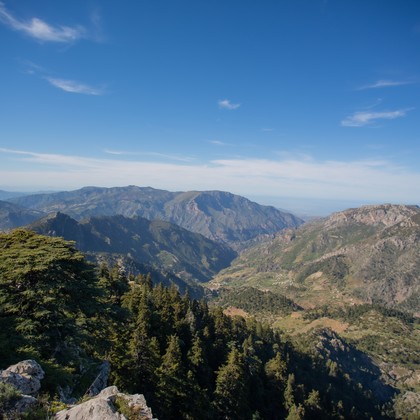
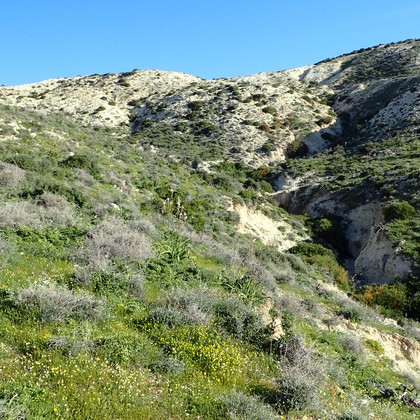
Dense, low scrub on hills and mountain slopes: maquis and garrigue with cistus, heath (Erica), gorse, dwarf palm and young cork or holm oaks, often after fire or felling. In Morocco up to well over 1500 m in the Rif and Middle Atlas; avoids open steppe and desert.
Where the bird is most at home, classified by the habitats of North Africa and the Middle East.
Range and movements
In the region only in the northern Maghreb: in Morocco in the Rif, the northern Atlantic coastal belt and the northern Middle Atlas; in northern Algeria in the coastal mountains and Tell Atlas, east to the border area with Tunisia; in north-west Tunisia in the Kroumirie and Mogod. Absent south of the Atlas and from Libya. In winter perhaps a few European birds join them in northern Morocco. Elsewhere from southern England and western France across Iberia to Liguria, Tuscany, Corsica and Sardinia.
- Resident
- Summer visitor (c. Oct–Mar)
- Winter visitor (c. Apr–Sep)
- Passage (Mar–Apr, Oct–Nov)
- dark = core range, pale = thinly spread
How and when to look
In Morocco in the maquis of the Rif around Chefchaouen and in the cork oak woods near Larache and Mamora; in Tunisia in the heath and cistus scrub of the Kroumirie near Aïn Draham. Listen for the rasping chairr call: those who wait for a singing bird often miss it.
Conservation status
Near Threatened. The world population has declined sharply, especially in Spain and France, through hard winters, fires and loss of scrub. The North African form toni is little studied; overgrazing, cutting and conversion of maquis to fields and plantations are the main threats.
Scientific name
Curruca undata | (Boddaert, 1783) (GBIF: Sylvia undata)
Boddaert described the species in 1783 as Motacilla undata; because it was later moved to another genus, the author and year stand in brackets. The genus Curruca was introduced in 1802 by Bechstein. Curruca is Latin, the name of an unidentified small bird mentioned by the Roman poet Juvenal. undata is Latin for 'waved, wavy', from unda 'wave'. The specimen the first description was based on came from Provence, France.