All species › Passerines › Chats and flycatchers › Isabelline Wheatear
Isabelline Wheatear | Oenanthe isabellina
Izabeltapuit | Collalba isabel
The Isabelline Wheatear is a large, pale, long-legged wheatear of open steppe and semi-desert. It breeds in the north of the Middle East and in winter is one of the commonest wheatears of Arabia.

Voice
The song is loud and varied, much richer than Northern Wheatear's: grating and clucking notes running into clear whistles and much mimicry, often in a high song flight. The call is a loud whistled weet and a hard chak.
Recording: Frantz Barrault — CC BY-NC-SA 4.0 · shortened to the first 60 s, mono · xeno-canto
Identification
15.5–16.5 cm. Large, with a big head, long black legs and a short tail; stands very upright. Uniformly sandy without contrast between back, breast and wing; the wing is as pale as the mantle, only the alula standing out as a small dark spot. Face plain, with dark lores and a white supercilium that is clearest in front of the eye. The bill is long and black. Tail with a white base and a broad black terminal band covering more than half the tail, so the white rump patch looks small. Underwing white. Sexes alike.
Confusion species
Females and autumn birds of Northern Wheatear (Oenanthe oenanthe) are slimmer and smaller, with darker wings contrasting with the back, a clearer supercilium behind the eye and a narrower terminal band. Desert Wheatear (Oenanthe deserti) has an almost entirely black tail. Buff-breasted Wheatear (Oenanthe bottae) of the Asir and Yemen highlands is warmer, with an orange-buff breast and a darker back.
Habitat
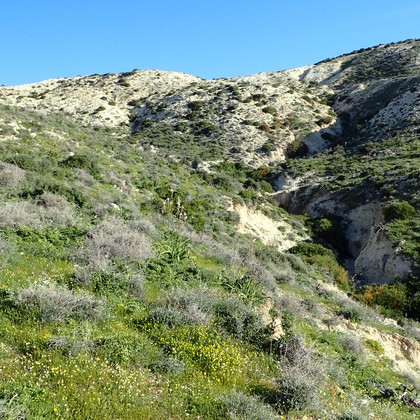
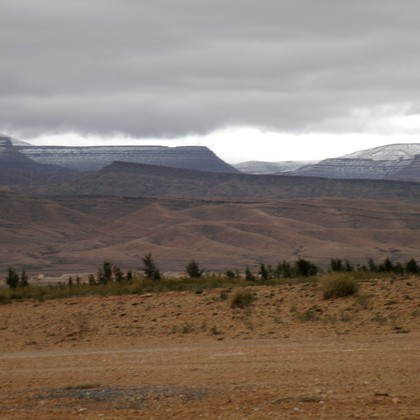
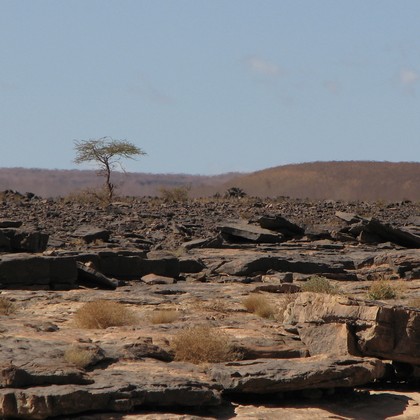
Flat or gently rolling steppe, semi-desert and plateaux with short vegetation, often near colonies of jerboas or gerbils, in whose burrows it nests. In winter on open stony desert, dry fields, fallow land and coastal plains.
Where the bird is most at home, classified by the habitats of North Africa and the Middle East.
Range and movements
Breeds in Syria, Lebanon (Bekaa), Jordan, northern Israel and Iraq, locally also in northern Saudi Arabia and Kuwait. A common winter visitor to Saudi Arabia, Yemen, Oman, the United Arab Emirates, Qatar, Bahrain, Kuwait, southern Iraq and Egypt; a passage migrant through the whole Levant and Sinai. West of Egypt scarce to rare, a vagrant in Morocco. Beyond the region from Turkey and Ukraine to Mongolia and China; also winters in the Sahel, East Africa and north-west India.
- Resident
- Summer visitor (c. Oct–Mar)
- Winter visitor (c. Apr–Sep)
- Passage (Mar–Apr, Oct–Nov)
- dark = core range, pale = thinly spread
How and when to look
In winter on any stony plain or dry field in the United Arab Emirates or Oman; in March and April singing above the steppe of Jordan or the Golan.
Conservation status
Not globally threatened. Locally declining through the ploughing of steppe and rodent control, which removes nesting burrows.
Scientific name
Oenanthe isabellina | (Temminck, 1829)
Temminck described the species in 1829 as Saxicola isabellina; because it was later moved to another genus, the author and year stand in brackets. The genus Oenanthe was introduced in 1816 by Vieillot. Oenanthe was used by Aristotle for a bird that can no longer be identified; the word comes from the Greek oinos, oinoē 'wine, vine' and anthos 'flower, bloom'. isabellina is Neo-Latin for 'isabelline', a greyish yellow-brown said to be named after Isabella of Castile. The specimen the first description was based on came from Nubia.