All species › Passerines › Chats and flycatchers › Western Black-Eared Wheatear
Western Black-Eared Wheatear | Oenanthe hispanica
Westelijke blonde tapuit | Collalba rubia occidental
The Western Black-eared Wheatear is a common summer visitor to the Maghreb in dry, stony and scrubby country, from the coast to the high plateaus of the Atlas. It hunts insects from a stone or bush and returns to the same perch after each catch. Since it has been treated as a species separate from Eastern Black-eared Wheatear, it is the region's black-eared wheatear of the west; from Egypt eastwards the eastern species replaces it.

Voice
The call is a hard, dry chak and a soft, whistled weet. The song is a short, scratchy and rattling phrase, often from a high perch or in a short song flight, including mimicry of other birds.
Recording: Stanislas Wroza — CC BY-NC-SA 4.0 · converted to mono · xeno-canto
Identification
13.5–15.5 cm. Slimmer and longer-tailed than Northern Wheatear. The breeding male has a creamy to warm ochre crown, nape and mantle, a black mask from the bill base across eye and ear-coverts, black wings and white underparts with a buff wash on the breast. There is a white-throated and a black-throated form; both occur together. The tail is mostly white with a narrow black terminal band and a thin black central stripe, the black band often broader on the outer feathers. The female is warm sandy brown with dark wings and a faint dark mask, and the same tail. In autumn broad pale fringes conceal the black.
Confusion species
Eastern Black-eared Wheatear (Oenanthe melanoleuca), which breeds from the Levant to Iran and migrates through Egypt and Arabia, has in the male a cooler, whiter back and head, a black mask extending over the bill base and, in black-throated birds, a broader black throat reaching the shoulder; females and autumn birds are usually not identifiable to species away from the breeding range. Male Pied Wheatear (Oenanthe pleschanka) has a black back joined to the black throat. Northern Wheatear (Oenanthe oenanthe) is larger, greyer-backed and has a broader black terminal band. Desert Wheatear (Oenanthe deserti) has an almost all-black tail.
Habitat
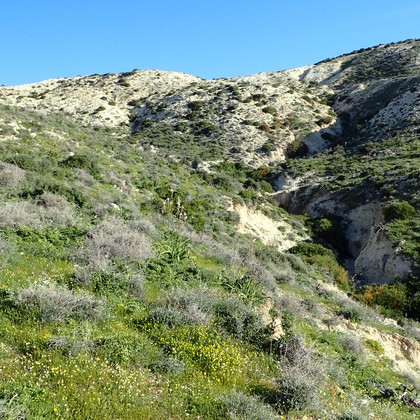
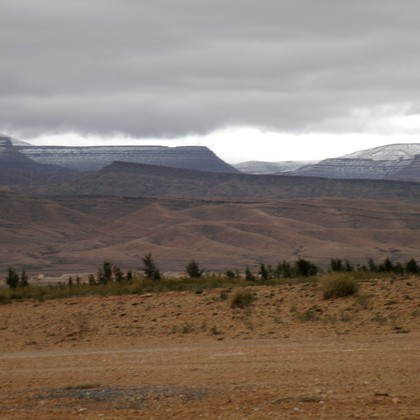
Dry, open and stony country with scattered bushes and trees: garrigue, dwarf-palm scrub, open oak and juniper woodland, stony slopes and terraces, alfa steppe and the edges of olive groves and fields, from sea level to about 2,000 m in the Atlas. Nests on the ground under a stone or in a crevice in a wall.
Where the bird is most at home, classified by the habitats of North Africa and the Middle East.

Range and movements
Breeds throughout northern Morocco, from the Atlantic coast and the Rif through the Middle and High Atlas and the Anti-Atlas to the eastern high plateaus; further in northern Algeria, Tunisia and north-west Libya. On passage, in March – April and August – October, it appears in the oases and wadis of the Sahara. East of Libya it is largely replaced by Eastern Black-eared Wheatear; confirmed records of the western species in Egypt and the Middle East are rare. Beyond the region the species breeds in Iberia, southern France and Italy, and winters in the Sahel from Senegal to Chad.
- Summer visitor (c. Apr–Sep)
- Winter visitor (c. Oct–Mar)
- Passage (Mar–Apr, Oct–Nov)
- dark = core range, pale = thinly spread
How and when to look
In Morocco it is common in April and May along the roads of the Middle Atlas and on the stony slopes around Ouarzazate and the Dades valley; males sing from boulders and bushes. Photograph black-throated males side-on to compare the throat patch with that of the eastern species.
Conservation status
Not globally threatened. Widespread and locally common in the Maghreb; in Europe numbers have fallen through the loss of extensive farming and scrub encroachment of open land, and in North Africa overgrazing plays a role locally.
Scientific name
Oenanthe hispanica | (Linnaeus, 1758)
Linnaeus described the species in 1758 as Motacilla hispanica; because it was later moved to another genus, the author and year stand in brackets. The genus Oenanthe was introduced in 1816 by Vieillot. Oenanthe was used by Aristotle for a bird that can no longer be identified; the word comes from the Greek oinos, oinoē 'wine, vine' and anthos 'flower, bloom'. hispanica is Latin for 'Spanish', after the Iberian Peninsula. The specimen the first description was based on came from Gibraltar.