All species › Waders, gulls and terns › Sandpipers and snipes › Lesser Yellowlegs
Lesser Yellowlegs | Tringa flavipes
Kleine geelpootruiter | Archibebe patigualdo chico
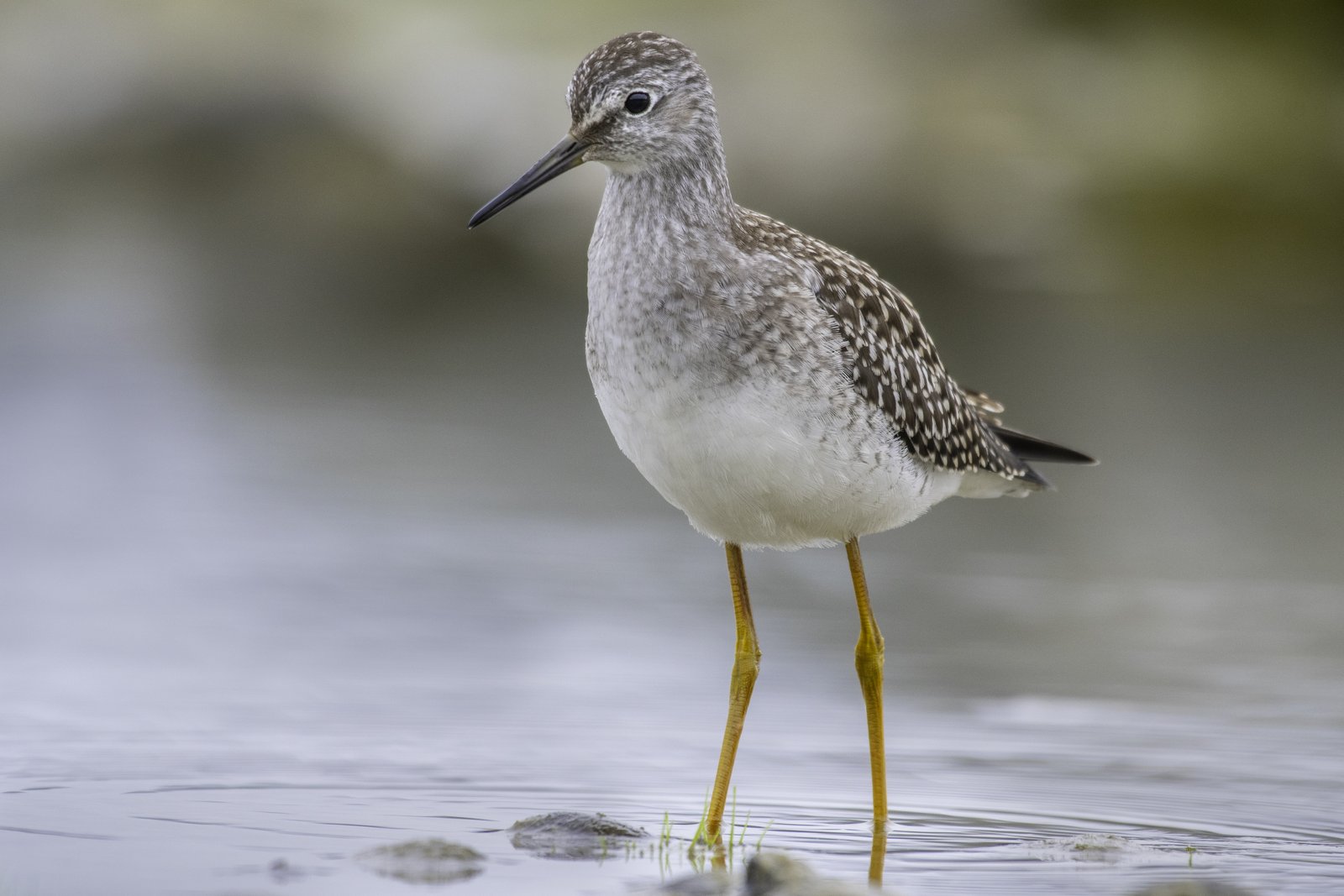
A slender Tringa with long canary-yellow legs, a breeder of the North American taiga that turns up annually in Europe but reaches the region only very exceptionally. The few records are scattered from Tunisia to Israel and the Emirates and concern single birds, which sometimes stay for weeks.
Voice
A soft, flat tew or tu-tu, usually one or two notes, softer and less penetrating than the three-note call of Common Greenshank. When alarmed a short kip.
Recording: Tony Rinaud — CC BY-NC-SA 4.0 · converted to mono · xeno-canto
Identification
Medium-sized and slim, with a straight, thin dark bill about as long as the head and long, bright yellow legs. Upperparts grey-brown with fine white spots along the feather edges; neck and breast finely streaked grey, belly white. A short white supercilium in front of the eye and a white eye-ring. Long wingtips reaching well beyond the tail, giving the bird an attenuated rear. In flight a plain dark wing without a wing bar, a square white rump with no wedge up the back and a finely barred grey tail.
Confusion species
Wood Sandpiper (Tringa glareola) is the main pitfall: smaller and shorter-legged, with a longer, clear white supercilium, more heavily spotted upperparts, shorter wingtips and yellowish-green rather than bright yellow legs. Marsh Sandpiper (Tringa stagnatilis) has a needle-fine bill, olive-green legs and a white wedge reaching far up the back. Common Redshank (Tringa totanus), including yellowish-legged juveniles, is more compact, with a red bill base and a broad white trailing edge to the wing. Green Sandpiper (Tringa ochropus) is darker with greenish legs. Greater Yellowlegs (Tringa melanoleuca), an extremely rare vagrant to the region (Morocco, Massa, November 2005), is larger with a longer, slightly upturned bill.
Habitat
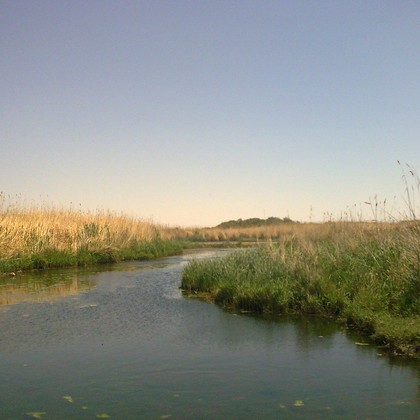
Shallow fresh and brackish water with soft edges: fish ponds, sewage ponds, small lakes, flooded fields and the sheltered edges of lagoons. In the region birds have mainly been found on fish ponds and inland pools, often among other Tringa species.
Where the bird is most at home, classified by the habitats of North Africa and the Middle East.


Range and movements
A very rare vagrant. Israel has two records: one at Ma'agan Michael on 26 June 1977 and one at the fish ponds of Kibbutz Neve Eitan in the Beit She'an Valley on 25 September 2008. In the Emirates one stayed at Neima Pools from 28 November 2007 to 25 January 2008 and then nearby until 23 April 2008, a case of overwintering. In Tunisia the first national record was published in 2015. There may be further records, for instance from Morocco and Oman; these could not be verified for this guide. Breeds in the taiga of Alaska and Canada and winters from the southern United States and the Caribbean to southern South America; in Europe the commonest American Tringa, mainly in Britain and Iberia.
How and when to look
The chances are small, but any "Wood Sandpiper" with strikingly yellow legs, long wingtips and a short supercilium deserves a second look, especially in autumn on fish ponds in Israel and the Gulf states and in winter on wetlands in the Maghreb. Photograph the bird in flight: the square white rump without a back wedge and the plain wing are decisive.
Conservation status
Vagrant to the region. Globally Vulnerable (IUCN): North American surveys point to a steep loss since the 1970s, of the order of more than half the population. Cited causes are the loss of shallow stopover wetlands along the flyway, hunting on migration in the Caribbean and northern South America, and changes on the boreal breeding grounds.
Scientific name
Tringa flavipes | (Gmelin, 1789)
Gmelin described the species in 1789 as Scolopax flavipes; because it was later moved to another genus, the author and year stand in brackets. The genus Tringa was introduced in 1758 by Linnaeus. Tringa is the Neo-Latin name Aldrovandi gave to the green sandpiper, after Ancient Greek trungas, a thrush-sized, white-rumped, tail-bobbing wading bird mentioned by Aristotle. flavipes is Latin, from flavus 'yellow' and pes 'foot', after the yellow legs. The specimen the first description was based on came from New York.