All species › Owls › Typical owls › Little Owl
Little Owl | Athene noctua
Steenuil | Mochuelo europeo
A small, compact owl with a flat head, yellow eyes and a stern look, found in the region from the Atlantic coast of Morocco to the Persian Gulf. It is often seen by day on a boulder, wall or post, and is the most frequently seen owl here.

Voice
The male’s song is a plaintive, rising gooek, repeated at intervals, especially at dusk. The alarm is a sharp, yelping kee-ew or kiew-kiew, also heard by day.
Recording: Jack Berteau — CC BY-NC-SA 4.0 · converted to mono · xeno-canto
Identification
Small and rotund, with a broad, flat head without ear tufts, short tail and fairly long legs. Upperparts brown with white spots, underparts white with broad brown streaks. White brows above the lemon-yellow eyes give a frowning expression. The desert forms of the region are much paler than European birds: saharae in the Sahara and lilith in the Middle East and Arabia are sandy to pale greyish-brown with little contrast. Flies in deep undulations; bobs and bows with the whole body when alarmed.
Confusion species
Eurasian Scops-Owl (Otus scops) and Pallid Scops Owl (Otus brucei) are slimmer, have ear tufts (often flattened) and are strictly nocturnal; by day they sit pressed against a trunk, not out in the open on a rock. Desert Owl (Strix hadorami) is larger, with orange eyes and a round face without brows. Western Barn Owl (Tyto alba) has a white heart-shaped face and black eyes.
Habitat
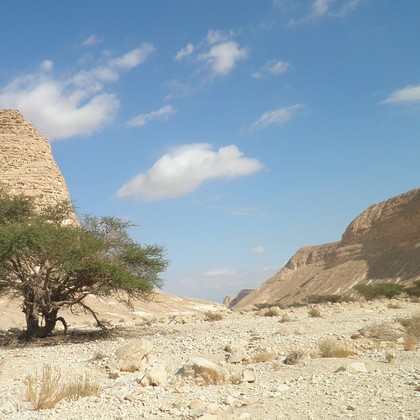
Open, dry country with perches and nest sites: stony desert and rocky slopes, wadis, oases and palm groves, olive groves, farmland with stone walls, ruins and village edges. Nests in rock crevices, walls, old buildings and hollow trees. Hunts from a lookout for beetles, grasshoppers, small rodents and lizards, and also runs a lot on the ground.
Where the bird is most at home, classified by the habitats of North Africa and the Middle East.


Range and movements
Widespread in North Africa: throughout Morocco including Western Sahara, northern Algeria and the Algerian Sahara to the Hoggar, Tunisia, the Libyan coast with the Jebel Akhdar and the oases of the Fezzan, and in Egypt in the Nile valley and delta, the oases of the Western Desert and Sinai. In the Middle East common in Israel and Samaria and Judea, Jordan, Lebanon, Syria and Iraq. On the Arabian Peninsula widespread in Saudi Arabia, Kuwait and the highlands of Yemen; scarcer and more local in Qatar, the Emirates and Oman, and absent from the deep sand seas of the Rub al Khali and from Socotra. Beyond the region from western Europe to China and Korea, and in East Africa to Eritrea and Somalia.
- Resident
- Summer visitor (c. Oct–Mar)
- Winter visitor (c. Apr–Sep)
- Passage (Mar–Apr, Oct–Nov)
- dark = core range, pale = thinly spread
How and when to look
At Petra and Wadi Rum (Jordan), on the scree slopes of Sinai and at the Roman ruins of Libya and Tunisia it often sits by day on a boulder or wall, easily seen with a telescope. Scan the edges of palm groves and olive groves in late afternoon light; a nervously bobbing bird soon gives itself away.
Conservation status
Not threatened, and widespread and locally common in the region. Road traffic, rodent poison and the loss of old walls and hollow trees as farming modernises take their toll; in Europe the species has declined sharply.
Scientific name
Athene noctua | (Scopoli, 1769)
Scopoli described the species in 1769 as Strix noctua; because it was later moved to another genus, the author and year stand in brackets. The genus Athene was introduced in 1822 by Boie. Athene refers to the Greek goddess Athena, whose emblem was the owl. noctua is the Latin name of the owl sacred to Minerva, Athena's Roman counterpart. The specimen the first description was based on came from Carniola, Slovenia.