All species › Swifts › Swifts › Little Swift
Little Swift | Apus affinis
Huisgierzwaluw | Vencejo moro
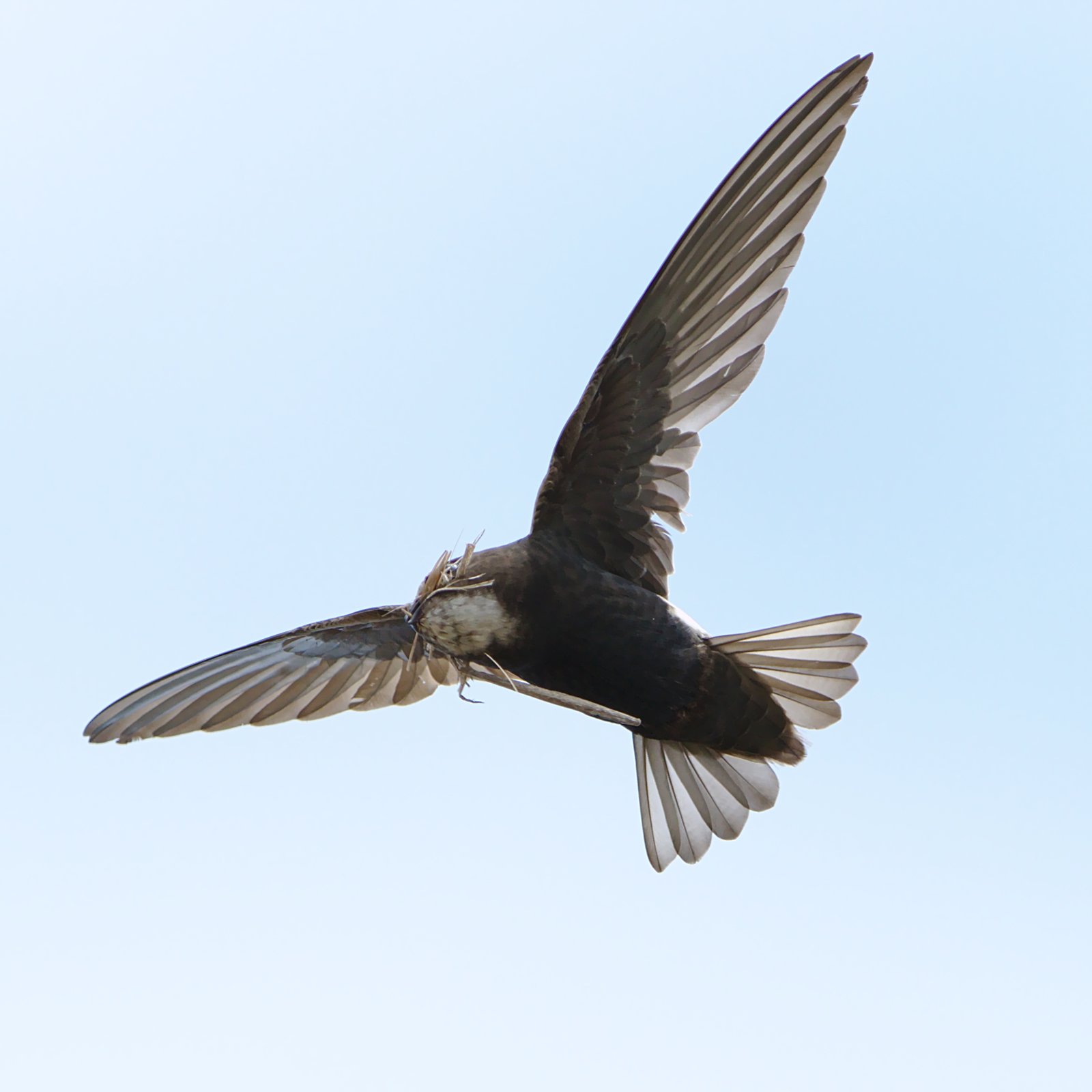
The small, compact swift of towns, oases and gorges throughout the region, recognised by its broad white rump. It breeds in colonies of tens to hundreds of pairs under eaves, bridges and rock overhangs, where it glues together nests of feathers and straws.
Voice
Noisy at the colony: a fast, shrill rattling trill, tirrr-tirrr-riririe, given by parties chasing around the nest site. Higher, drier and more rattling than the scream of Common Swift.
Recording: African Bioacoustics Community — CC BY-NC-SA 4.0 · converted to mono · xeno-canto
Identification
Small and compact, with a broad wing base, rather blunt wing tips and a square-cut tail with no fork, looking even rounded when spread. Plumage black-brown; the large, square white rump wraps far onto the flanks and is visible from the side. A large white throat patch reaching onto the face. Flight is more fluttering and twisting than in the larger swifts, with short glides.
Confusion species
White-rumped Swift (Apus caffer) is slimmer, with a narrow white crescent that does not reach the flanks and a long, deeply forked tail. Common Swift (Apus apus) and Pallid Swift (Apus pallidus) are much larger and lack a white rump. Common House-Martin (Delichon urbicum) also has a white rump, but wholly white underparts and a forked tail. African Palm Swift (Cypsiurus parvus) is uniform grey-brown and needle-thin.
Habitat
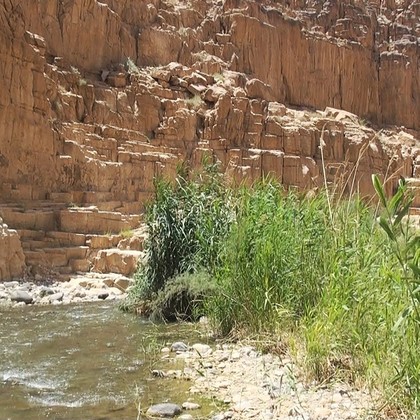
Towns and villages with tall buildings, bridges, mosques and forts, also oases and date groves; also gorges, cliffs and rock faces in mountains and desert. Hunts over roofs, valleys, irrigated land and water, often low and in parties.
Where the bird is most at home, classified by the habitats of North Africa and the Middle East.


Range and movements
Morocco: common and widespread in cities such as Rabat, Fez and Marrakech, in the Atlas gorges and in the oases of the south. Algeria and Tunisia: in towns and villages of the north and the oases of the northern Sahara. Libya: mainly along the coast of Tripolitania and Cyrenaica. Egypt: common in the Nile Valley and Delta, from Cairo to Aswan, and in Sinai. In the Levant common in Israel, Samaria and Judea, Jordan, Lebanon and Syria, especially in the Jordan Valley and around the Dead Sea. Iraq: resident in the towns of Mesopotamia. Saudi Arabia and Yemen: widespread in the mountains of the Hejaz and Asir, the highlands and coastal towns. Oman: common in the Hajar, around Muscat and in Dhofar. United Arab Emirates: breeds in the east, mainly in and around Al Ain and the Hajar; a scarce visitor to Kuwait, Qatar and Bahrain. Northern Maghreb birds partly move away in winter. Beyond the region from southern Anatolia and Iran to India and South-East Asia, and in almost all of Africa south of the Sahara; since 2000 it has also bred in southern Spain.
- Resident
- Summer visitor (c. Oct–Mar)
- Winter visitor (c. Apr–Sep)
- Passage (Mar–Apr, Oct–Nov)
- dark = core range, pale = thinly spread
How and when to look
Look in an old medina or under a bridge in a gorge: colonies are often in plain view under an overhang. At Luxor and Aswan in Egypt they hunt low over the Nile all year, and in Morocco large colonies sit in the old city walls.
Conservation status
Not globally threatened and common; in the region it benefits from buildings and bridges, but renovation can wipe out whole colonies.
Scientific name
Apus affinis | (Gray, 1830)
Gray described the species in 1830 as Cypselus affinis; because it was later moved to another genus, the author and year stand in brackets. The genus Apus was introduced in 1777 by Scopoli. Apus is Latin for a swift, from Greek a- 'without' and pous 'foot', the ancients taking it for a kind of swallow without feet. affinis is Latin for 'related to, similar'; which species the bird supposedly resembles is not clear from the description. The specimen the first description was based on came from the Ganges, India.