All species › Swifts › Swifts › Common Swift
Common Swift | Apus apus
Gierzwaluw | Vencejo común
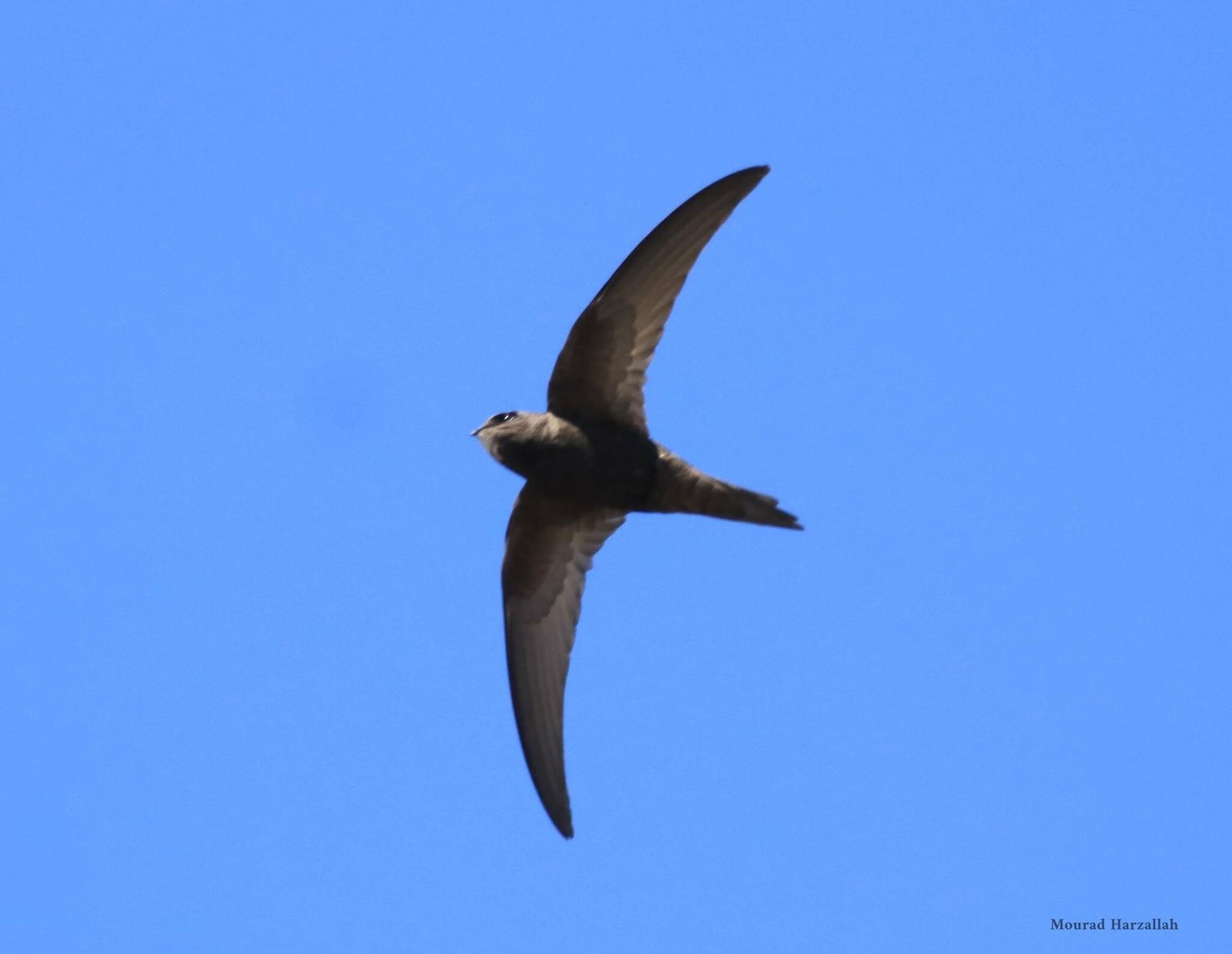
The familiar black sickle of towns and villages, which breeds in the north of the region and crosses the whole region in spring and autumn by the million on its way to and from Africa south of the Sahara. In the Levant it is one of the first summer visitors: in Jerusalem it returns to the old walls as early as February.
Voice
A shrill, drawn-out scream, sreeeeeh, often in chorus from parties racing along the roofs. Lower and sharper than the call of Pallid Swift.
Recording: João Ferreira Tomás — CC BY-NC-SA 4.0 · converted to mono · xeno-canto
Identification
Medium-sized, with long, narrow, sickle-shaped wings and a short forked tail. Plumage uniform dark sooty-brown, barely paler below, with a small, ill-defined pale throat patch; juveniles show pale fringes and a whiter throat. The eastern form pekinensis, which passes through Iraq and Arabia, is slightly paler with a larger pale throat. Fast, stiff wingbeats alternating with glides; often in noisy parties low between houses.
Confusion species
Pallid Swift (Apus pallidus) is paler and browner, with a large, diffuse pale throat patch, a dark eye mask, a paler inner wing and a broader, blunter wing tip; its beat is slower. Plain Swift (Apus unicolor) is smaller, slimmer and blacker, with a deeper tail fork. Forbes-Watson's Swift (Apus berliozi) of the south Arabian coast is browner with a large white throat. Alpine Swift (Tachymarptis melba) is much larger with a white belly.
Habitat
Breeds mainly in buildings: old city walls, mosques, churches and flats; also in rock faces and cliffs. Hunts high in the air over any landscape, on passage also over desert and sea.
Where the bird is most at home, classified by the habitats of North Africa and the Middle East.


Range and movements
Morocco, Algeria and Tunisia: breeds in towns and villages of the north and in the Atlas, with large numbers in the old medinas. Libya: breeds along the coast. Egypt: mainly a passage migrant, in large numbers along the Nile and over Sinai. In the Levant it breeds in Israel, Samaria and Judea, Jordan, Lebanon and Syria. Iraq: breeds in towns of the north and centre, mainly a passage migrant in the south. Arabian Peninsula: passage migrant over Saudi Arabia, Yemen, Oman, the United Arab Emirates, Qatar, Bahrain and Kuwait, commoner in spring than in autumn; the eastern pekinensis is the usual form here. It crosses the whole Sahara on a broad front, high and largely unseen. Beyond the region it breeds across almost all of Europe and temperate Asia to China; it winters in Africa south of the equator.
- Resident
- Summer visitor (c. Apr–Sep)
- Winter visitor (c. Oct–Mar)
- Passage (Mar–Apr, Oct–Nov)
- dark = core range, pale = thinly spread
How and when to look
Go to the Western Wall or the old city walls of Jerusalem in late February or March to see and hear the first birds of the year. On passage, thunderstorms or headwinds can bring huge flocks down low over lakes and coastal plains, for example at Eilat, Azraq and the Nile Delta.
Conservation status
Not globally threatened, but declining in parts of Europe and the Middle East through loss of nest sites to renovation and fewer insects. Nest boxes and open joints in old walls help.
Scientific name
Apus apus | (Linnaeus, 1758)
Linnaeus described the species in 1758 as Hirundo Apus; because it was later moved to another genus, the author and year stand in brackets. The genus Apus was introduced in 1777 by Scopoli. Apus is Latin for a swift, from Greek a- 'without' and pous 'foot', the ancients taking it for a kind of swallow without feet. The specific name repeats the genus name. The specimen the first description was based on came from Sweden.