All species › Swifts › Swifts › Forbes-Watson's Swift
Forbes-Watson's Swift | Apus berliozi
Socotragierzwaluw | Vencejo de Socotora
A drab brown swift of the coasts around the Gulf of Aden that long remained a mystery: the 'Dhofar swift' of Oman and old specimens from Aden were only shown to belong to this species in 2012. It is resident on Socotra; on the south coast of Arabia it is a summer visitor that breeds on sea cliffs.

Voice
Shrill screaming calls in the manner of Pallid Swift, sriiieh, often in chorus from parties hunting along the cliffs. Differences from related species are barely described.
Recording: Stanislas Wroza — CC BY-NC-SA 4.0 · converted to mono · xeno-canto
Identification
Medium-sized, slightly smaller than Common Swift, with fairly broad wings and a moderately forked tail. Plumage brown with a faintly scaled look below; striking are the large white throat patch, a paler forehead and a dark eye mask. From below the inner primaries and secondaries look paler against the darker outer wing. Flight is fairly slow and floating, like Pallid Swift.
Confusion species
Pallid Swift (Apus pallidus) is very similar and often cannot be separated with certainty in the field; it is paler and sandier, with a less sharply defined throat patch, and is rare on the south coast of Arabia in summer. Common Swift (Apus apus), especially the pale eastern form pekinensis that passes through Oman, is darker with a smaller throat patch and more pointed wings. Alpine Swift (Tachymarptis melba) is much larger with a white belly.
Habitat
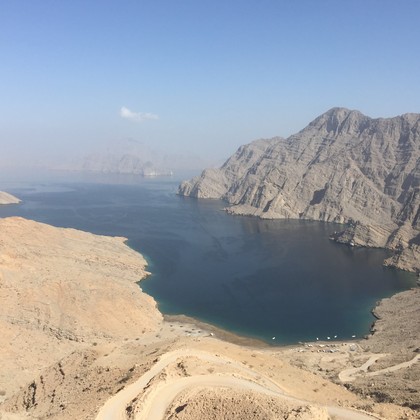
Sea cliffs, rocky islets and steep mountain walls, on Socotra also caves and limestone plateaux far inland. Hunts over coast, wadis and low mountains, often in parties.
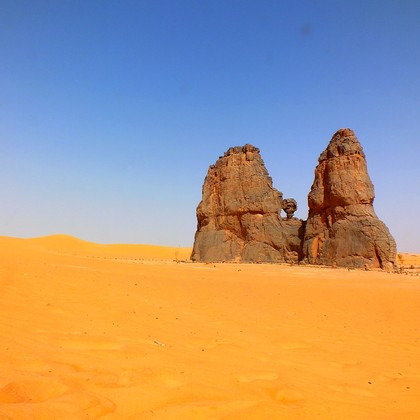
Where the bird is most at home, classified by the habitats of North Africa and the Middle East.
Range and movements
Yemen: resident on Socotra (nominate berliozi), widespread over coast and uplands; on the mainland patchily along the south coast west to Aden, where specimens were collected as early as 1922. Oman: a locally fairly common summer visitor to Dhofar from April to September and sometimes into October, with breeding colonies on the sea cliffs of the south-west; birds also hunt over Salalah. Not reliably recorded elsewhere in the region. Beyond the region it breeds on the coast of Somalia and winters on the coast of south-east Kenya; the Arabian birds probably belong to that migratory form bensoni.
- Summer visitor (c. Apr–Sep)
- Passage (Mar–Apr, Oct–Nov)
- dark = core range, pale = thinly spread
How and when to look
On Socotra it can be seen almost everywhere over cliffs and wadis. In Dhofar the sea cliffs between Mughsail and the Yemen border are the best area; come in summer, when the monsoon mist drifts over the coast, and compare every bird carefully with Pallid Swift.
Conservation status
Not globally threatened, but poorly known; the Arabian breeding range was discovered only recently and the population size is unknown.
Scientific name
Apus berliozi | Ripley, 1966
Ripley described the species in 1966 and placed it straight away in the genus where it still stands. The genus Apus was introduced in 1777 by Scopoli. Apus is Latin for a swift, from Greek a- 'without' and pous 'foot', the ancients taking it for a kind of swallow without feet. berliozi honours the French ornithologist Jacques Berlioz (1891–1975).